
Why Pay $20/month, When you can Self Host n8n @ $3.99 only

50+ InMails. Advanced Lead search. First 2 Users only

Promoted by BULDRR AI

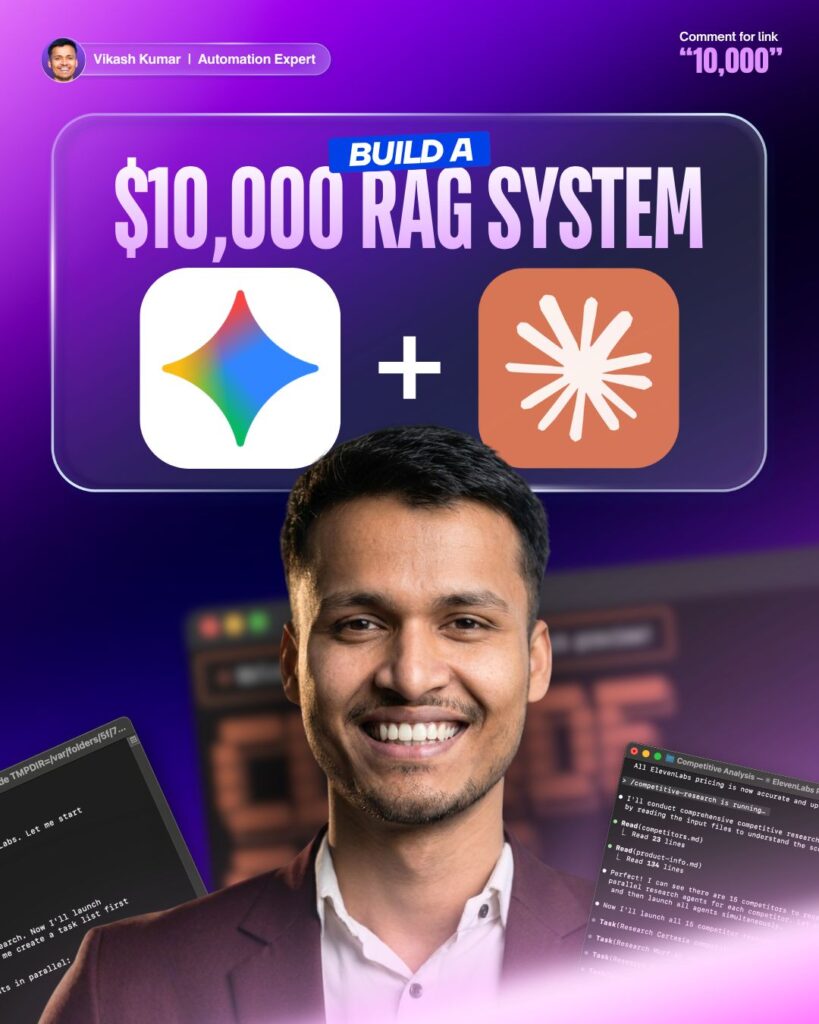
Build a $10,000 RAG system using Gemini + Claude Code

RAG

STEP 1. Understand what you’re building

You are creating a system where:

→ Text, images, videos, documents live in one database

→ All data gets embedded into the same vector space

→ AI retrieves the most relevant pieces before answering

This is RAG

Retrieval Augmented Generation

✦ Key shift

Old systems handled text only

New systems handle meaning across formats


STEP 2. Set up your tools

You need 3 things:

  1. Gemini API → Used for embeddings → Get from Google AI Studio
  2. Pinecone → Your vector database → Stores embeddings
  3. OpenRouter or model provider → Used for chat responses
  4. Visual Studio Code → Your working environment
  5. Claude Code → Builds everything for you

STEP 3. Create your project

→ Open VS Code

Install Claude Code extension

→ Open a new folder

Now open Claude Code panel

Switch to plan mode

Paste documentation link for Gemini embeddings

Then prompt:

“Build a multimodal RAG system using Gemini Embedding 2 and Pinecone.

Create env file placeholders for API keys.

Support text, images, and videos.”

Claude Code will generate:

→ Project structure

→ Dependencies

→ Step-by-step plan

Accept it


STEP 4. Add API keys

In your env file, add:

→ Gemini API key

→ Pinecone API key

→ OpenRouter or model key

Save the file

That’s it for setup


STEP 5. Add your data

Create a “data” folder

Drop in anything:

→ PDFs

→ Images

→ Videos

→ Text files

No need to organize perfectly

The system handles classification


STEP 6. Run ingestion

Prompt Claude Code:

“Process all files and store embeddings in Pinecone.

Then build a simple chat app.”

What happens behind the scenes:

→ Files get chunked

→ Gemini creates embeddings

→ Data stored in Pinecone

→ Metadata added

✦ This is where older tools like n8n get messy

Manual chunking

Separate pipelines

Frequent failures

Here, it runs in one flow


STEP 7. Test your system

Claude Code builds a local app

You open localhost

Now test queries:

→ “How do I clean the filter?”

↳ Returns steps + images from PDF

→ “What are the parts?”

↳ Pulls multiple sections + diagrams

→ Upload an image

↳ Finds similar entries in database


STEP 8. Improve retrieval quality

By default:

→ Images and videos are stored as descriptions

To improve:

Ask Claude Code:

“Add better metadata descriptions for images and videos

Update app to display media inline”

Now your system:

→ Shows images

→ Plays videos

→ Gives richer results


STEP 9. Understand limitations

Current constraints:

→ Video length limit around 120 seconds

→ Image batch limits

→ Quality depends on metadata

✦ Important

Better descriptions = better retrieval


STEP 10. Real use cases

  1. Instruction manuals → Chat with complex PDFs → Get visual answers
  2. Service businesses → Upload project images → Retrieve similar jobs with pricing
  3. Internal knowledge bases → Mix documents, videos, images → One unified search

STEP 11. What changed

Before:

→ Complex n8n pipelines

→ Manual configuration

→ Fragile systems

Now:

→ Describe system in plain language

→ AI builds it

→ You refine outputs

Mini insight

This build took under 30 minutes

Earlier versions took hours or days

Learn how to Build this Workflow with AI:

Follow us:

There’s no automation you can’t learn to build with BULDRR AI.

I'll show how you can implement AI AGENTS to take over repetitive tasks.

Promoted by BULDRR AI

Build a $10,000 RAG system using Gemini + Claude Code

RAG

STEP 1. Understand what you’re building

You are creating a system where:

→ Text, images, videos, documents live in one database

→ All data gets embedded into the same vector space

→ AI retrieves the most relevant pieces before answering

This is RAG

Retrieval Augmented Generation

✦ Key shift

Old systems handled text only

New systems handle meaning across formats


STEP 2. Set up your tools

You need 3 things:

  1. Gemini API → Used for embeddings → Get from Google AI Studio
  2. Pinecone → Your vector database → Stores embeddings
  3. OpenRouter or model provider → Used for chat responses
  4. Visual Studio Code → Your working environment
  5. Claude Code → Builds everything for you

STEP 3. Create your project

→ Open VS Code

Install Claude Code extension

→ Open a new folder

Now open Claude Code panel

Switch to plan mode

Paste documentation link for Gemini embeddings

Then prompt:

“Build a multimodal RAG system using Gemini Embedding 2 and Pinecone.

Create env file placeholders for API keys.

Support text, images, and videos.”

Claude Code will generate:

→ Project structure

→ Dependencies

→ Step-by-step plan

Accept it


STEP 4. Add API keys

In your env file, add:

→ Gemini API key

→ Pinecone API key

→ OpenRouter or model key

Save the file

That’s it for setup


STEP 5. Add your data

Create a “data” folder

Drop in anything:

→ PDFs

→ Images

→ Videos

→ Text files

No need to organize perfectly

The system handles classification


STEP 6. Run ingestion

Prompt Claude Code:

“Process all files and store embeddings in Pinecone.

Then build a simple chat app.”

What happens behind the scenes:

→ Files get chunked

→ Gemini creates embeddings

→ Data stored in Pinecone

→ Metadata added

✦ This is where older tools like n8n get messy

Manual chunking

Separate pipelines

Frequent failures

Here, it runs in one flow


STEP 7. Test your system

Claude Code builds a local app

You open localhost

Now test queries:

→ “How do I clean the filter?”

↳ Returns steps + images from PDF

→ “What are the parts?”

↳ Pulls multiple sections + diagrams

→ Upload an image

↳ Finds similar entries in database


STEP 8. Improve retrieval quality

By default:

→ Images and videos are stored as descriptions

To improve:

Ask Claude Code:

“Add better metadata descriptions for images and videos

Update app to display media inline”

Now your system:

→ Shows images

→ Plays videos

→ Gives richer results


STEP 9. Understand limitations

Current constraints:

→ Video length limit around 120 seconds

→ Image batch limits

→ Quality depends on metadata

✦ Important

Better descriptions = better retrieval


STEP 10. Real use cases

  1. Instruction manuals → Chat with complex PDFs → Get visual answers
  2. Service businesses → Upload project images → Retrieve similar jobs with pricing
  3. Internal knowledge bases → Mix documents, videos, images → One unified search

STEP 11. What changed

Before:

→ Complex n8n pipelines

→ Manual configuration

→ Fragile systems

Now:

→ Describe system in plain language

→ AI builds it

→ You refine outputs

Mini insight

This build took under 30 minutes

Earlier versions took hours or days

Learn how to Build this Workflow with AI:

Follow us:

Promoted by BULDRR AI

Our AI Articles

Learn from our AI Articles to excel in your profession ;)

How to Use OpenClaw Skills — A Complete Beginner’s Guide

What is OpenClaw? OpenClaw is an open-source AI assistant designed as “AI that actually does things.” It doesn’t just chat....

Build a $10,000 RAG system using Gemini + Claude Code

This ‘$10,000 RAG system’ isn’t about expensive infrastructure—it’s about how you structure retrieval....

Free OpenRouter API Keys & Free Models List [Updated April 2026]

Get a free OpenRouter API key in minutes. See all free models available in 2026, rate limits, and how to...

7 AI Agents Clients Are Paying $2,000+/Month For in 2026 [Real Examples]

Discover the 7 AI agents businesses are actively buying in 2026 — with real pricing, use cases, and how to...

Comprehensive Channel Analysis: Alex Hormozi

Alex Hormozi gives away what others sell for $10K—not to make money from content, but to manufacture million-dollar businesses at...

Beginner to Pro Guide: Using the Agentic SEO Claude Skill

This isn’t just an SEO audit—it’s a feedback loop where your system analyzes, prioritizes, and answers based on your data,...

Top 60 Claude Skills, Workflows & GitHub Repos for AI

This isn’t just a list. It’s a full-stack AI toolkit: from coding agents → to frameworks → to workflows →...

How to Use Claude Code for Free in 2026 (No Subscription Needed)

Yes, you can use Claude Code for free. This guide shows exactly how — free tier limits, local model workarounds,...

The Billion-Dollar AI Board: Build Your Free AI Board of Directors with 8 Business Legends

What if you could ask Alex Hormozi about your pricing, Grant Cardone about your sales volume, and Gary Vee about...

ChatGPT Image Model 1.5 Prompting Guide: Get Better Images Every Time [2026]

The complete guide to prompting ChatGPT Image Model 1.5. Learn prompt structures, style controls, and advanced techniques to generate better...

Frequently Asked Questions

We share all our insights and resources for free, but building them isn’t cheap. Ads help us recover those costs so we can keep offering everything at no charge forever.

Yes, Ofcourse. Contact us and we’ll set it up. We also offer 100+ hours of free visibility to select brands.

No, nothing at all. In fact, many ads come with extra discounts for you.

Yes, sometimes. If you buy through our links, we may earn a small commission at no extra cost to you.

1:1 Free Strategy Session
Your competitors are already automating. Are you still paying for it manually?

Do you want to adopt AI Automation?

Every hour your team does repetitive work, you're burning real money.
While you wait, faster businesses are cutting costs and moving quicker.
AI and automations aren't the future anymore — they're the present.

Book a live 1-on-1 session where we show you exactly which of your daily tasks can be automated — and what it’s costing you not to.