
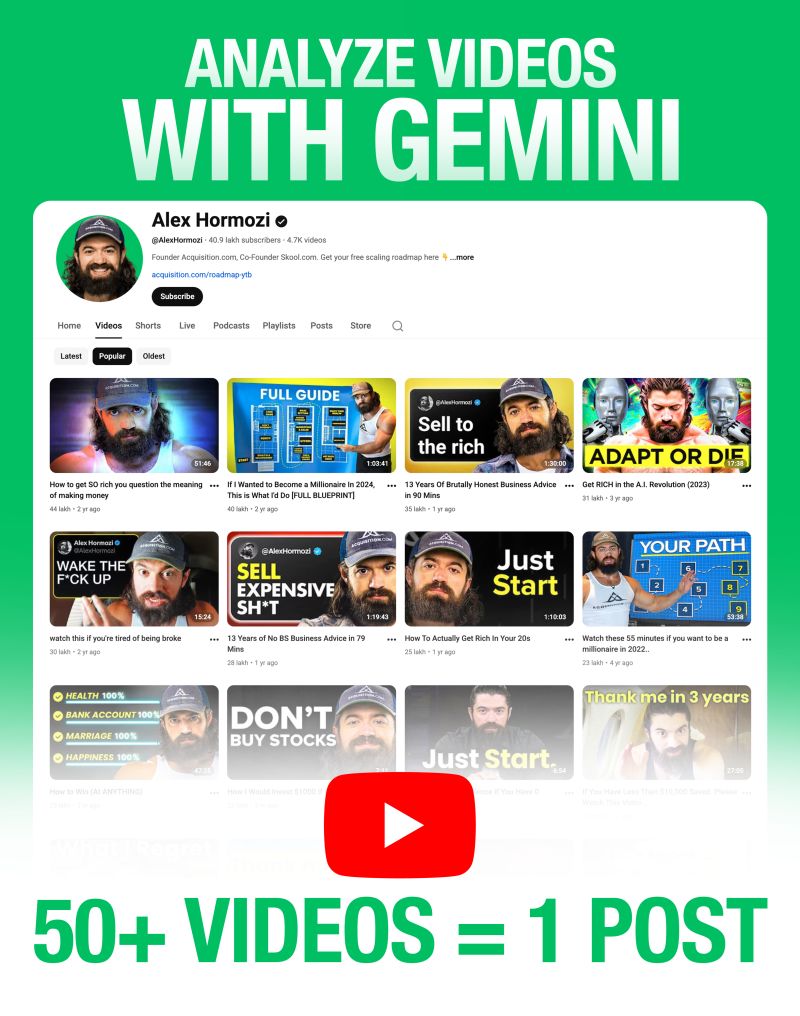
1. The Comprehensive Channel Analysis: The “Reverse Funnel”
To understand Alex Hormozi’s channel, you must understand its ultimate purpose. He is not a “YouTuber” in the traditional sense; he does not rely on AdSense, brand deals, or selling $997 courses.
His YouTube channel operates as the largest Top-of-Funnel (TOFU) mechanism in the world for his private equity firm, Acquisition.com.
- The Strategy: Give away the exact information that other “gurus” charge $5,000 to $10,000 for.
- The Goal: Help thousands of beginner and intermediate entrepreneurs scale their businesses to the $1M–$3M/year mark for free.
- The ROI: Once those businesses hit that threshold, they inevitably face scaling bottlenecks. Because Hormozi is the one who got them there for free, he becomes the sole, logical partner they look to when they need capital or high-level scaling infrastructure. He monetizes through equity, not course fees.
More recently, he has integrated his investment in Skool (a community-building platform) into his content, teaching his audience how to build paid communities as a highly leveraged, high-margin business model.
2. Core Educational Pillars & Frameworks
Hormozi’s content is heavily framework-driven. He creates proprietary models that give viewers a new lens through which to view their business.
A. The $100M Offer Mechanics
Hormozi argues that most businesses fail because they sell a commoditized product and compete on price, which is a “race to the bottom.”
- The Value Equation: This is the bedrock of his teaching. Value = (Dream Outcome × Perceived Likelihood of Achievement) ÷ (Time Delay × Effort & Sacrifice).
- Top of the fraction: You must promise exactly what they want and prove you can deliver it (via case studies and guarantees).
- Bottom of the fraction: The true secret to wealth is shrinking the bottom. The closer you can get a client to zero time delay and zero effort (the “Magic Pill” effect), the infinitely higher you can price your service.
- The Grand Slam Offer: An offer so compelling the prospect feels stupid saying no. It requires:
- Niche specific pricing: Charging based on the value of the problem solved, not the cost of fulfillment.
- Value-driven bonuses: Stacking bonuses that solve the next problem the client will have after buying your product.
- Guarantees: Utilizing anti-risk mechanisms (unconditional, conditional, or performance-based guarantees) to completely reverse the risk of buying.
B. The $100M Lead Generation System
He demystifies marketing by turning it into a pure volume-and-math equation.
- The Core Four: He states there are strictly four ways to get a customer:
- Warm Outreach: Reaching out to people you know.
- Cold Outreach: Reaching out to strangers (cold calling, DMs, cold email).
- Free Content: Posting on platforms where the algorithm finds the audience.
- Paid Ads: Paying platforms to put your offer in front of an audience.
- The Rule of 100: To guarantee you will never starve in business, commit to 100 primary actions per day. 100 cold emails, 100 DMs, $100 a day in ads, or 100 minutes of content creation.
- Lead Magnets & The “Giveaway” Model: He teaches that a lead magnet must be a complete solution to a narrow problem. His philosophy is: “Give away the secrets, sell the implementation.”
C. Sales, Psychology, and Conversions
Hormozi’s sales training stems from doing thousands of gym turn-around sales consultations.
- The CLOSER Framework: His specific methodology for handling sales calls. It focuses on diagnosing the exact pain point before ever pitching a solution.
- Tonality and Frame Control: He teaches how to maintain the position of an “expert diagnosing a patient” rather than a “salesperson begging for a commission.”
- Price Psychology: He constantly advocates for raising prices. Higher prices filter out bad clients, increase the perceived value of the product, and give the business owner enough gross margin to deliver an exceptional experience.
3. Business Architecture & Scaling Metrics
Hormozi frequently targets intermediate business owners with “boring” but highly lucrative operational insights.
- LTV to CAC Ratio (Lifetime Value vs. Cost to Acquire a Customer): He hammers the point that whoever can spend the most to acquire a customer wins. If your LTV is $10,000, you can spend $3,000 to acquire them and crush the competitor whose LTV is only $1,000 and can only spend $300 on ads.
- Gross Margins: He advises against businesses with low margins (like physical e-commerce or drop-shipping). He advocates for services, software, or digital products with 80%+ gross margins, as that cash flow is required to weather mistakes and scale rapidly.
- Identifying Bottlenecks: He teaches owners to stop doing random tasks and identify the single constraint holding the business back:
- Do you have a Lead problem? (No one is booking calls).
- Do you have a Sales problem? (Calls are booked, but no one is buying).
- Do you have a Fulfillment/Churn problem? (People buy, but they leave immediately because the product is bad).
4. Mindset: The “Anti-Motivation” Philosophy
Hormozi’s approach to mindset is starkly different from typical self-help. It is rooted in behavioral psychology and stoicism.
- Volume Negates Luck: If you do something 10,000 times, you do not need to be lucky or even exceptionally talented to succeed. You just need the stamina to survive the learning curve.
- Doing the Work Out of Spite: He openly admits that his early drive wasn’t a “beautiful vision for the future,” but a dark, burning desire to prove his doubters (specifically his father) wrong. He normalizes using negative emotions as fuel.
- The “Nothing Matters” Paradox: He frequently brings up the existential reality that everyone will die and be forgotten. Instead of this being depressing, he frames it as the ultimate liberation—if nothing matters, there is zero risk in failing, looking stupid, or launching a business today.
- Patience and “Billionaire Math”: He constantly critiques the desire to get rich in 90 days. He highlights that Warren Buffett made the vast majority of his wealth after age 65 due to the compounding of skills and capital over decades.
5. Content Formats and Video Anatomy
His content delivery is meticulously designed to maximize watch time and retention.
- The Whiteboard/iPad Breakdowns: These are his highest-performing, most dense videos. He uses simple visual drawings to explain complex financial or marketing concepts. The visual anchor keeps the viewer engaged while he talks at a rapid pace.
- The “Raw” Walk-and-Talks: Videos shot on a phone while he walks around his house or neighborhood. These build immense parasocial connection. They feel like a private, intimate FaceTime call with a billionaire mentor.
- High-Paced Editing: His editors use fast cuts, sound effects, and constant visual pattern interrupts (text on screen, zooming in and out) to cater to modern, low-attention-span audiences, even on 40-minute videos.
- Story-Driven Case Studies: He often breaks down exactly how he acquired a specific company, the exact numbers, the mistakes he made, and how he fixed the bottlenecks. This provides concrete “proof of concept” for his theoretical frameworks.
