
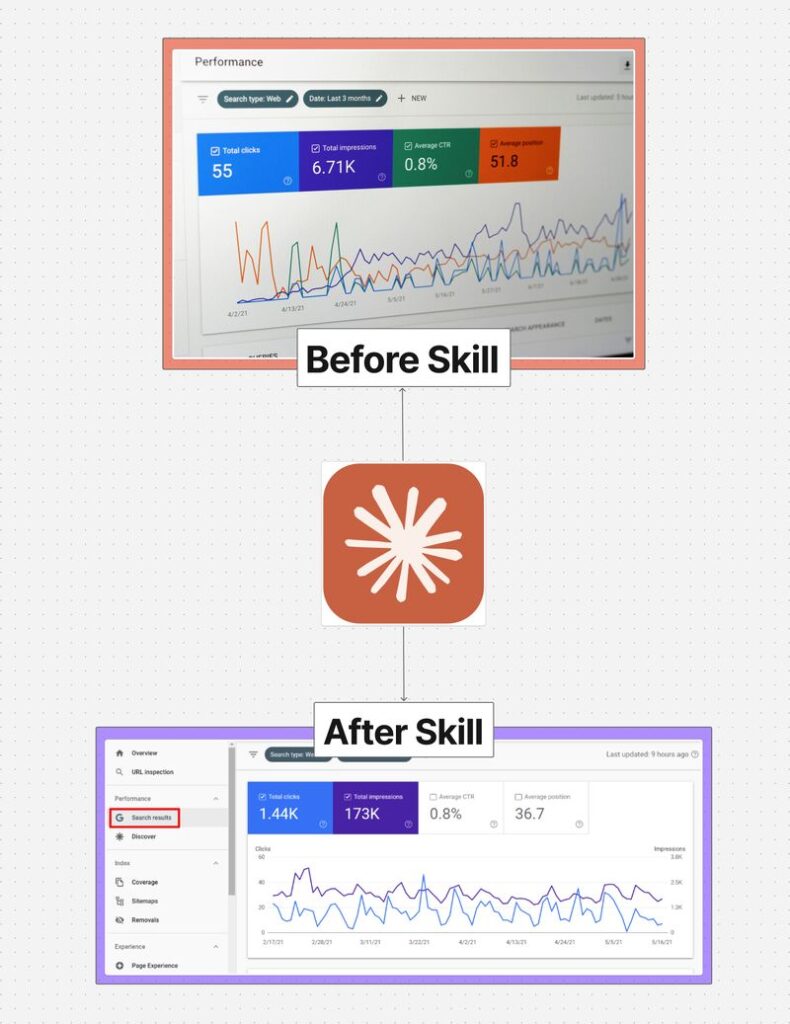
Beginner to Pro Guide: Using the Agentic SEO Claude Skill

1. What this actually does

You give one command:

→ “run a full SEO audit on mysite.com

The system:

  • Crawls your site
  • Runs 17 Python scripts
  • Analyzes pages using an LLM
  • Returns a scored report across 8 categories

Then the real value starts:

You ask follow-ups based on your data.


2. Setup in 3 steps

Open your terminal inside your IDE.

Run:

  1. Clone repo git clone https://github.com/Bhanunamikaze/Agentic-SEO-Skill.git
  2. Move into folder cd Agentic-SEO-Skill
  3. Install everything ./install.sh –target all –force

Restart your IDE.

Done.


3. First run

Inside Claude Code or your AI agent:

Type:

→ run a full SEO audit on yourdomain.com

Wait for processing.

What happens:

  • Site gets scanned
  • Scripts run in sequence
  • Data gets analyzed
  • HTML report is generated

4. Understanding the report

You will get:

→ Overall SEO score

→ Radar chart across categories

→ List of issues

→ Priority fixes

Each issue includes:

  • Description
  • Impact level
  • Suggested fix

Also:

✦ Confidence labels

↳ Confirmed

↳ Likely

↳ Hypothesis

This tells you what is reliable vs estimated.


5. The real power, asking questions

Most tools stop at reports.

This starts there.

Ask:

→ “Which issues should I fix first?”

→ “Why is this schema issue important?”

→ “What happens if I fix Core Web Vitals?”

The system answers using your site data.

Not generic SEO advice.


6. What it checks (breakdown)

Core Web Vitals

→ LCP, INP, CLS via PageSpeed

Technical SEO

→ robots.txt, redirects, headers

Content and E E A T

→ readability, thin pages, AI signals

Schema

→ detects outdated markup

Entity SEO

→ knowledge graph, sameAs, Wikidata

Hreflang

→ language mapping issues

AI Search readiness

→ snippet targeting, passage clarity


7. How to use it properly

Do not run once and leave.

Use this flow:

  1. Run audit
  2. Fix top 3 issues
  3. Re-run audit
  4. Compare score
  5. Ask follow-up questions

Repeat weekly.


8. Practical workflow

Example:

You run audit → get 12 issues

Now:

→ Ask “Top 3 fixes for fastest ranking improvement”

→ Fix those

→ Re-run

Then:

→ Ask “What still limits growth?”

This creates a loop.


9. What makes this different

Normal SEO tools:

  • Static reports
  • No reasoning
  • No prioritization logic

This system:

  • Thinks with your data
  • Explains decisions
  • Guides next steps

10. How it works internally (simple)

Main controller:

SKILL.md

This controls:

  • 13 sub-agents
  • 17 scripts
  • Reference knowledge

Flow:

  1. Crawl data
  2. Run scripts
  3. Analyze via LLM
  4. Score results
  5. Generate report

11. Extend this system

Same pattern works for:

  • Security audits
  • Accessibility checks
  • Performance analysis
  • Internal tooling

Structure:

→ One orchestrator

→ Multiple specialist agents

→ Tools + data


12. Common mistakes

Do not:

  • Ignore confidence labels
  • Fix everything at once
  • Treat all issues equally

Do:

  • Focus on high impact
  • Validate fixes
  • Re-run audits

13. Final takeaway

You are not using an SEO tool.

You are working with:

→ an AI agent

→ with tools

→ with structured thinking

If you use it properly:

You replace:

  • manual audits
  • guesswork
  • random fixes

With:

  • clear priorities
  • data-backed decisions
  • faster iteration

1. What this actually does

You give one command:

→ “run a full SEO audit on mysite.com

The system:

  • Crawls your site
  • Runs 17 Python scripts
  • Analyzes pages using an LLM
  • Returns a scored report across 8 categories

Then the real value starts:

You ask follow-ups based on your data.


2. Setup in 3 steps

Open your terminal inside your IDE.

Run:

  1. Clone repo git clone https://github.com/Bhanunamikaze/Agentic-SEO-Skill.git
  2. Move into folder cd Agentic-SEO-Skill
  3. Install everything ./install.sh –target all –force

Restart your IDE.

Done.


3. First run

Inside Claude Code or your AI agent:

Type:

→ run a full SEO audit on yourdomain.com

Wait for processing.

What happens:

  • Site gets scanned
  • Scripts run in sequence
  • Data gets analyzed
  • HTML report is generated

4. Understanding the report

You will get:

→ Overall SEO score

→ Radar chart across categories

→ List of issues

→ Priority fixes

Each issue includes:

  • Description
  • Impact level
  • Suggested fix

Also:

✦ Confidence labels

↳ Confirmed

↳ Likely

↳ Hypothesis

This tells you what is reliable vs estimated.


5. The real power, asking questions

Most tools stop at reports.

This starts there.

Ask:

→ “Which issues should I fix first?”

→ “Why is this schema issue important?”

→ “What happens if I fix Core Web Vitals?”

The system answers using your site data.

Not generic SEO advice.


6. What it checks (breakdown)

Core Web Vitals

→ LCP, INP, CLS via PageSpeed

Technical SEO

→ robots.txt, redirects, headers

Content and E E A T

→ readability, thin pages, AI signals

Schema

→ detects outdated markup

Entity SEO

→ knowledge graph, sameAs, Wikidata

Hreflang

→ language mapping issues

AI Search readiness

→ snippet targeting, passage clarity


7. How to use it properly

Do not run once and leave.

Use this flow:

  1. Run audit
  2. Fix top 3 issues
  3. Re-run audit
  4. Compare score
  5. Ask follow-up questions

Repeat weekly.


8. Practical workflow

Example:

You run audit → get 12 issues

Now:

→ Ask “Top 3 fixes for fastest ranking improvement”

→ Fix those

→ Re-run

Then:

→ Ask “What still limits growth?”

This creates a loop.


9. What makes this different

Normal SEO tools:

  • Static reports
  • No reasoning
  • No prioritization logic

This system:

  • Thinks with your data
  • Explains decisions
  • Guides next steps

10. How it works internally (simple)

Main controller:

SKILL.md

This controls:

  • 13 sub-agents
  • 17 scripts
  • Reference knowledge

Flow:

  1. Crawl data
  2. Run scripts
  3. Analyze via LLM
  4. Score results
  5. Generate report

11. Extend this system

Same pattern works for:

  • Security audits
  • Accessibility checks
  • Performance analysis
  • Internal tooling

Structure:

→ One orchestrator

→ Multiple specialist agents

→ Tools + data


12. Common mistakes

Do not:

  • Ignore confidence labels
  • Fix everything at once
  • Treat all issues equally

Do:

  • Focus on high impact
  • Validate fixes
  • Re-run audits

13. Final takeaway

You are not using an SEO tool.

You are working with:

→ an AI agent

→ with tools

→ with structured thinking

If you use it properly:

You replace:

  • manual audits
  • guesswork
  • random fixes

With:

  • clear priorities
  • data-backed decisions
  • faster iteration
Author
Written By
Vikash Kumar
Building AI agents, n8n workflows and end-to-end automation for 30+ Brands across India, the US, Europe, Dubai & Australia. 7+ years of Experience saving founders real hours every week - no code required.
Author
Written By
Vikash Kumar
Building AI agents, n8n workflows and end-to-end automation for 30+ Brands across India, the US, Europe, Dubai & Australia. 7+ years of Experience saving founders real hours every week - no code required.
Ask more Questions about this Blog with AI:

Our AI Articles

Learn from our AI Articles to excel in your profession ;)

n8n AI Agent Node: Build Your First AI Agent in 15 Minutes

Learn how the n8n AI Agent node works and build your first AI agent in 15 minutes. Step-by-step beginner guide...

Best Free OpenRouter Models in 2026: Which One Should You Use?

OpenRouter has 29 free AI models as of June 2026. Picking the wrong one for your task wastes your daily...

ClawdBot Tutorial 2026: Complete Beginner Guide to Install, Configure & Run Your First AI Agent

The complete beginner guide to Clawdbot in 2026 — from installation to your first running AI agent, with config templates,...

What Are Claude Skills? A Beginner’s Guide to AI Skills in 2026

Every time you start a new conversation with Claude, it forgets everything from the last one. Your preferences, your writing...

Claude vs ChatGPT in 2026: I Tested Both on the Same 10 Real Tasks

You’re probably paying $20 a month for one of these tools and quietly wondering if the other one is better....

HOW TO GET CLAUDE TO TEACH YOU STEP BY STEP

This framework turns any “I want to do X with Claude but have no idea where to start” into a...

Claude Code Without a Subscription: 3 Free Ways to Run It in 2026

Claude Code is Anthropic’s terminal-based AI coding assistant. It edits files, runs commands, plans projects, and debugs errors — entirely...

Best Claude Prompts 2026: 75 Templates That Actually Work

If your Claude outputs feel generic, the fix isn’t switching models — it’s fixing the prompt. Most people send a...

Build n8n Workflows Without Coding Using Claude Code: Step-by-Step (2026)

For years, building an n8n automation meant dragging nodes around a canvas, guessing field names, and bouncing between docs and...

7 Claude Code prompts

7 simple Claude Code prompts to get you started...
1:1 Free Strategy Session
Your competitors are already automating. Are you still paying for it manually?

Do you want to adopt AI Automation?

Every hour your team does repetitive work, you're burning real money.
While you wait, faster businesses are cutting costs and moving quicker.
AI and automations aren't the future anymore — they're the present.

Book a live 1-on-1 session where we show you exactly which of your daily tasks can be automated — and what it’s costing you not to.