
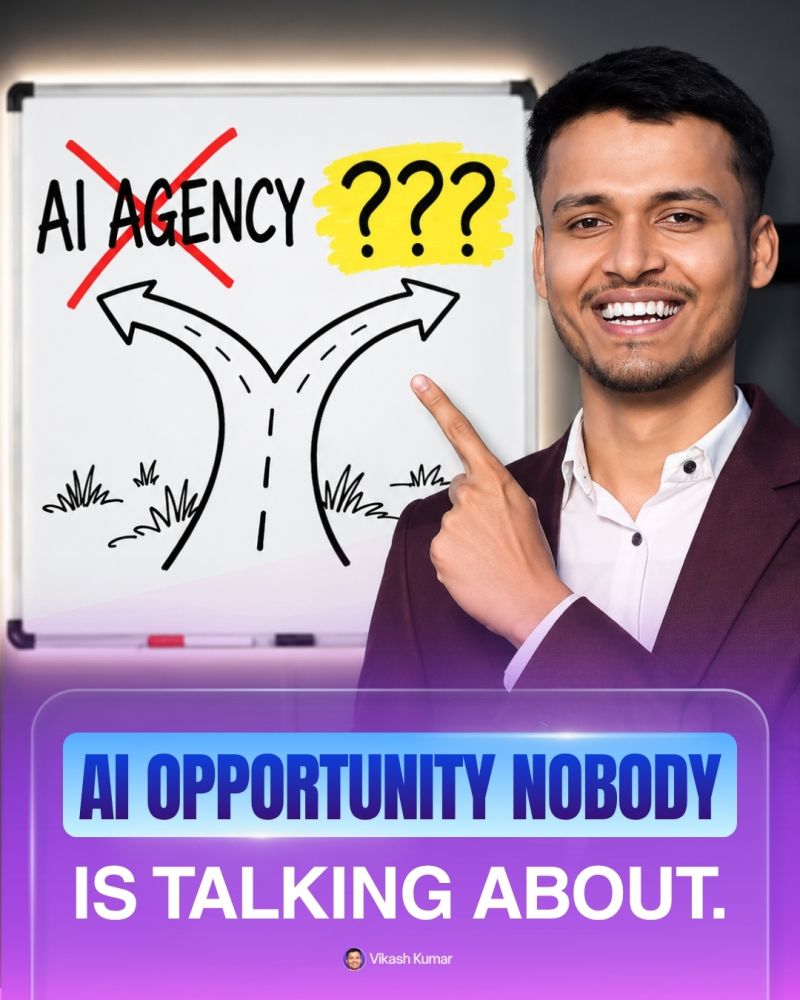
The AI Career Shift Nobody Is Talking About

Right now, most people entering AI are hearing the same advice everywhere:

“Start an AI automation agency.”

And yes, that model works.

A lot of creators are teaching it because agencies can make serious money if you know sales, client management, and automation systems.

But there’s another opportunity growing much faster in the background, and for most people, it’s probably the more realistic path.

This guide breaks down:

  • Why companies are suddenly hiring AI leaders
  • Why AI fluency matters more than coding
  • The two biggest career paths in AI right now
  • Why AI agencies are not the only option anymore
  • How to become “AI-native” inside your existing field

The Biggest Shift Happening Inside Companies

IBM surveyed 2,000 CEOs from large companies.

One statistic stood out immediately:

→ 76% of CEOs either already have a Chief AI Officer or are hiring one.

Just two years ago, that number was only 26%.

That growth is massive.

And it tells us something important:

AI is no longer treated like an experiment.

It’s becoming part of company infrastructure.


What Is a Chief AI Officer?

Most companies already have:

  • CEO → runs the company
  • CFO → handles finance
  • COO → handles operations
  • CISO → handles cybersecurity

The interesting part is that the CISO role didn’t exist before the internet era.

Cybersecurity only became critical after the internet created new risks.

The exact same thing is happening with AI right now.

Five years ago:

→ companies barely discussed AI.

Today:

→ CEOs are asked about AI in meetings, investor calls, and board discussions constantly.

So naturally:

→ a new leadership role appeared.

The Chief AI Officer.

And unlike past tech shifts, this one happened extremely fast.


The Real Opportunity Most People Miss

You do NOT need to become a Chief AI Officer.

That’s the key point.

Because AI fluency is spreading across every department.

Companies now want:

  • AI-native marketers
  • AI-native operations managers
  • AI-native finance teams
  • AI-native sales leaders
  • AI-native customer support systems

The AI wave is not creating one job.

It’s changing every job.


The 61% AI Gap Inside Companies

Another IBM statistic exposed the real problem businesses face.

CEOs said:

→ 86% of employees could learn AI tools with some training.

But only:

→ 25% of employees actually use AI daily.

That creates a huge gap.

The problem is not lack of talent.

The problem is:

→ nobody is connecting AI tools to real workflows.

Companies have employees who could use AI.

But they don’t have people building:

  • automations
  • systems
  • processes
  • AI workflows
  • internal AI operations

That bridge is missing.

And whoever builds that bridge becomes extremely valuable.


Why Companies Struggle With AI Adoption

Most organizations resist change because:

  • retraining employees is painful
  • workflows must be rebuilt
  • productivity temporarily drops
  • leadership fears mistakes

Even if AI saves massive time long-term, the short-term disruption scares companies.

That’s why many companies move slowly.

And this creates opportunity for AI-fluent employees.


The Two Main AI Career Paths

Path A — AI Agency / Consultant Path

This is the popular route.

You:

  • start an AI agency
  • freelance
  • build automations
  • help companies solve AI problems

Eventually:

→ some companies may hire you internally.

This path works well if you enjoy:

  • sales
  • networking
  • closing clients
  • pitching services
  • entrepreneurship

But it’s not for everyone.


Path B — Internal AI Leader Path

This is the underrated path.

You already work at a company.

You become:

  • the person experimenting with AI
  • the person automating workflows
  • the person saving the team time
  • the person building internal systems

Over time:

→ leadership notices.

And when the company decides it needs an AI strategy:

→ your name becomes the obvious choice.

This is already happening across companies right now.

Many AI leaders were promoted internally because they were already doing the work before the role even existed.


Why Most People Should Pay Attention to Path B

Most people do NOT want to:

  • run sales calls all day
  • chase leads
  • hear “no” repeatedly
  • constantly find clients

And that’s okay.

The internet makes it seem like:

→ agency = only AI opportunity.

But that’s false.

Internal AI adoption may become the larger long-term opportunity.

Especially for people who already have expertise in:

  • marketing
  • operations
  • finance
  • healthcare
  • education
  • customer support
  • HR
  • logistics

The Most Important Lesson: Follow Your Existing Strengths

A huge mistake people make is trying to become someone else.

Example:

  • A marketer forcing themselves into finance automations
  • A designer trying to become a backend engineer
  • A non-sales person forcing themselves into agency sales

That creates burnout fast.

Instead:

→ become the AI-native version of what you already do.

If you love marketing:

→ automate campaigns, copywriting, landing pages, reporting.

If you love operations:

→ automate SOPs, scheduling, approvals.

If you love finance:

→ automate forecasting and reporting.

AI works best when combined with domain expertise.


AI Will Become Invisible

Think about internet marketing.

Years ago people called themselves:

  • internet marketers
  • digital consultants
  • web specialists

Today:

→ that’s just normal marketing.

The same thing will happen with AI.

Soon:

  • AI marketers
  • AI consultants
  • AI strategists

Will simply become:

  • marketers
  • consultants
  • strategists

Because AI will become embedded into everything.


Why AI Fluency Matters More Than Titles

IBM found:

→ 85% of CEOs believe every functional leader must become tech fluent.

Not just engineers.

Everyone.

That means future promotions increasingly go to people who:

  • understand business
  • understand workflows
  • understand AI systems

The combination matters.


AI Is Changing Workflows, Not Just Tools

One important idea from the transcript:

“Today AI augments people. By 2030, people will augment AI.”

Meaning:

→ AI will become part of everyday work infrastructure.

The real shift is not just tools.

It’s how humans work alongside systems.


Why Regulated Industries Have Even Bigger Opportunity

Many people in:

  • healthcare
  • finance
  • government
  • legal
  • defense

Think AI doesn’t apply to them because of compliance restrictions.

Actually:

→ these industries may have the biggest opportunity.

Because very few people understand BOTH:

  • the industry
  • AI systems

That combination becomes extremely valuable.


What To Do If Your Company Says “No” to AI

A lot of companies still resist AI adoption.

That’s normal.

The smartest move is:

  • build personal AI projects
  • automate your own workflows
  • use dummy data if needed
  • casually share results internally

Because eventually leadership will ask:

“Who understands AI here?”

And the person already experimenting becomes the default choice.


Key Takeaways

AI agencies are not the only opportunity anymore

Internal AI leadership is growing rapidly.


Companies need AI-native employees

Not just AI engineers.


The biggest opportunity is workflow transformation

Not just prompting tools.


Follow your existing strengths

Don’t force yourself into a role you hate.


AI fluency + domain expertise is extremely valuable

Especially in regulated industries.


The future belongs to people who integrate AI into real work

Not people who only consume AI content.


Final Thought

You probably do not need to completely change careers.

You simply need to become:

→ the AI-native version of your current role.

That is the real shift happening right now.

Right now, most people entering AI are hearing the same advice everywhere:

“Start an AI automation agency.”

And yes, that model works.

A lot of creators are teaching it because agencies can make serious money if you know sales, client management, and automation systems.

But there’s another opportunity growing much faster in the background, and for most people, it’s probably the more realistic path.

This guide breaks down:

  • Why companies are suddenly hiring AI leaders
  • Why AI fluency matters more than coding
  • The two biggest career paths in AI right now
  • Why AI agencies are not the only option anymore
  • How to become “AI-native” inside your existing field

The Biggest Shift Happening Inside Companies

IBM surveyed 2,000 CEOs from large companies.

One statistic stood out immediately:

→ 76% of CEOs either already have a Chief AI Officer or are hiring one.

Just two years ago, that number was only 26%.

That growth is massive.

And it tells us something important:

AI is no longer treated like an experiment.

It’s becoming part of company infrastructure.


What Is a Chief AI Officer?

Most companies already have:

  • CEO → runs the company
  • CFO → handles finance
  • COO → handles operations
  • CISO → handles cybersecurity

The interesting part is that the CISO role didn’t exist before the internet era.

Cybersecurity only became critical after the internet created new risks.

The exact same thing is happening with AI right now.

Five years ago:

→ companies barely discussed AI.

Today:

→ CEOs are asked about AI in meetings, investor calls, and board discussions constantly.

So naturally:

→ a new leadership role appeared.

The Chief AI Officer.

And unlike past tech shifts, this one happened extremely fast.


The Real Opportunity Most People Miss

You do NOT need to become a Chief AI Officer.

That’s the key point.

Because AI fluency is spreading across every department.

Companies now want:

  • AI-native marketers
  • AI-native operations managers
  • AI-native finance teams
  • AI-native sales leaders
  • AI-native customer support systems

The AI wave is not creating one job.

It’s changing every job.


The 61% AI Gap Inside Companies

Another IBM statistic exposed the real problem businesses face.

CEOs said:

→ 86% of employees could learn AI tools with some training.

But only:

→ 25% of employees actually use AI daily.

That creates a huge gap.

The problem is not lack of talent.

The problem is:

→ nobody is connecting AI tools to real workflows.

Companies have employees who could use AI.

But they don’t have people building:

  • automations
  • systems
  • processes
  • AI workflows
  • internal AI operations

That bridge is missing.

And whoever builds that bridge becomes extremely valuable.


Why Companies Struggle With AI Adoption

Most organizations resist change because:

  • retraining employees is painful
  • workflows must be rebuilt
  • productivity temporarily drops
  • leadership fears mistakes

Even if AI saves massive time long-term, the short-term disruption scares companies.

That’s why many companies move slowly.

And this creates opportunity for AI-fluent employees.


The Two Main AI Career Paths

Path A — AI Agency / Consultant Path

This is the popular route.

You:

  • start an AI agency
  • freelance
  • build automations
  • help companies solve AI problems

Eventually:

→ some companies may hire you internally.

This path works well if you enjoy:

  • sales
  • networking
  • closing clients
  • pitching services
  • entrepreneurship

But it’s not for everyone.


Path B — Internal AI Leader Path

This is the underrated path.

You already work at a company.

You become:

  • the person experimenting with AI
  • the person automating workflows
  • the person saving the team time
  • the person building internal systems

Over time:

→ leadership notices.

And when the company decides it needs an AI strategy:

→ your name becomes the obvious choice.

This is already happening across companies right now.

Many AI leaders were promoted internally because they were already doing the work before the role even existed.


Why Most People Should Pay Attention to Path B

Most people do NOT want to:

  • run sales calls all day
  • chase leads
  • hear “no” repeatedly
  • constantly find clients

And that’s okay.

The internet makes it seem like:

→ agency = only AI opportunity.

But that’s false.

Internal AI adoption may become the larger long-term opportunity.

Especially for people who already have expertise in:

  • marketing
  • operations
  • finance
  • healthcare
  • education
  • customer support
  • HR
  • logistics

The Most Important Lesson: Follow Your Existing Strengths

A huge mistake people make is trying to become someone else.

Example:

  • A marketer forcing themselves into finance automations
  • A designer trying to become a backend engineer
  • A non-sales person forcing themselves into agency sales

That creates burnout fast.

Instead:

→ become the AI-native version of what you already do.

If you love marketing:

→ automate campaigns, copywriting, landing pages, reporting.

If you love operations:

→ automate SOPs, scheduling, approvals.

If you love finance:

→ automate forecasting and reporting.

AI works best when combined with domain expertise.


AI Will Become Invisible

Think about internet marketing.

Years ago people called themselves:

  • internet marketers
  • digital consultants
  • web specialists

Today:

→ that’s just normal marketing.

The same thing will happen with AI.

Soon:

  • AI marketers
  • AI consultants
  • AI strategists

Will simply become:

  • marketers
  • consultants
  • strategists

Because AI will become embedded into everything.


Why AI Fluency Matters More Than Titles

IBM found:

→ 85% of CEOs believe every functional leader must become tech fluent.

Not just engineers.

Everyone.

That means future promotions increasingly go to people who:

  • understand business
  • understand workflows
  • understand AI systems

The combination matters.


AI Is Changing Workflows, Not Just Tools

One important idea from the transcript:

“Today AI augments people. By 2030, people will augment AI.”

Meaning:

→ AI will become part of everyday work infrastructure.

The real shift is not just tools.

It’s how humans work alongside systems.


Why Regulated Industries Have Even Bigger Opportunity

Many people in:

  • healthcare
  • finance
  • government
  • legal
  • defense

Think AI doesn’t apply to them because of compliance restrictions.

Actually:

→ these industries may have the biggest opportunity.

Because very few people understand BOTH:

  • the industry
  • AI systems

That combination becomes extremely valuable.


What To Do If Your Company Says “No” to AI

A lot of companies still resist AI adoption.

That’s normal.

The smartest move is:

  • build personal AI projects
  • automate your own workflows
  • use dummy data if needed
  • casually share results internally

Because eventually leadership will ask:

“Who understands AI here?”

And the person already experimenting becomes the default choice.


Key Takeaways

AI agencies are not the only opportunity anymore

Internal AI leadership is growing rapidly.


Companies need AI-native employees

Not just AI engineers.


The biggest opportunity is workflow transformation

Not just prompting tools.


Follow your existing strengths

Don’t force yourself into a role you hate.


AI fluency + domain expertise is extremely valuable

Especially in regulated industries.


The future belongs to people who integrate AI into real work

Not people who only consume AI content.


Final Thought

You probably do not need to completely change careers.

You simply need to become:

→ the AI-native version of your current role.

That is the real shift happening right now.

Author

Written By

Vikash Kumar

Building AI agents, n8n workflows and end-to-end automation for 30+ Brands across India, the US, Europe, Dubai & Australia. 7+ years of Experience saving founders real hours every week - no code required.

Ask more Questions about this Blog with AI:

Our AI Articles

Learn from our AI Articles to excel in your profession ;)

How To Build AI Voice Agents Using Claude, Retell AI, And Zapier MCP

This guide explains how to build a fully automated AI calling system where Claude can automatically call customers, handle conversations,...

AI Voice Receptionist Guide For Clinics

Most clinics don’t lose patients because doctors are bad They lose patients because nobody picked up the phone....

The Complete Claude Mastery Guide

This roadmap breaks Claude mastery into 10 stages. Follow them in order....

Complete Guide To Claude Code Agent Teams

Agent Teams are one of the most advanced features inside Claude Code. Instead of using one AI agent to complete...

How To Build Realistic AI Voice Agents With 11Labs + Make.com

How Agent Teams turn Claude Code into a collaborative AI workforce for building complex systems....

100 SECRET CLAUDE PROMPT CODES

Practical Claude prompt systems that improve writing, research, strategy, automation, and workflows....

The Real Claude AI Business Guide for 2026

5 Claude AI business models solving expensive problems businesses already pay for in 2026....

Complete Guide: How To Build A Claude Skill For SEO Content Writing

Reusable Claude workflows that turn generic AI writing into personalized, scalable SEO systems....

Complete Breakdown: How To Build AI Backlink Systems Using Claude Skills + Automation

Complete Breakdown: How To Build AI Backlink Systems Using Claude Skills + Automation...

Claude AI SEO Automation Guide

This AI SEO workflow automates content creation, optimization, publishing, and indexing at scale....
1:1 Free Strategy Session
Your competitors are already automating. Are you still paying for it manually?

Do you want to adopt AI Automation?

Every hour your team does repetitive work, you're burning real money.
While you wait, faster businesses are cutting costs and moving quicker.
AI and automations aren't the future anymore — they're the present.

Book a live 1-on-1 session where we show you exactly which of your daily tasks can be automated — and what it’s costing you not to.