
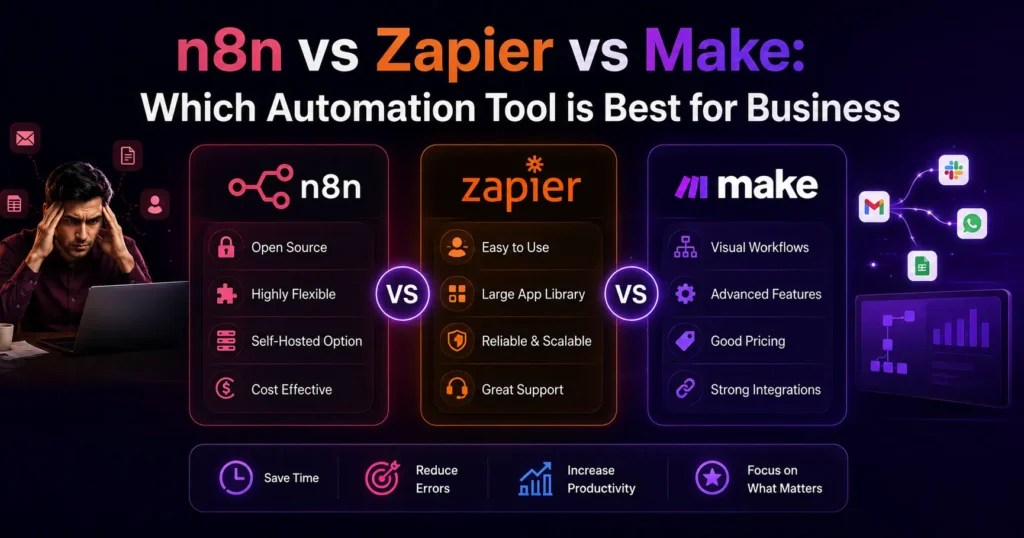
n8n is the best fit for businesses that want self-hosting, unlimited executions, and deep AI-agent capability and have some technical capacity; Zapier is best for non-technical teams that want the widest app library and the fastest setup; Make sits in between, offering strong visual workflow design at a lower cost than Zapier without requiring code. Zapier leads with 7,000+ integrations and the simplest UX, Make delivers visual workflow power at roughly 60% lower cost than Zapier, and n8n is the only option with true self-hosting and unlimited executions.
Choosing between these three platforms used to be mostly a price comparison. In 2026 it’s a more layered decision, shaped by how AI-heavy your workflows are, whether data residency matters to your business, and how much technical capacity your team actually has.
The core difference: how each platform charges you
This is where the three tools diverge the most, and it’s the single biggest factor in long-term cost:
- Zapier bills per task — every individual action inside a workflow counts against your quota.
- Make bills per operation — similar concept to Zapier but generally more operations per dollar.
- n8n bills per execution — an entire multi-step workflow run counts as one execution, regardless of how many steps it has.
For a 10-step workflow running 10,000 times a month, n8n can cut costs by 80–90% compared to Zapier, because Zapier would be counting each of those 10 steps separately across 10,000 runs. This gap widens as your workflows get more complex — the more steps a single automation has, the more n8n’s execution-based pricing pulls ahead.
Pricing snapshot (2026)
n8n starts from $20/mo or is free when self-hosted, Zapier starts from $19.99/mo, and Make starts from $9/mo. But sticker price isn’t the full story — at real production volume, the picture changes considerably. Running a workflow 10,000 times a month with 8 steps per run, n8n Cloud costs around $50/month, Make would need roughly $150–200/month across tiers, and Zapier could run $250–400+/month for the equivalent task volume.
Self-hosted n8n removes execution-based billing entirely — the source-available license allows self-hosting for personal and commercial use without a subscription fee, meaning the only ongoing cost is server hosting, often under $10–15/month for small-to-mid workloads.
Integration breadth: Zapier’s clear advantage
If breadth of pre-built app connections matters most to your team, Zapier still wins by a wide margin. Zapier dominates with 8,000+ pre-built integrations, so if you need to connect a niche SaaS tool quickly without any technical setup, Zapier likely already supports it out of the box. n8n and Make both close this gap with a universal HTTP/API request node that can connect to virtually any service with a REST API — n8n’s generic HTTP Request node allows connecting to any service using REST/GraphQL, handling custom authentication, and parsing complex JSON responses — but that requires more technical comfort than clicking a pre-built Zapier integration.
AI capabilities: where n8n has pulled ahead
All three platforms added meaningful AI features going into 2026, but the depth differs. n8n 2.0 introduced LangChain integration and 70+ AI nodes, Make launched Maia AI and Make AI Agents, and Zapier released Zapier Agents for autonomous task execution. n8n offers the most advanced technical capabilities for complex, highly customized AI solutions; Make takes an intermediate approach integrating existing AI services with good functional depth; and Zapier focuses on making AI accessible without technical knowledge but with more limited customization.
n8n’s AI Agent Tool Node enables multi-agent orchestration with native LangChain integration, which is a meaningfully deeper capability than either competitor offers for teams building genuinely custom AI-driven workflows — like a lead-qualification agent that reasons through multiple decision branches, not just a single AI-enhanced action step.
Self-hosting and data control: n8n’s structural advantage
This is the feature Zapier and Make simply can’t match, because they’re closed SaaS platforms. n8n is open-source and can be run entirely on infrastructure you control — as an open-source solution, n8n offers something neither Zapier nor Make can match: complete data sovereignty. For businesses in regulated industries, or those with strict data-residency requirements, this alone can be the deciding factor regardless of pricing.
Which one should you actually choose?
- Choose Zapier if you have a non-technical team, need the broadest possible app coverage immediately, and value simplicity over cost efficiency at scale.
- Choose Make if you want visual, branching workflow logic at a meaningfully lower cost than Zapier, and your team is comfortable with a moderate learning curve.
- Choose n8n if you have some technical capacity (in-house or via an agency), want unlimited executions and full data control through self-hosting, or are building AI-agent-driven workflows that need real orchestration depth.
If you’re on Zapier and considering a move, the common trigger is a monthly bill north of $300 or unexpected AI-credit charges — teams in that position often migrate to self-hosted n8n for cost control, with payback typically in 8–12 weeks once migration time is included.
Why businesses partner with an agency for the n8n path
n8n’s power comes with a steeper setup curve than Zapier or Make — self-hosting, custom nodes, and AI-agent orchestration all require technical judgment calls that a non-technical team may not want to own alone. This is exactly the gap an n8n automation agency fills: getting the cost and data-control advantages of n8n without needing an in-house engineer to manage the infrastructure from day one.
FAQs
Is n8n cheaper than Zapier?
Generally yes, especially for multi-step workflows run at volume, because n8n bills per workflow execution rather than per individual task step — and self-hosted n8n has no per-execution cost at all beyond server hosting.
Is n8n harder to learn than Zapier?
Yes, n8n has a steeper learning curve, particularly for self-hosting and advanced logic, though its visual canvas is still no-code-friendly for straightforward workflows.
Can I migrate from Zapier to n8n?
Yes, though it requires manually rebuilding workflows in n8n’s interface rather than a one-click import — this is one of the most common reasons businesses bring in an automation agency for the migration.
Which is best for AI-powered workflows: n8n, Zapier, or Make?
n8n currently offers the deepest AI-agent orchestration capability of the three, making it the strongest choice for businesses building genuinely custom, multi-step AI-driven automations rather than single AI-enhanced actions.
Conclusion
There’s no universal winner in the n8n vs Zapier vs Make comparison — the right choice depends on your team’s technical capacity, how complex your workflows are, and whether cost efficiency or out-of-the-box simplicity matters more. Zapier wins on breadth and ease, Make wins on visual power at a mid-tier price, and n8n wins on cost efficiency at scale, data control, and AI-agent depth for businesses willing to invest a bit more setup effort — often through an experienced automation partner rather than going it alone.
