

1. Opening Problem Statement
Meet Sarah, a busy customer support manager who handles dozens of email threads daily. Each message labeled for attention demands a thoughtful reply, but manually drafting responses consumes hours every day. She often finds herself overwhelmed, risking delayed replies and inconsistent messaging that frustrates customers and costs her company valuable trust and revenue.
Automating responses is critical for Sarah to regain control, reduce human errors, and boost team productivity. But setting up a system that smartly replies within existing email threads without losing context seemed too technical and cumbersome — until discovering this comprehensive n8n workflow integration leveraging Gmail and OpenAI Assistant.
Sarah’s pain quantified: saving 2+ hours per day and eliminating hundreds of repetitive typing tasks while maintaining personalized, relevant email communication.
2. What This Automation Does
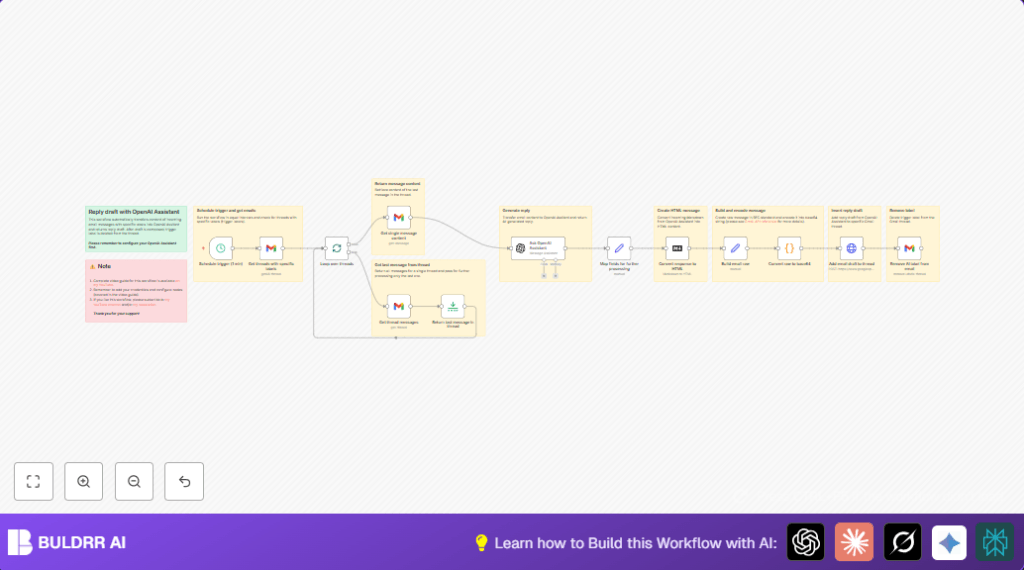
This n8n workflow automates the process of generating reply drafts for emails marked with specific labels in Gmail using AI-generated responses from OpenAI Assistant. Here’s what happens when it runs:
- Automatically scans Gmail for threads with trigger labels every minute.
- Retrieves the latest message content within each identified thread.
- Sends the email content to OpenAI Assistant for context-aware reply generation.
- Converts the AI-generated Markdown reply into properly formatted HTML.
- Builds and encodes the reply message in raw RFC format to comply with Gmail API standards.
- Inserts the AI-generated reply draft back into the original Gmail thread.
- Removes the trigger label to prevent repeated processing of the same thread.
This automation saves hours by eliminating manual reply drafting, maintaining consistent communication tone, and streamlining inbox management.
3. Prerequisites ⚙️
- n8n account (cloud or self-hosted) 🔌
- Gmail account with Gmail API OAuth2 credentials 📧🔑
- OpenAI account with API key configured for an assistant instance 💬🔑
- Basic knowledge of n8n workflow environment
For self-hosting n8n, you can easily use hosting platforms like Hostinger for reliable infrastructure and technical support: https://buldrr.com/hostinger
4. Step-by-Step Guide
Step 1: Set up a Schedule Trigger to Run Every Minute
Navigate to the Schedule Trigger node → Set rule interval to 1 minute. This sets the workflow to check for labeled emails frequently.
Expected: The workflow triggers automatically every minute to scan Gmail threads.
Common mistake: Forgetting to adjust the interval leads to delayed or excessive API usage.
Step 2: Get Gmail Threads with Specific Labels
In the Get threads with specific labels node, configure label IDs that the workflow should monitor (e.g., “AI Response Needed”).
Expected: The node fetches all email threads tagged with the specified label.
Common mistake: Leaving label filters empty fetches all emails, overloading the workflow.
Step 3: Loop Over Threads
Use the Split In Batches node named Loop over threads to process the fetched threads one by one to prevent overwhelming API calls.
Expected: Each Gmail thread is processed individually downstream.
Common mistake: Batch size misconfigurations can cause delays or data loss.
Step 4: Retrieve the Last Message in Each Thread
Use the sequence of Get thread messages to fetch all messages, then Return last message in thread node to filter only the most recent message for processing.
Expected: Only the latest email content per thread is extracted.
Common mistake: Not using a limit filter results in processing multiple unnecessary messages.
Step 5: Get Single Message Content
Use the Get single message content node with the last message ID to get full details including from, subject, and body text.
Expected: The node returns detailed information on the last email in the thread.
Common mistake: Incorrectly passing the message ID leads to empty or wrong data.
Step 6: Ask OpenAI Assistant for a Reply
In the Ask OpenAI Assistant node, pass the extracted email text as input. This uses a configured assistant ID to generate a reply in Markdown format.
Example prompt: “{{ $json.text }}” where $json.text includes email content.
Expected: The AI returns a context-aware reply draft.
Common mistake: Forgetting to authenticate the OpenAI node causes errors.
Step 7: Map Fields for Further Processing
Use the Set node named Map fields for further processing to collect all relevant data: AI response, threadId, to-address, subject, messageId for next steps.
Expected: All data needed for email building is prepared in one place.
Common mistake: Missing or misnaming fields leads to errors downstream.
Step 8: Convert AI Markdown Response to HTML
The Convert response to HTML node transforms AI-generated Markdown text into HTML to allow rich email formatting.
Expected: Clean HTML representation of the reply ready for email composition.
Common mistake: Not enabling “markdownToHtml” mode will leave response in Markdown format.
Step 9: Build Raw Email Message
In the Build email raw node (Set node), construct the raw RFC822 email format string:
=To: {{ $json.to }}
Subject: {{ $json.subject }}
Content-Type: text/html; charset="utf-8"

{{ $json.response }}
Expected: A properly structured email body in HTML is created.
Common mistake: Omitting headers or incorrectly formatted content breaks email sending.
Step 10: Convert Raw Email to Base64
The Convert raw to base64 node is a Code node running this JavaScript:
const encoded = Buffer.from($json.raw).toString('base64');
return { encoded };
This encoding is required by Gmail API to accept draft messages.
Expected: Base64 encoded string output ready for API submission.
Common mistake: Forgetting to encode causes API errors in message formatting.
Step 11: Add Reply Draft to Gmail Thread
The Add email draft to thread node sends the base64 draft JSON to Gmail API using HTTP POST.
Request body format:
{
  "message": {
    "raw": "{{ $json.encoded }}",
    "threadId": "{{ threadId }}"
  }
}
Expected: Draft reply is created inside the correct Gmail thread.
Common mistake: Incorrect threadId referencing causes drafts in wrong threads or fails.
Step 12: Remove Trigger Label from Thread
Finally, the Remove AI label from email node removes the processing label from the Gmail thread so it won’t be reprocessed.
Expected: Gmail thread label is cleared for next automation cycle.
Common mistake: Removing the wrong label or not removing any leads to duplicate replies.
5. Customizations ✏️
- Change Trigger Label: In the Get threads with specific labels Gmail node, update the labelIds array to target different Gmail labels. This filters which emails receive AI replies.
- Modify AI Assistant Prompt: In the Ask OpenAI Assistant node, adjust the prompt text to fine-tune response style or language.
- Set Email Reply Formatting: Customize the Build email raw node template to add CC, BCC, or plain text parts if needed.
- Adjust Schedule Interval: In the Schedule Trigger node, change the frequency to control how often emails are processed.
- Include More Email Metadata: Extend the Map fields for further processing node with additional details like message snippet or sender’s display name.
6. Troubleshooting 🔧
Problem: HTTP 401 Unauthorized error when sending draft.
Cause: Invalid or expired Gmail OAuth2 credentials.
Solution: Re-authenticate Gmail credentials in n8n and ensure OAuth2 tokens are refreshed.
Problem: Draft reply not inserted into correct thread.
Cause: Incorrect threadId passed in HTTP request body.
Solution: Verify that the threadId is correctly mapped from the original email thread in “Map fields for further processing” node.
Problem: OpenAI node returns empty or irrelevant reply.
Cause: Improper prompt or insufficient email content.
Solution: Refine the prompt text in the Ask OpenAI Assistant node and ensure email content extracted is comprehensive.
7. Pre-Production Checklist ✅
- Confirm Gmail OAuth2 credentials are valid and authorized for required scopes.
- Set correct Gmail label IDs in “Get threads with specific labels” node.
- Test OpenAI Assistant node with sample email content to ensure reply generation.
- Run workflow in manual mode with test email threads labeled accordingly.
- Backup your workflow and credentials before going live.
8. Deployment Guide
Activate your workflow by setting it to active in n8n and ensure the schedule trigger is enabled. Monitor workflow executions initially from the executions list to verify no errors occur.
Since the workflow uses polling every minute, consider limiting volume or increasing interval if API quota becomes an issue.
Optionally, set up n8n’s built-in error notifications or webhook alerts for monitoring.
9. FAQs
Q: Can I use a different email provider instead of Gmail?
A: This workflow specifically uses Gmail OAuth2 and APIs, so replacing Gmail requires adapting nodes for another provider (e.g., Microsoft Outlook API).
Q: Does this consume OpenAI API credits?
A: Yes, every AI-generated reply counts towards your OpenAI usage. Monitor API consumption accordingly.
Q: Is my email data secure?
A: The workflow runs on your n8n instance, so your data security depends on your n8n hosting environment and credentials management.
10. Conclusion
By building this unique n8n workflow, you have automated the process of generating AI-based reply drafts for Gmail threads labeled for response. This saves hours daily for busy professionals like Sarah, reduces human errors, and accelerates timely communication.
Next, consider expanding with workflows that automatically send approved replies, analyze sentiment of incoming emails, or integrate with CRM systems for enhanced customer relationships.
Now, you are equipped to confidently streamline your email management with n8n and OpenAI Assistant—simplifying complex communication one thread at a time.
