
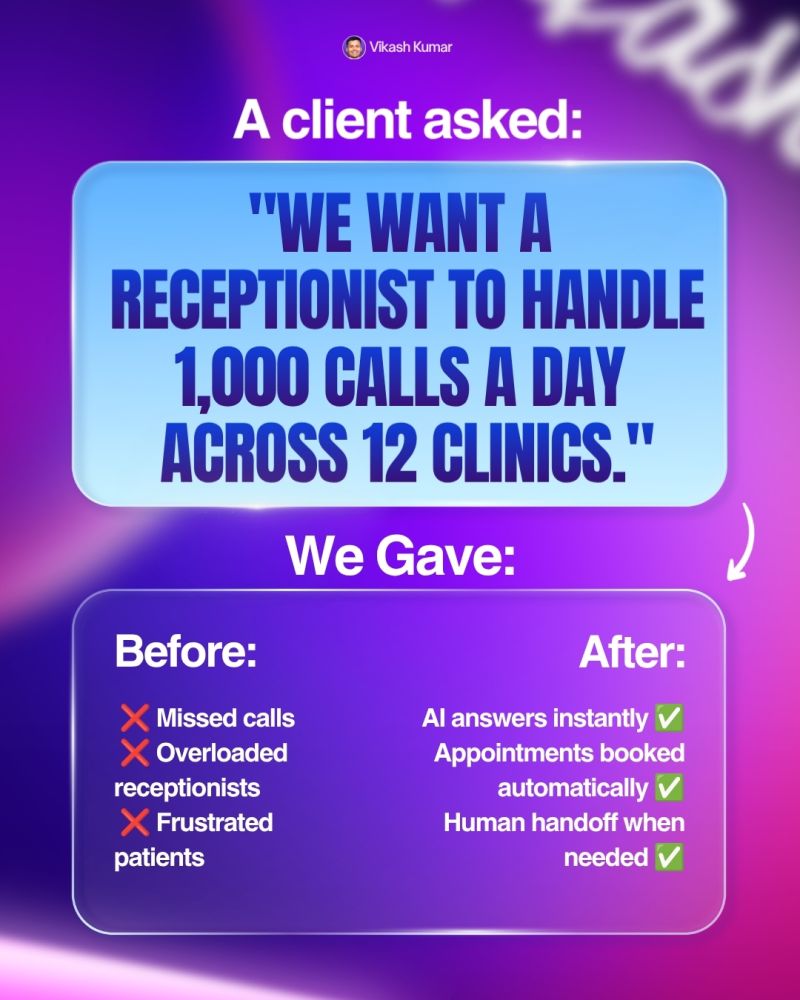
Most clinics don’t lose patients because doctors are bad.
They lose patients because nobody picked up the phone.
This Chennai based medical group had:
• 12 clinics
• 1,000+ daily calls
• overloaded receptionists
• angry patients
• missed bookings
• revenue leakage
Nearly 30% of incoming calls went unanswered.
So instead of hiring more receptionists, they built an AI voice receptionist system.
This guide breaks down the exact workflow they used.
The Real Lesson
This project was not about:
• AI tools
• fancy dashboards
• trendy automation
It was about building a workflow that solved a real business problem.
That matters far more than the tool itself.
Step 1: Study Real Customer Calls
Before building anything, the operations team listened to:
• 200 real patient call recordings
This was the most important step.
Most people build AI agents based on assumptions.
That creates useless systems.
Instead, they identified:
• common questions
• booking behavior
• language preferences
• complaint patterns
• rescheduling requests
They mapped exactly why patients called.
Step 2: Build The AI Receptionist Prompt
Once they understood the workflow, they created the voice agent.
The system prompt looked something like this:
“You are a receptionist for a medical clinic.
You speak:
• English
• Hindi
• Tamil
• Telugu
Your responsibilities:
• appointment booking
• appointment rescheduling
• answering basic questions
If the patient has a complaint, immediately transfer to a human.”
This prompt defined:
• the role
• the languages
• the responsibilities
• the escalation rules
Good prompts create reliable agents.
Step 3: Add Indian Language Voice Support
This was one of the biggest improvements.
Most default AI voices sound unnatural in Indian languages.
Especially Tamil and Telugu.
So they used:
• Saram AI
Saram AI handled:
• natural Indian accents
• regional pronunciation
• multilingual conversations
This made the system sound human instead of robotic.
That matters a lot in healthcare.
Patients trust natural communication.
Step 4: Connect The Agent To The Clinic Calendar
The voice agent was connected directly to the clinic booking system using:
• MCP integrations
This allowed the AI to:
• check availability
• create appointments
• reschedule bookings
• update calendars in real time
Without integrations, the AI would only say:
“Okay noted.”
With integrations, the booking became real instantly.
Step 5: Add Human Escalation Rules
The clinic did not allow the AI to handle sensitive situations.
So they created escalation triggers.
If patients mentioned:
• complaints
• emergencies
• frustration
• negative keywords
the call transferred immediately to a human receptionist.
Even better:
the AI passed the conversation context before transfer.
So patients did not need to repeat themselves.
This improved:
• patient experience
• call handling speed
• support quality
Final Workflow
The complete workflow looked like this:
- Patient calls clinic
- AI receptionist answers instantly
- AI detects language
- AI handles booking or rescheduling
- AI updates real calendar
- Complaints escalate to humans
- Human receives full context
Simple workflow.
Massive business impact.
Results
The numbers were huge.
Daily Operations
- 1,000+ calls handled daily
• 24/7 availability
• 0.8 second pickup speed
Resolution Rate
- 70% resolved completely by AI
• 30% escalated to humans
Humans only handled complex cases.
Cost Savings
The clinic saved:
• 3 receptionist salaries in month one
Patient Experience
Patients experienced:
• faster response times
• multilingual support
• fewer missed calls
• smoother booking experience
Why This Worked
The success came from:
• understanding real workflows
• solving actual pain points
• integrating with real systems
• keeping humans involved for edge cases
Most failed AI projects skip these steps.
Key Lessons
1. Workflows Matter More Than Tools
The tool itself is secondary.
The workflow is what creates value.
2. Train Using Real Data
Never guess customer behavior.
Use:
• call recordings
• support tickets
• real conversations
3. Human Escalation Is Critical
AI should not handle:
• emotional situations
• complaints
• sensitive healthcare discussions
Humans still matter.
4. Integrations Change Everything
Without integrations:
AI becomes a chatbot.
With integrations:
AI becomes an employee.
Best Use Cases For AI Voice Receptionists
This workflow works extremely well for:
• clinics
• hospitals
• dental centers
• salons
• real estate offices
• restaurants
• customer support teams
Anywhere repetitive calls happen daily.
Final Takeaway
The clinic did not automate humans away.
They automated repetitive work:
• bookings
• reschedules
• FAQs
• language handling
Humans focused on:
• complaints
• emotional situations
• complex cases
That is the real future of AI voice systems.
Not replacing people.
Filtering repetitive work so humans handle what matters most.
