

What this workflow does
This n8n workflow helps users create AI-generated images based on a prompt and chosen visual style.
It solves the problem of spending too much manual time on writing prompts, calling AI models, and hosting images online.
The outcome is an automatically styled image hosted on cloud storage and shown on a web page instantly.
Users get a faster way to make styled AI images without technical hassle or file handling.
Who should use this workflow
This workflow is best for freelance artists and creators who want quick AI art generation.
It is also good for people who want to avoid errors in prompts and reduce waiting time for image hosting.
Any user familiar with basic web forms and wanting to see AI images fast will find this helpful.
Tools and services used
- n8n Automation Platform: Runs the automation workflow.
- Huggingface Flux AI model API: Generates images from combined prompts.
- S3-compatible cloud storage (e.g., Cloudflare R2): Hosts generated images.
- Respond to Webhook node: Serves responsive HTML pages showing results.
Input → Process → Output
Inputs
- User submits a text prompt describing an image.
- User selects one style option from a dropdown.
Processing Steps
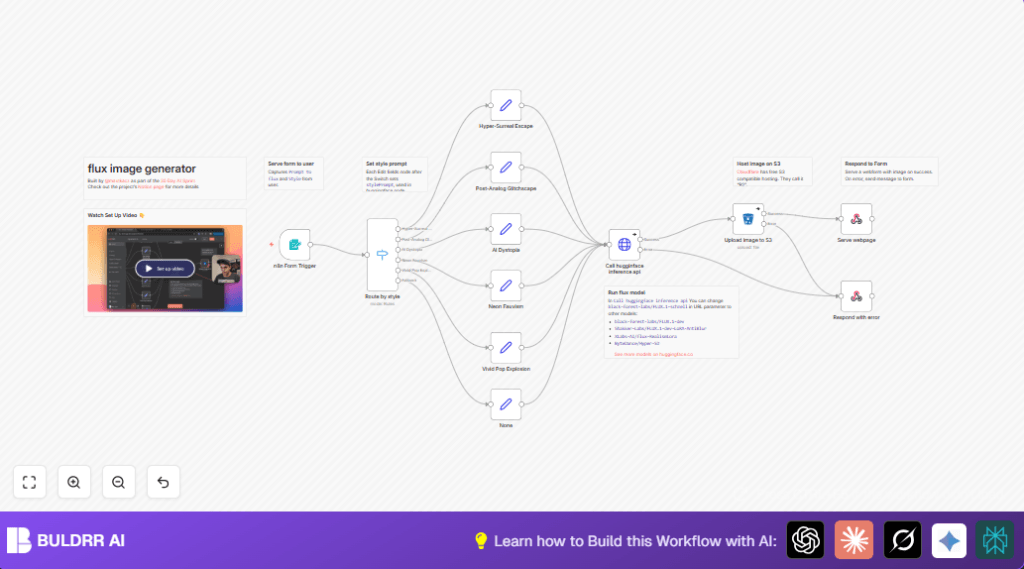
- The workflow uses a Form Trigger to capture input.
- A Switch node picks a path depending on the style chosen.
- Each style path adds a special style prompt using a Set node.
- The combined prompt is sent to Huggingface Flux AI model via HTTP Request node.
- The generated image is saved to S3 cloud storage by S3 node.
- A Respond to Webhook node returns a web page showing the image and style info.
- If the AI API fails, another Respond to Webhook node sends a JSON error message.
Output
The final output is a hosted image accessible via web browser with style details and recent images shown.
Errors are handled smoothly with messages to retry.
Beginner step-by-step: How to use this workflow in n8n
Step 1: Download and Import
- Download the workflow JSON file from the Download button on this page.
- Open the n8n editor where workflows are managed.
- Use “Import from File” option to upload the downloaded workflow file.
Step 2: Configure Credentials
- Add Huggingface API Key in the n8n credentials section.
- Set up S3-compatible storage credentials (Cloudflare R2 or similar).
Step 3: Adjust Workflow Settings
- Check if any IDs, emails, channels, or storage bucket names need updating to match own accounts.
- Verify the form fields and style dropdown values if customization is required.
- Copy and update prompt text or URLs if needed.
Step 4: Test and Activate
- Run the workflow once by submitting test prompts from the form URL.
- Check that images generate properly and show on the response page.
- If all works, activate the workflow for production use inside n8n.
Optionally, explore self-host n8n to run workflows on own server for more control.
Inputs and outputs
- Input: User text prompt (e.g., “An astronaut riding a horse”) plus chosen visual style.
- Output: A hosted styled image with webpage display of style info and recent images.
Edge cases and error handling
API call to Huggingface model fails about 10% of time.
In those cases, workflow returns a JSON error advising user to refresh and retry.
This avoids broken pages or crashes and keeps user experience smooth.
Common causes include invalid API keys or network issues.
Users should verify credentials and bucket permissions if images do not show.
Customization ideas
- Add more styles by copying a Set node and adding new prompts. Adjust the Switch node to route accordingly.
- Change the AI model by editing the URL in the HTTP Request node to new Huggingface models.
- Edit the HTML code in Respond to Webhook node to customize the result page with own branding.
- Use different cloud storage services by swapping the S3 node with nodes like Google Cloud Storage or Azure Blob Storage.
Pre-production checklist
- Submit test prompts in all style options from the web form.
- Verify Huggingface API key is valid and has quota.
- Check that S3 bucket is configured correctly and is public.
- Ensure images show on the returned webpage.
Deployment guide
Activate the workflow in n8n after testing.
Share the form webhook URL with users for prompt submissions.
Monitor executions to track errors or delays.
Consider self-host n8n for scaling and better control in production.
Summary of results
✓ Saves hours of manual prompt crafting and image hosting.
✓ Automatically applies expert style prompts.
✓ Hosts generated images online for easy sharing.
✓ Returns a viewable web page showing recent images and style data.
✓ Handles API errors smoothly without crashing.
→ Users get styled AI images fast with fewer errors.
→ Artists and creators spend more time on creativity, less on tech tasks.
