
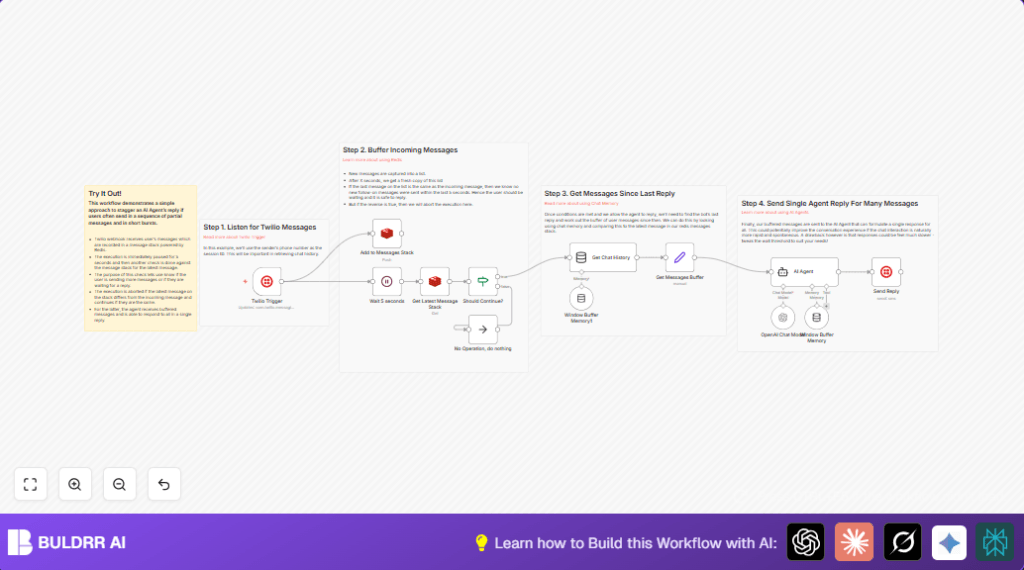

What This Workflow Does
This workflow collects quick, broken SMS messages sent to a Twilio number.
It groups these messages using Redis and waits 5 seconds to see if more arrive before replying.
The grouped messages get sent to an OpenAI-powered AI Agent.
The AI Agent makes one clear reply that covers all messages.
This stops replying to every small message separately.
The result is saved time and better replies for users texting fast.
Who Should Use This Workflow
Use this workflow if many SMS messages come rapidly to a Twilio number.
It helps anyone who wants to avoid messy, split conversations with customers.
This is good for support teams, sales, or services that reply by SMS.
The workflow saves time by replying just once per group of messages instead of many times.
Tools and Services Used
- Twilio: Receives and sends SMS messages.
- Redis: Stores SMS messages temporarily in lists per sender.
- OpenAI via AI Agent node: Reads grouped messages and writes one reply.
- n8n automation platform: Runs the workflow and connects all parts.
How This Workflow Works (Input → Process → Output)
Input
- Each incoming SMS to the Twilio phone number.
- Sender phone number used as a unique chat key.
Processing Steps
- The Twilio Trigger captures every new SMS.
- Messages get pushed into a Redis list keyed by sender number.
- The workflow pauses 5 seconds with the Wait node to let more messages arrive.
- After the wait, the workflow fetches the current list of messages from Redis.
- It compares the newest Redis message with the just-received SMS; if they differ, the workflow stops and waits for the next trigger.
- If no new messages arrived, it fetches chat history from AI Memory Manager to keep context.
- A Set node slices the Redis messages after the last AI reply and joins them into one text input.
- The AI Agent node receives the grouped message text and generates one smart reply.
- The Twilio node sends the AI reply back as one SMS to the sender.
Output
- A single, clear SMS reply covering all recent messages.
- Reduced errors and fewer replies sent per conversation.
- Faster, cleaner communication that saves agent time.
Beginner Step-by-Step: How to Use This Workflow in n8n
1. Import the Workflow
- Download the workflow file using the Download button on this page.
- Inside the n8n editor, click on “Import from File”.
- Choose the downloaded workflow file and import it.
2. Add Credentials and Configure Nodes
- Open the Twilio Trigger and add your Twilio Account SID, Auth Token, and phone number.
- Edit the Redis nodes and enter the Redis host, port, and password.
- Go to the AI Agent node and add your OpenAI API Key.
- Check any IDs or keys, such as phone numbers or session keys, and update if needed.
3. Test the Workflow
- Send a test SMS to your Twilio number.
- Watch n8n execution to confirm the workflow triggers and processes.
- Make sure the AI reply arrives as a single message.
4. Activate for Production
- Toggle the workflow switch at the top right corner to activate.
- Monitor initial messages for errors or delays.
- Adjust the wait time or AI prompt settings inside the workflow if necessary.
For anyone using self-host n8n, check self-host n8n to run this workflow smoothly on a server.
Customization Ideas
- Change the Wait node time to find the best pause length for your users.
- Update the Redis key prefix to fit other chat apps or multiple bots.
- Tweak the AI Agent prompt or model to match the tone or topic desired.
- Add extra Function nodes to log message counts or conversation times.
Handling Common Issues
- Workflow does not trigger on incoming SMS: Check the webhook URL set in Twilio matches n8n webhook and credentials are correct.
- Redis nodes fail to push or get messages: Verify Redis credentials, permissions, and network access.
- AI Agent replies are empty or off-topic: Confirm message buffer joining code is correct and OpenAI API key is valid.
Pre-Production Checklist
- Confirm Twilio triggers workflow with test SMS.
- Verify Redis message stacking and retrieval.
- Test sending multiple quick SMS to check message buffering.
- Make sure AI Agent replies with consolidated message.
- Check outbound SMS from Twilio reach the phone.
Summary of Results
✓ Faster SMS replies by grouping quick messages.
✓ Less chance of reply mistakes or duplicated responses.
✓ Clearer communication for users texting fast.
✓ Saves support agents about 15 minutes per conversation.
✓ Easy to add and customize inside n8n with common nodes.
