
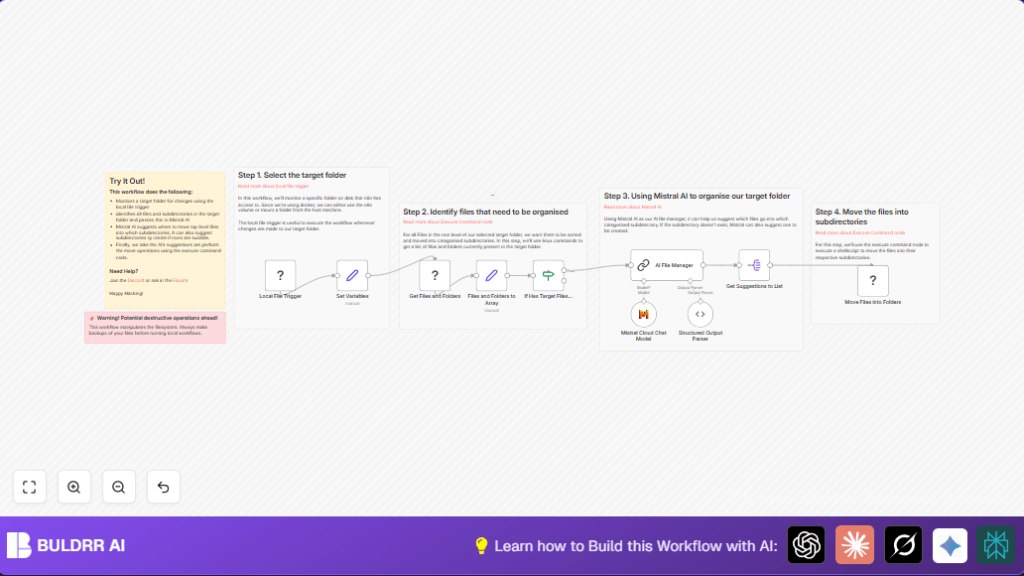

What This Automation Does
This workflow watches a Linux folder for new files.
It sorts those files into folders based on their names.
This way, files don’t pile up or get lost.
Everything gets organized automatically.
The goal is to save time and avoid mistakes in manual sorting.
The result is a tidy folder with files in the right places.
Workflow Inputs, Processing, and Outputs
Inputs
- New files added to a chosen Linux folder monitored by the workflow.
- Existing folder and file list from that folder, collected by shell commands in the workflow.
- AI prompt information including names of files and folders for grouping advice.
Processing Steps
- The workflow triggers when new files appear in the folder.
- It runs shell commands to get names of all files and folders at top level.
- These names are split into clean lists for files and for folders.
- An AI model analyzes the file and folder names.
It suggests which folders the files belong in, or if new folders need to be created. - The workflow then runs a shell script.
It creates new folders if needed.
It moves files into folders safely, handling name conflicts by renaming.
Outputs
- Files moved into organized folders or new folders.
- A clean workspace with fewer misplaced or cluttered files.
- Continuous automation that needs no manual sorting by the user after setup.
Who Should Use This Workflow
This workflow is good for anyone using Linux who deals with many files daily.
People like designers or freelancers who want to save hours spent organizing files.
No deep technical skills are needed after setup.
Users just need to run it and trust the AI helps keep folders tidy.
Tools and Services Used
- n8n: To build and run the automation workflow.
- Local File Trigger node: Watches the folder for new files.
- Execute Command node: Runs Linux shell commands (ls, mkdir, mv) to list and move files.
- Set node: Prepares variables and arrays used in the workflow.
- Mistral Cloud Chat Model node: Uses AI to suggest file grouping based on names.
- If node: Checks if files exist before continuing.
Beginner Step-by-Step: How to Use This Workflow in n8n
1. Import the Workflow
- Download the workflow file using the Download button on this page.
- Open your n8n editor.
- Use the “Import from File” option to upload this workflow.
2. Configure Credentials and Settings
- Add your Mistral Cloud API credentials in the respective node.
- Check the Local File Trigger node and update the folder path to your Linux folder you want to monitor.
- If needed, update any IDs, emails, or channels if the workflow has those integrations.
- Review the AI prompt in the Mistral Cloud Chat Model node to ensure it fits your file grouping rules.
3. Test the Workflow
- Manually add a test file to the monitored folder.
- Watch n8n run the workflow.
Check that files get moved into suggested folders as expected.
4. Activate for Production
- When the test works well, activate the workflow in n8n.
This makes it run automatically when new files appear. - Regularly check logs to catch any errors or permission issues early.
- If running your own server, keep the monitored folder accessible and permissions correct after restarts.
See self-host n8n for related tips.
Customization Ideas
- Change the monitored folder path in the Local File Trigger node to any folder you want sorted.
- Modify the AI prompt to apply special rules like archiving old files.
- Add a Function node to filter only certain file types before sorting.
- Edit the move file script to rename conflicts by adding timestamps instead of random numbers.
- Use different AI models for grouping if that fits your needs better.
Troubleshooting
- Problem: Local File Trigger does not activate when files are added.
Cause: Wrong folder path or missing permission for n8n process.
Fix: Check trigger folder path and give n8n proper read access. - Problem: Execute Command node gives syntax errors.
Cause: Shell commands typed wrongly or not compatible with your shell.
Fix: Run commands manually in terminal. Use absolute paths where needed. - Problem: AI node returns confusing suggestions or errors.
Cause: Prompt is wrong or API credentials invalid.
Fix: Check prompt formatting and refresh API Key. Watch API usage limits.
Pre-Production Checklist
- Confirm folder path in Local File Trigger exactly matches folder to watch.
- Run test shell commands manually to verify permissions and expected behaviors.
- Validate Mistral Cloud API Keys by running a simple prompt test.
- Test workflow on a sample folder with example files to ensure correct sorting.
- Keep backup copies of files before using workflow in real work folders.
Conclusion
This workflow uses n8n and Mistral AI to watch a Linux folder.
It sorts files based on AI folder grouping suggestions.
This saves time, lowers mistakes, and cleans your workspace.
Users gain hours weekly and avoid chasing lost files.
After setup, no manual sorting is needed and folders stay neat.
Try expanding the workflow by adding email alerts or archiving rules.
Enjoy saved time and organized digital files!
