
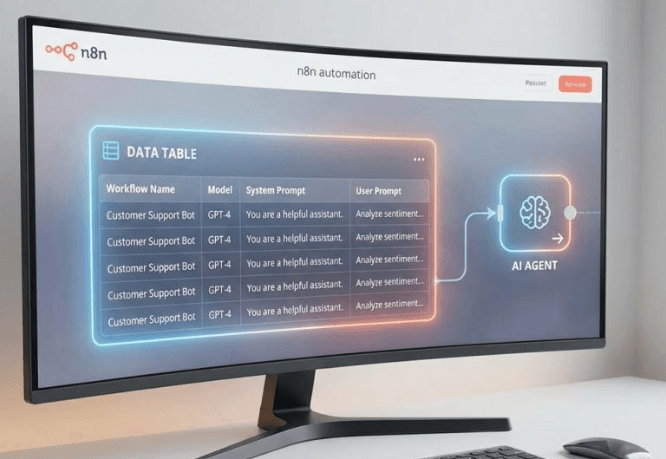
The Ultimate Guide to n8n Data Tables: How to Make Your AI Agents Smarter, Faster & Fully Configurable

n8n’s new native data tables completely change how you design AI workflows.

Until now, storing or updating data inside n8n always required external tools like Google Sheets, Airtable, or custom APIs.

But with Data Tables, you can:

  • Store prompts, models, variables
  • Feed data directly into AI agents
  • Log every action an agent takes
  • Run evaluations on your agents
  • Sync with external sources
  • Treat n8n like a mini internal database

This guide breaks down the 3 major hacks that unlock their real power.


🔷 HACK 1 — Use Data Tables as a Control Center for Prompts, Models & Dynamic Agent Behavior

Instead of hard-coding system prompts or model names inside workflows, you can now store them in a data table and inject them dynamically.

Why this matters

  • You can update an agent’s prompt without opening the workflow.
  • You can safely give clients access to control parameters without exposing the actual workflow logic.
  • You can securely share workflow templates without sharing your proprietary system prompts.
  • You can change models on the fly (GPT-5 → Claude Sonnet → whatever).

How it works

Create a table like:

workflowchatModelsystemPromptuserPrompt
research-agentgpt-5{system prompt}{user prompt for industry research}

Inside your workflow:

  1. Add a Data Table “Get Row” filtered by workflow name.
  2. Drag:
    • systemPrompt → agent’s system prompt field
    • userPrompt → the agent’s query
    • chatModel → the LLM node or router model input

Now changing values in the table instantly updates all dependent agents.

Real example from the workflow

  • Original tool: Perplexity
  • Change to: Tavily
  • Original model: GPT-5
  • Change to: Claude 3.7 Sonnet

Result?

The agent instantly switches tools + model without touching the workflow.

Bonus: Dynamic Workflows (Newsletter Example)

You can also use tables to dynamically control multi-step automations:

  • Newsletter research agent
  • Newsletter planning agent
  • Newsletter editor agent

Each can pull:

  • the topic
  • the user prompt
  • the system prompt
  • the chosen model

This makes the entire content pipeline configurable from a single table.


🔷 HACK 2 — Use Data Tables as Full Agent Log Storage (Actions, Tokens, Intermediate Steps)

If you want scalable autonomous agents, you MUST track:

  • Errors
  • Intermediate tool steps
  • Token usage
  • Inputs/outputs per run
  • Overall performance

Before Data Tables, most people logged this in Google Sheets.

Now you can store everything inside n8n itself.

What you need to enable

Inside your AI agent node:

Add Option → Return Intermediate Steps → ON

This exposes:

  • Think steps
  • Tool calls
  • Raw inputs to tools
  • Raw outputs from tools
  • Token count per segment
  • Total tokens

What the logs look like

A log entry includes:

  • Timestamp
  • Workflow name
  • Input question
  • Output result
  • Tools used (think → contact agent → calendar agent)
  • Token usage
  • Execution time

This allows you to:

  • Detect failure patterns
  • Improve system prompts intelligently
  • Benchmark different models
  • Debug agent behavior without guessing
  • Build guardrails to prevent known failure cases

Error Logging Bonus

You can store errors in a “error-logger” Data Table:

Columns:

  • date
  • time
  • workflow
  • errorNode
  • errorMessage
  • executionID

You can also push these to Slack/Telegram alerts.


🔷 HACK 3 — Run Agent Evaluations (Evals) Inside n8n Using Data Tables

Evaluations let you test agents systematically:

  • Input → expected output → actual output → score
  • Track performance across model changes
  • Detect regressions
  • Compare prompts
  • Benchmark tool usage

Before: required a Google Sheet

Now: Data Tables do it natively.

How evals work

Your eval table contains:

| input | expectedAnswer | actualAnswer | score |

n8n:

  1. Reads each row
  2. Sends “input” to your agent
  3. Agent produces “actualAnswer”
  4. Compare actual vs expected using similarity scoring
  5. Writes back results + correctness score

What you learn from evals

  • Did the prompt update improve quality?
  • Is Claude better at this workflow than GPT-5?
  • Does adding/removing a tool help?
  • Did changing the system prompt break something?

You MUST change only one variable per run, or you can’t measure the effect.

Metrics n8n gives you

  • Average tokens
  • Average response time
  • Score per test input
  • High-level pass/fail
  • Score trends across versions

This is crucial for building reliable autonomous agents or RAG systems.


🔷 Bonus — Syncing Data Tables With Google Sheets

Since Data Tables lack:

  • Copy/paste bulk input
  • Dropdowns
  • Advanced validation

You can sync them with Google Sheets:

Two-way sync options

Option A: Data Table → Google Sheet

Daily:

  • Pull entire table
  • Clear sheet
  • Rewrite everything into Google Sheets

Option B: Google Sheet → Data Table

If Sheets is your “front-end”:

  • Pull from Sheets
  • Clear Data Table
  • Rewrite into Data Table

This keeps both perfectly aligned.


🔷 WHY ALL OF THIS MATTERS

Data Tables turn n8n into a lightweight database + configuration layer + analytics engine.

You can now:

  • Treat n8n like a unified control system
  • Build scalable, maintainable AI agents
  • Share workflows securely without exposing IP
  • Debug and improve agents systematically
  • Store logs, errors, prompts, evals — all in one place
  • Remove dependency on external Sheets/APIs
  • Increase speed, reduce costs

This is a massive upgrade for building autonomous AI systems.


🔷 Final Takeaway

If you’re using n8n for:

  • RAG
  • Autonomous agents
  • AI-driven automation
  • Client dashboards
  • System design

…Data Tables should be at the core of your architecture.

They make agents smarter, safer, cheaper to run, and dramatically easier to scale.

n8n’s new native data tables completely change how you design AI workflows.

Until now, storing or updating data inside n8n always required external tools like Google Sheets, Airtable, or custom APIs.

But with Data Tables, you can:

  • Store prompts, models, variables
  • Feed data directly into AI agents
  • Log every action an agent takes
  • Run evaluations on your agents
  • Sync with external sources
  • Treat n8n like a mini internal database

This guide breaks down the 3 major hacks that unlock their real power.


🔷 HACK 1 — Use Data Tables as a Control Center for Prompts, Models & Dynamic Agent Behavior

Instead of hard-coding system prompts or model names inside workflows, you can now store them in a data table and inject them dynamically.

Why this matters

  • You can update an agent’s prompt without opening the workflow.
  • You can safely give clients access to control parameters without exposing the actual workflow logic.
  • You can securely share workflow templates without sharing your proprietary system prompts.
  • You can change models on the fly (GPT-5 → Claude Sonnet → whatever).

How it works

Create a table like:

workflowchatModelsystemPromptuserPrompt
research-agentgpt-5{system prompt}{user prompt for industry research}

Inside your workflow:

  1. Add a Data Table “Get Row” filtered by workflow name.
  2. Drag:
    • systemPrompt → agent’s system prompt field
    • userPrompt → the agent’s query
    • chatModel → the LLM node or router model input

Now changing values in the table instantly updates all dependent agents.

Real example from the workflow

  • Original tool: Perplexity
  • Change to: Tavily
  • Original model: GPT-5
  • Change to: Claude 3.7 Sonnet

Result?

The agent instantly switches tools + model without touching the workflow.

Bonus: Dynamic Workflows (Newsletter Example)

You can also use tables to dynamically control multi-step automations:

  • Newsletter research agent
  • Newsletter planning agent
  • Newsletter editor agent

Each can pull:

  • the topic
  • the user prompt
  • the system prompt
  • the chosen model

This makes the entire content pipeline configurable from a single table.


🔷 HACK 2 — Use Data Tables as Full Agent Log Storage (Actions, Tokens, Intermediate Steps)

If you want scalable autonomous agents, you MUST track:

  • Errors
  • Intermediate tool steps
  • Token usage
  • Inputs/outputs per run
  • Overall performance

Before Data Tables, most people logged this in Google Sheets.

Now you can store everything inside n8n itself.

What you need to enable

Inside your AI agent node:

Add Option → Return Intermediate Steps → ON

This exposes:

  • Think steps
  • Tool calls
  • Raw inputs to tools
  • Raw outputs from tools
  • Token count per segment
  • Total tokens

What the logs look like

A log entry includes:

  • Timestamp
  • Workflow name
  • Input question
  • Output result
  • Tools used (think → contact agent → calendar agent)
  • Token usage
  • Execution time

This allows you to:

  • Detect failure patterns
  • Improve system prompts intelligently
  • Benchmark different models
  • Debug agent behavior without guessing
  • Build guardrails to prevent known failure cases

Error Logging Bonus

You can store errors in a “error-logger” Data Table:

Columns:

  • date
  • time
  • workflow
  • errorNode
  • errorMessage
  • executionID

You can also push these to Slack/Telegram alerts.


🔷 HACK 3 — Run Agent Evaluations (Evals) Inside n8n Using Data Tables

Evaluations let you test agents systematically:

  • Input → expected output → actual output → score
  • Track performance across model changes
  • Detect regressions
  • Compare prompts
  • Benchmark tool usage

Before: required a Google Sheet

Now: Data Tables do it natively.

How evals work

Your eval table contains:

| input | expectedAnswer | actualAnswer | score |

n8n:

  1. Reads each row
  2. Sends “input” to your agent
  3. Agent produces “actualAnswer”
  4. Compare actual vs expected using similarity scoring
  5. Writes back results + correctness score

What you learn from evals

  • Did the prompt update improve quality?
  • Is Claude better at this workflow than GPT-5?
  • Does adding/removing a tool help?
  • Did changing the system prompt break something?

You MUST change only one variable per run, or you can’t measure the effect.

Metrics n8n gives you

  • Average tokens
  • Average response time
  • Score per test input
  • High-level pass/fail
  • Score trends across versions

This is crucial for building reliable autonomous agents or RAG systems.


🔷 Bonus — Syncing Data Tables With Google Sheets

Since Data Tables lack:

  • Copy/paste bulk input
  • Dropdowns
  • Advanced validation

You can sync them with Google Sheets:

Two-way sync options

Option A: Data Table → Google Sheet

Daily:

  • Pull entire table
  • Clear sheet
  • Rewrite everything into Google Sheets

Option B: Google Sheet → Data Table

If Sheets is your “front-end”:

  • Pull from Sheets
  • Clear Data Table
  • Rewrite into Data Table

This keeps both perfectly aligned.


🔷 WHY ALL OF THIS MATTERS

Data Tables turn n8n into a lightweight database + configuration layer + analytics engine.

You can now:

  • Treat n8n like a unified control system
  • Build scalable, maintainable AI agents
  • Share workflows securely without exposing IP
  • Debug and improve agents systematically
  • Store logs, errors, prompts, evals — all in one place
  • Remove dependency on external Sheets/APIs
  • Increase speed, reduce costs

This is a massive upgrade for building autonomous AI systems.


🔷 Final Takeaway

If you’re using n8n for:

  • RAG
  • Autonomous agents
  • AI-driven automation
  • Client dashboards
  • System design

…Data Tables should be at the core of your architecture.

They make agents smarter, safer, cheaper to run, and dramatically easier to scale.

Author

Written By

Vikash Kumar

Building AI agents, n8n workflows and end-to-end automation for 30+ Brands across India, the US, Europe, Dubai & Australia. 7+ years of Experience saving founders real hours every week - no code required.

Ask more Questions about this Blog with AI:

Our AI Articles

Learn from our AI Articles to excel in your profession ;)

Complete Guide: How To Build A Claude Skill For SEO Content Writing

Reusable Claude workflows that turn generic AI writing into personalized, scalable SEO systems....

Complete Breakdown: How To Build AI Backlink Systems Using Claude Skills + Automation

Complete Breakdown: How To Build AI Backlink Systems Using Claude Skills + Automation...

Claude AI SEO Automation Guide

This AI SEO workflow automates content creation, optimization, publishing, and indexing at scale....

Complete AI Lead Generation Workflow Using Claude AI + ChatGPT

AI workflow to automate lead generation, outreach emails, and scalable client acquisition....

Use Amazon Bedrock To Try Claude, OpenAI, DeepSeek, And More

Beginner guide to using Amazon Bedrock with Claude, OpenAI, DeepSeek, APIs, and AI workflows....

Build n8n Automations With Claude Code

This guide shows how to build AI automation systems using Cursor, Claude Code, n8n, MCP, and agents....

Anthropic’s Prompt Engineering Guide, Explained Simply

Anthropic’s workshop reveals prompt engineering is about context, structure, and iteration — not magic words....

Building Effective AI Agents

A practical breakdown of Barry’s Anthropic talk on AI agents, workflows, orchestration systems, and production deployment....

Tools Stack

A curated AI tools stack covering research, coding, automation, creativity, sales, and learning workflows....

Claude Code MBA

A complete beginner-to-operator guide for mastering [Claude Code](https://www.anthropic.com/claude-code?utm_source=chatgpt.com) without needing a technical background. Learn how to think like an AI...
1:1 Free Strategy Session
Your competitors are already automating. Are you still paying for it manually?

Do you want to adopt AI Automation?

Every hour your team does repetitive work, you're burning real money.
While you wait, faster businesses are cutting costs and moving quicker.
AI and automations aren't the future anymore — they're the present.

Book a live 1-on-1 session where we show you exactly which of your daily tasks can be automated — and what it’s costing you not to.