

1. What This Workflow Does
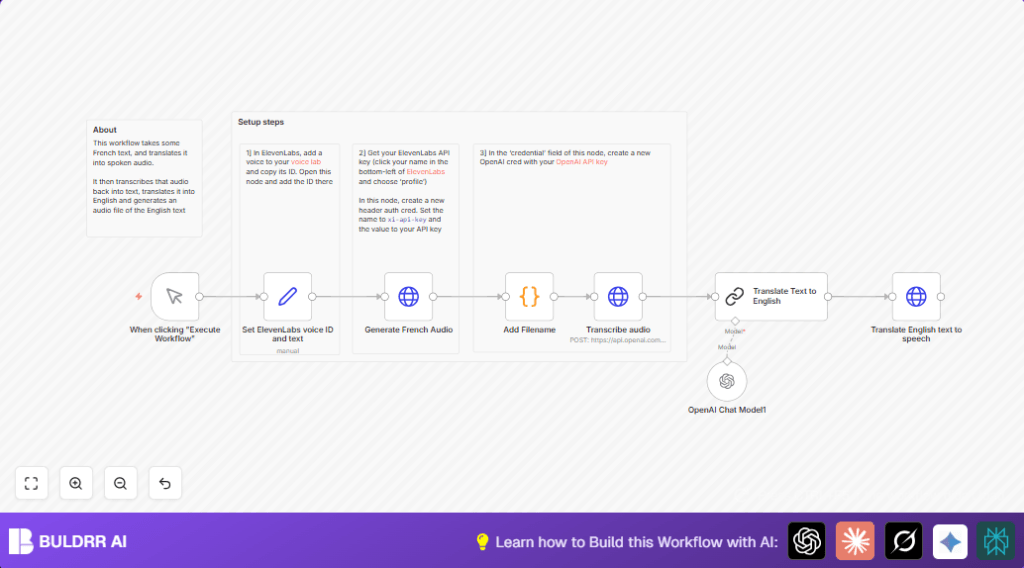
This workflow takes French text as input and makes two audio files. The first is French speech from the text. The second is English speech from a translation of the French text.
The main problem it solves is saving time. It avoids manually recording, transcribing, and translating text. The user gets fast, clear audio in both languages.
The result is ready bilingual audio files named properly. The files are easy to save or share with others.
2. Tools and Services Used
- ElevenLabs Text-to-Speech API: Converts text into natural sounding speech in multiple languages.
- OpenAI Whisper API: Transcribes French audio back into text to check accuracy.
- OpenAI GPT model: Translates the French transcription into English text.
- n8n Automation Platform: Runs the workflow and connects the different services.
3. Beginner Step-by-Step: How to Use This Workflow in n8n
Import Workflow
- Download the workflow file using the Download button on this page.
- Open the n8n editor where you want to use it.
- Use the Import from File option to load the workflow.
Configure Credentials and Settings
- Add your ElevenLabs API Key in n8n credentials.
- Add your OpenAI API Key for Whisper and GPT services.
- In the Set ElevenLabs voice ID and text node, update the
voice_idto the voice ID from ElevenLabs Voice Lab you want to use. - Change the sample French text if you want different input.
- Optionally edit translation prompt if you want to use another OpenAI model.
Test and Activate
- Run the workflow once by clicking Execute Workflow on the Manual Trigger node to check everything works.
- Watch for audio files named
audio.mp3generated in the output. - If all works as expected, switch the workflow from inactive to active for production use.
- You can run the workflow manually or connect it to other triggers inside n8n for automation.
- If using self-host n8n, set up the environment accordingly before deployment.
4. Inputs, Processing, and Output
Inputs
- French text to be converted into audio.
- ElevenLabs voice ID for the French audio voice.
Processing Steps
- The workflow creates French audio from the text using ElevenLabs TTS.
- It adds a filename to the audio data for proper handling.
- The French audio is sent to OpenAI Whisper for transcription back into French text.
- The transcription is then sent to GPT to translate into English text.
- ElevenLabs TTS converts the translated English text into English audio.
Output
- French audio file named
audio.mp3. - English audio file named
audio.mp3representing the translation.
5. Common Problems and Fixes
ElevenLabs API Key Error
If you see a 401 Unauthorized error, check if the ElevenLabs API key is correct and not expired. Fix the credentials inside n8n and try again.
Empty or Bad Transcriptions
Make sure audio files are not broken. Confirm the Add Filename node sets the filename on the audio binary data properly before transcription.
Translation Issues
If translation fails or is wrong, verify the prompt format inside the Translate Text to English node. It should use {{ $json.text }} as input. Test with sample texts.
6. Ways to Customize
- Change the voice in ElevenLabs by updating the
voice_idin the setting node. - Tweak the
stabilityandsimilarity_boostin ElevenLabs API calls to get voice tone you like. - Use other OpenAI GPT models in the translation step for faster or more detailed results.
- Add support for other languages by duplicating translation and audio generation nodes with new languages.
7. Summary of Results
✓ Saves many hours converting French text to bilingual audio.
✓ Produces two clear audio files: one French and one English translation.
✓ Reduces errors by automating transcription and translation steps.
→ Allows creating audio content faster and easier for a bigger audience.
