
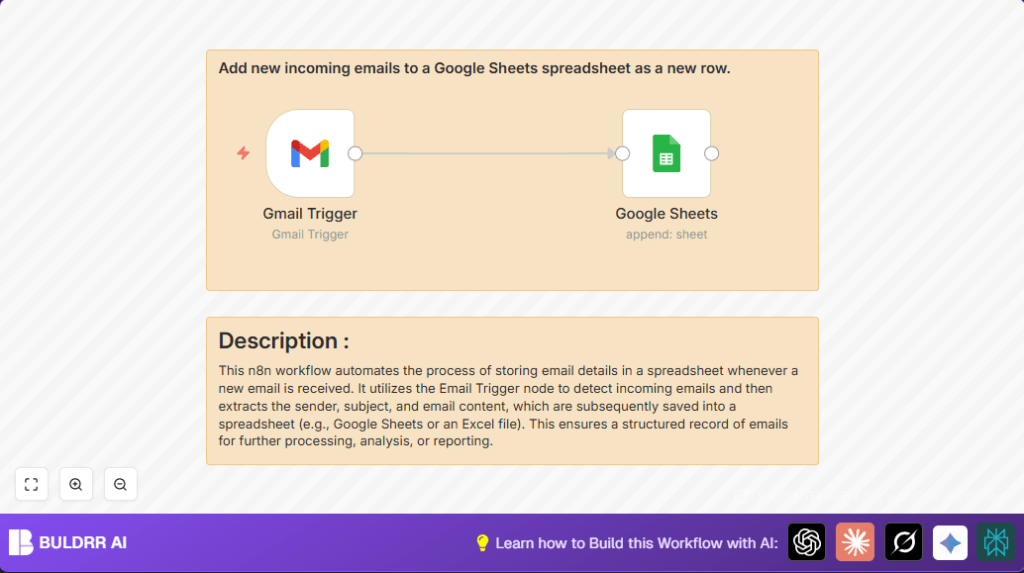

What This Workflow Does
This workflow watches for new Gmail emails and puts three main details into a Google Sheets sheet.
It helps stop manual email logging. Users get each email saved with sender, subject, and a snippet fast and error-free.
This makes email tracking simple and always up to date with no typing needed.
Who Should Use This Workflow
Anyone with many client emails to track daily can use this.
It helps people who log emails manually and want to save hours.
Teams handling leads, support requests, or customer questions find this useful.
Tools and Services Used
- n8n Platform: Automates workflows easily.
- Gmail API: Checks for new emails every minute.
- Google Sheets API: Adds rows to a spreadsheet automatically.
Beginner Step-by-Step: How to Use This Workflow in n8n
1. Import the Workflow
- Download the workflow file using the Download button on this page.
- Inside the n8n editor, click on “Import from File” and select the downloaded file.
2. Configure Credentials
- Open the Gmail Trigger node and set up your Gmail OAuth2 credentials.
- Open the Google Sheets node and add your Google Sheets OAuth2 credentials.
3. Update Identifiers
- In the Google Sheets node, update the Document ID to your sheet’s ID (the long string in the URL).
- Check the Sheet Name or GID to make sure it matches the target sheet.
4. Test the Workflow
- Send a test email to your Gmail account.
- Run the workflow manually to check if the new row is added to the spreadsheet.
5. Activate for Production
- Once confirmed working, toggle the workflow’s Active switch to turn it on.
- Monitor logs to ensure new emails are captured and recorded correctly.
You can also explore self-host n8n if running the automation on your own server.
Inputs, Processing, and Output
Inputs
- New incoming emails checked every minute by the Gmail Trigger node.
Processing Steps
- The trigger extracts sender email, subject, and a short snippet from the email.
- The extracted values are mapped as fields for appending into Google Sheets.
Output
- New rows added automatically to the selected Google Sheets spreadsheet containing email details.
Customization Ideas
- Add columns like Date Received or Attachment Links in the Google Sheets node by mapping more email data.
- Set filters in Gmail Trigger to track only certain senders or subjects.
- Swap Google Sheets with Excel node if Excel is preferred for logging.
Edge Cases and Troubleshooting
Problem: New emails don’t appear in Google Sheets
Possible cause is expired OAuth2 tokens or wrong Document ID or Sheet Name.
Fix by reauthorizing credentials and double-checking IDs and sheet names from Google Sheets URL.
Problem: Workflow does not trigger on new emails
Possible cause is missing credentials or poll interval not set.
Fix by setting Gmail Trigger poll time to “Every Minute” and confirming OAuth2 setup.
Pre-Production Checklist
- Check the Gmail OAuth2 credentials allow reading emails.
- Check Google Sheets OAuth2 credentials allow editing the spreadsheet.
- Send a test email and confirm a new row appears.
- Backup any existing Google Sheets data before structural changes.
Deployment Guide
Activate the workflow in n8n by toggling the active switch.
Watch execution logs regularly at first to catch problems.
Set up notifications for failures if needed.
Workflow uses little resources and works well on simple servers.
Summary of Benefits and Outcome
✓ Saves many hours by removing manual email logging.
✓ Records sender, subject and snippet automatically.
✓ Reduces errors in maintaining email follow-up lists.
→ Keeps Google Sheets always updated with latest emails.
→ Allows faster and clear client communication tracking.
