
What Is GPT-6 Astra? OpenAI’s New Model, Explained (2026)

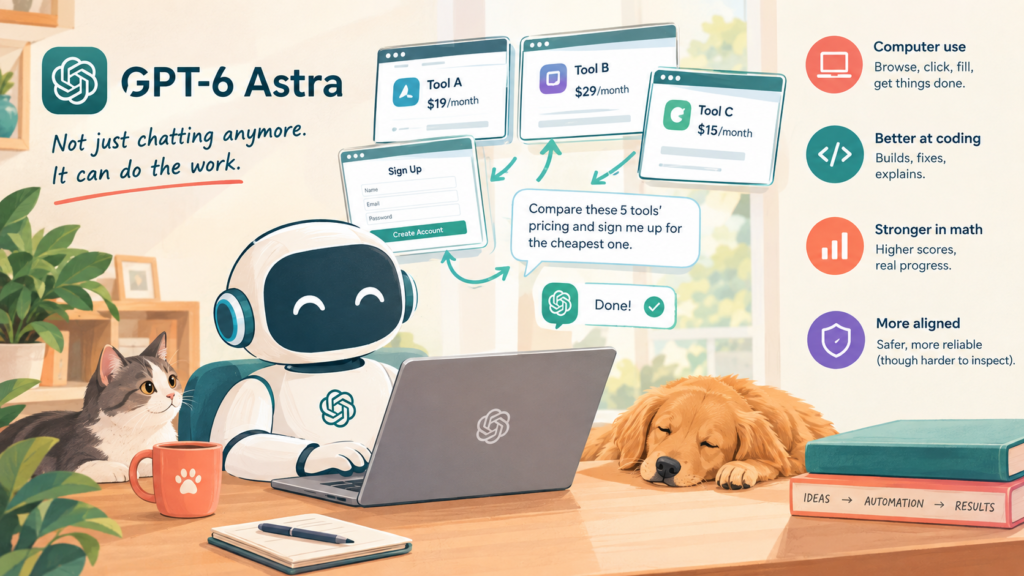
GPT-6 Astra AI model using a laptop to browse websites, compare tools, complete forms, and perform multi-step tasks, highlighting computer use, coding, math, and safety improvements.
Updated: September 21, 2026

Another AI model name just showed up in your feed and you have no idea if it actually matters – totally normal, lol. Every few months there’s a new one, and half the time nobody explains what changed.

This post breaks down GPT-6 Astra, OpenAI’s newest model, in plain simple English. No tech background needed.

What Is GPT-6 Astra?

GPT-6 Astra is OpenAI’s newest flagship AI model. It’s the successor to GPT-5.6, and OpenAI started rolling it out on September 3, 2026, with a wider public release the next day.

Think of it like a phone getting its newest model. It’s still the same “brand” you already know – ChatGPT – but this version is noticeably better at the stuff you were already using it for: writing, coding, research, and now, actually doing things on a screen for you, not just talking about them.

You can use Astra through ChatGPT Plus, Pro, Business, or Enterprise plans, through OpenAI’s API, or through Microsoft Azure and AWS Bedrock if your company already builds on those. One thing to know: for Enterprise accounts, access is turned off by default, so an admin has to switch it on first.

What Makes Astra Different From Older GPT Models?

The biggest change is “computer use.” Astra can actually operate a computer the way you would – filling out forms, clicking through websites, updating a CRM, checking a calendar, and pulling together research across multiple tabs. Older models mostly just answered questions in a chat box. Astra can go do the task itself.

Okay so here’s the part that sounds technical but isn’t, once you break it down. Astra uses something called “recurrent depth.” Recurrent depth is a new way of building the model so it can loop back over a problem instead of reading it once and moving on – kind of like rereading a tricky paragraph a second time instead of skimming it once and hoping you got it. That looping is part of why it’s better at multi-step tasks like coding and math.

It also got there through sheer scale. OpenAI says this was, by far, their biggest training run ever – using more than 100,000 GPUs at their Stargate site in Texas. That’s the “gym” the model trained in, so to speak.

On test scores, Astra jumped a lot in areas like:

  • Computer use – 72.6% on a benchmark called OSWorld 2.0, up from 65.7% for the previous model
  • Advanced math – 97.6% on FrontierMath Tier 4, a very hard math benchmark
  • Reasoning puzzles – 99.9% on ARC-AGI-3

During testing, Astra also reportedly helped make progress on a genuinely hard, long-standing math problem about prime numbers, and found two previously unknown security flaws (called “zero-day vulnerabilities”) while being evaluated.

Is GPT-6 Astra Actually Safer, Like OpenAI Claims?

OpenAI is calling Astra its “most aligned model yet.” In their own testing, Astra refused to bypass its safety rules 0% of the time it was pushed to, compared to 48% for the older model – and they say it’s about three times less likely to overstate what it can actually do.

But here’s the honest, balanced part. The same “recurrent depth” trick that makes Astra smarter also makes its internal reasoning harder for outside researchers to inspect. AI safety experts have raised concerns about this – basically, it’s gotten better at the task, but a little harder to watch it “think.” That’s worth knowing, not something to panic about.

By the way, OpenAI’s own president, Greg Brockman, said Astra might represent a step toward what’s called AGI – artificial general intelligence, meaning AI that can handle a very wide range of human tasks. That’s his opinion, not a settled fact, and it’s a good example of why it’s smart to read AI news with a little healthy skepticism either way.

Real-World Example – Before and After Astra

Before: Say you need to compare prices for a new tool across five different websites, then fill out a signup form on the cheapest one. You open five tabs, copy numbers into a note, compare them by hand, then manually type your details into the form. Fifteen, twenty minutes, easy.

After: You describe the task to Astra in one message – “compare these five tools’ pricing and sign me up for the cheapest one.” It visits the sites, pulls the numbers, and fills out the form itself. You just check the result before it submits.

Does This Matter for Small Businesses?

Honestly, yes – and this is where it connects to what BULDRR AI already does every day. This “do the task, not just describe it” direction is exactly where AI agents and automation tools like n8n have been heading for a while now. A model that can operate a browser or fill in a form on its own is basically doing, in one AI model, a smaller version of what a custom automation workflow does.

You don’t need to switch everything over to Astra tomorrow. But if you’re already curious about how automation could save you hours each week, BULDRR AI’s free workflows library has 10,000+ ready-made automations you can download and use – no credit card needed, just grab one and see what it does.

Common Questions People Ask

Is GPT-6 Astra available to everyone yet?

Not fully. It started with a limited rollout to some organizations on September 3, 2026, and expanded from there. Access on Enterprise ChatGPT plans has to be turned on by an admin – it’s not automatic.

How much does GPT-6 Astra cost?

Through the API, it’s $10 per million input tokens and $50 per million output tokens. There’s also a “Fast mode” that runs twice as quick for twice the price. If you use ChatGPT itself, Astra usage is included in your existing Plus, Pro, Business, or Enterprise plan.

Is GPT-6 Astra the same as AGI?

No, not officially. OpenAI’s president said it might be a step toward AGI (artificial general intelligence), but that’s his opinion, not a claim OpenAI has confirmed as fact. Treat that comment as speculation, not a settled label.

Quick Recap

  • GPT-6 Astra is OpenAI’s newest model, released the first week of September 2026
  • The biggest new feature is “computer use” – it can browse, click, and fill out things on its own
  • It scored much higher than the last model on coding, math, and reasoning tests
  • OpenAI says it’s more aligned and safer, though its reasoning is harder for outsiders to inspect
  • It costs $10/$50 per million input/output tokens through the API, or is included in ChatGPT paid plans

What Should You Do Next?

Your one action right now: open ChatGPT and ask it to do one small multi-step task for you – like “find me three options for X and summarize them in a table.” You don’t have to understand the whole architecture behind it. Just try one small thing and see what it does. That’s it.

Another AI model name just showed up in your feed and you have no idea if it actually matters – totally normal, lol. Every few months there’s a new one, and half the time nobody explains what changed.

This post breaks down GPT-6 Astra, OpenAI’s newest model, in plain simple English. No tech background needed.

What Is GPT-6 Astra?

GPT-6 Astra is OpenAI’s newest flagship AI model. It’s the successor to GPT-5.6, and OpenAI started rolling it out on September 3, 2026, with a wider public release the next day.

Think of it like a phone getting its newest model. It’s still the same “brand” you already know – ChatGPT – but this version is noticeably better at the stuff you were already using it for: writing, coding, research, and now, actually doing things on a screen for you, not just talking about them.

You can use Astra through ChatGPT Plus, Pro, Business, or Enterprise plans, through OpenAI’s API, or through Microsoft Azure and AWS Bedrock if your company already builds on those. One thing to know: for Enterprise accounts, access is turned off by default, so an admin has to switch it on first.

What Makes Astra Different From Older GPT Models?

The biggest change is “computer use.” Astra can actually operate a computer the way you would – filling out forms, clicking through websites, updating a CRM, checking a calendar, and pulling together research across multiple tabs. Older models mostly just answered questions in a chat box. Astra can go do the task itself.

Okay so here’s the part that sounds technical but isn’t, once you break it down. Astra uses something called “recurrent depth.” Recurrent depth is a new way of building the model so it can loop back over a problem instead of reading it once and moving on – kind of like rereading a tricky paragraph a second time instead of skimming it once and hoping you got it. That looping is part of why it’s better at multi-step tasks like coding and math.

It also got there through sheer scale. OpenAI says this was, by far, their biggest training run ever – using more than 100,000 GPUs at their Stargate site in Texas. That’s the “gym” the model trained in, so to speak.

On test scores, Astra jumped a lot in areas like:

  • Computer use – 72.6% on a benchmark called OSWorld 2.0, up from 65.7% for the previous model
  • Advanced math – 97.6% on FrontierMath Tier 4, a very hard math benchmark
  • Reasoning puzzles – 99.9% on ARC-AGI-3

During testing, Astra also reportedly helped make progress on a genuinely hard, long-standing math problem about prime numbers, and found two previously unknown security flaws (called “zero-day vulnerabilities”) while being evaluated.

Is GPT-6 Astra Actually Safer, Like OpenAI Claims?

OpenAI is calling Astra its “most aligned model yet.” In their own testing, Astra refused to bypass its safety rules 0% of the time it was pushed to, compared to 48% for the older model – and they say it’s about three times less likely to overstate what it can actually do.

But here’s the honest, balanced part. The same “recurrent depth” trick that makes Astra smarter also makes its internal reasoning harder for outside researchers to inspect. AI safety experts have raised concerns about this – basically, it’s gotten better at the task, but a little harder to watch it “think.” That’s worth knowing, not something to panic about.

By the way, OpenAI’s own president, Greg Brockman, said Astra might represent a step toward what’s called AGI – artificial general intelligence, meaning AI that can handle a very wide range of human tasks. That’s his opinion, not a settled fact, and it’s a good example of why it’s smart to read AI news with a little healthy skepticism either way.

Real-World Example – Before and After Astra

Before: Say you need to compare prices for a new tool across five different websites, then fill out a signup form on the cheapest one. You open five tabs, copy numbers into a note, compare them by hand, then manually type your details into the form. Fifteen, twenty minutes, easy.

After: You describe the task to Astra in one message – “compare these five tools’ pricing and sign me up for the cheapest one.” It visits the sites, pulls the numbers, and fills out the form itself. You just check the result before it submits.

Does This Matter for Small Businesses?

Honestly, yes – and this is where it connects to what BULDRR AI already does every day. This “do the task, not just describe it” direction is exactly where AI agents and automation tools like n8n have been heading for a while now. A model that can operate a browser or fill in a form on its own is basically doing, in one AI model, a smaller version of what a custom automation workflow does.

You don’t need to switch everything over to Astra tomorrow. But if you’re already curious about how automation could save you hours each week, BULDRR AI’s free workflows library has 10,000+ ready-made automations you can download and use – no credit card needed, just grab one and see what it does.

Common Questions People Ask

Is GPT-6 Astra available to everyone yet?

Not fully. It started with a limited rollout to some organizations on September 3, 2026, and expanded from there. Access on Enterprise ChatGPT plans has to be turned on by an admin – it’s not automatic.

How much does GPT-6 Astra cost?

Through the API, it’s $10 per million input tokens and $50 per million output tokens. There’s also a “Fast mode” that runs twice as quick for twice the price. If you use ChatGPT itself, Astra usage is included in your existing Plus, Pro, Business, or Enterprise plan.

Is GPT-6 Astra the same as AGI?

No, not officially. OpenAI’s president said it might be a step toward AGI (artificial general intelligence), but that’s his opinion, not a claim OpenAI has confirmed as fact. Treat that comment as speculation, not a settled label.

Quick Recap

  • GPT-6 Astra is OpenAI’s newest model, released the first week of September 2026
  • The biggest new feature is “computer use” – it can browse, click, and fill out things on its own
  • It scored much higher than the last model on coding, math, and reasoning tests
  • OpenAI says it’s more aligned and safer, though its reasoning is harder for outsiders to inspect
  • It costs $10/$50 per million input/output tokens through the API, or is included in ChatGPT paid plans

What Should You Do Next?

Your one action right now: open ChatGPT and ask it to do one small multi-step task for you – like “find me three options for X and summarize them in a table.” You don’t have to understand the whole architecture behind it. Just try one small thing and see what it does. That’s it.

Author
Written By
Vikash Kumar
Building AI agents, n8n workflows and end-to-end automation for 30+ Brands across India, the US, Europe, Dubai & Australia. 7+ years of Experience saving founders real hours every week - no code required.
Ask more Questions about this Blog with AI:

Our AI Articles

Learn from our AI Articles to excel in your profession ;)

How to Grow on LinkedIn in 2026: What 360Brew Actually Rewards (and Punishes)

LinkedIn's AI now scores every post on real signals, not likes. Here's exactly what it rewards, what gets you penalized,...

LinkedIn Algorithm 2026: Why Lower Reach Now Means Better Clients

LinkedIn's algorithm is now fully AI-powered. Here's what changed, real post data proving it, and how to make it work...

SLAY Framework: Lara Acosta’s LinkedIn Templates

Learn Lara Acosta's SLAY framework (Story, Lesson, Actionable, You) with real LinkedIn post templates and a step-by-step guide for beginners....

The LinkedIn SLAY Framework Explained Step by Step (With Real Post Examples)

Most LinkedIn posts fail for the same reason. They either read like a press release, sound like a motivational poster,...

What Is n8n? A Simplest-English Guide for Non-Technical People

What is n8n? This plain-English guide explains it simply for beginners — what it does, how it works, and why...

Build an AI Agent in n8n: Beginner Step-by-Step Guide (2026)

Learn to build your first n8n AI agent step by step with no code. This beginner guide covers the AI...

n8n on Hostinger VPS: The Complete Beginner Setup Guide (2026)

Learn how to deploy n8n on a Hostinger VPS step by step. A beginner-friendly 2026 guide with no Linux or...

n8n Webhook Tutorial: Trigger Any Automation from Anywhere (2026)

Learn how to set up n8n webhooks step by step. This beginner guide covers triggers, test vs production mode, security...

n8n Pricing 2026: Free Self-Hosted vs Cloud Costs Explained

n8n pricing broken down for 2026: every Cloud plan cost, real self-hosted server prices, and how to pick the option...

n8n MCP: How to Connect AI Agents to Any Tool (2026)

n8n MCP lets your AI agent connect to any tool through one shared standard, no custom code needed. Here is...

Lara Acosta LinkedIn Templates and Hooks (2026 Examples)

Copy Lara Acosta LinkedIn templates and hook examples, plus the SLAY framework, to write posts that get read. A simple...

n8n Docker Setup: Install n8n the Easy Way (2026 Guide)

Learn how to install n8n with Docker step by step. A beginner-friendly 2026 guide to run n8n on your own...
1:1 Free Strategy Session
Your competitors are already automating. Are you still paying for it manually?

Do you want to adopt AI Automation?

Every hour your team does repetitive work, you're burning real money.
While you wait, faster businesses are cutting costs and moving quicker.
AI and automations aren't the future anymore — they're the present.

Book a live 1-on-1 session where we show you exactly which of your daily tasks can be automated — and what it’s costing you not to.