
How Claude Code’s Creator Thinks the Next Generation of Companies Will Be Built
Introduction
For decades, businesses have been built around departments.
Marketing creates campaigns.
Engineering builds products.
Sales closes deals.
Support solves customer issues.
Operations keeps everything running.
That structure worked because humans were responsible for every stage of execution.
But AI changes one fundamental assumption:
Humans no longer need to perform every task themselves.
Instead of spending hours writing code, researching competitors, creating documentation, or cleaning datasets, AI can handle a large portion of the execution.
That means the biggest competitive advantage is no longer having the largest team.
It’s building the best workflow.
Boris Cherny, one of the creators behind Claude Code, believes this shift will completely redefine how companies operate over the next decade.
Instead of organizing businesses around job titles…
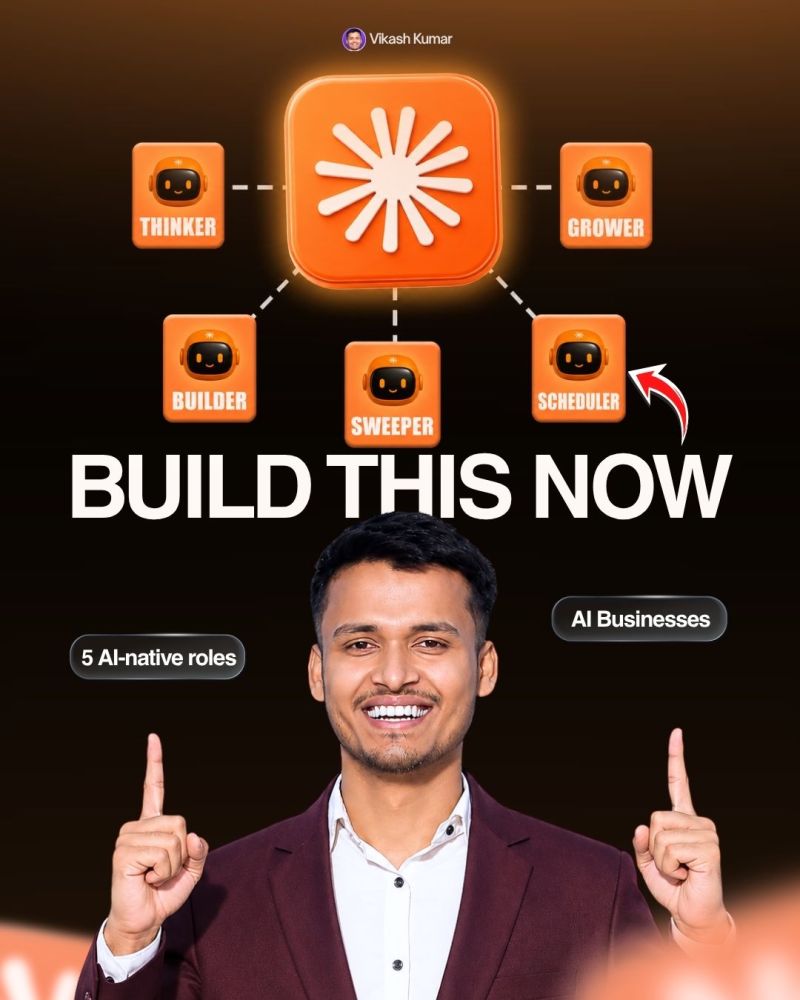
Companies will organize themselves around five core roles that every successful product goes through.
Why Traditional Business Structures Are Breaking
Imagine you’re launching a new SaaS product.
Ten years ago you needed:
- Product Manager
- UI Designer
- Frontend Developer
- Backend Developer
- QA Engineer
- Marketing Manager
- Copywriter
- Growth Manager
Today?
One founder with the right AI stack can perform much of that work.
Not because AI replaces expertise.
Because AI removes repetitive execution.
Instead of spending weeks building the first version…
You can build it in hours.
The bottleneck is no longer writing code.
The bottleneck is making good decisions.
That is why Boris argues companies should stop thinking about departments…
…and start thinking about workflows.
The Five AI-Native Roles
These aren’t job titles.
They’re stages every successful product moves through.
One person can perform all five.
A team of fifty can also perform the same five.
The roles never change.
Only the scale does.
1. The Prototyper
“Can this idea work?”
Every successful business starts with experimentation.
Most ideas fail.
The job of the prototyper is to fail quickly.
Instead of debating whether an idea is good…
They build something small enough to test.
Imagine you run a fitness company.
Instead of spending three months creating a complete coaching program…
The prototyper creates:
- a landing page
- a waitlist
- a simple prototype
- an AI-generated demo
Within a day, real users tell you whether they care.
That’s infinitely more valuable than six weeks of internal meetings.
AI makes this role dramatically faster.
Instead of designing everything manually, tools like Claude Code, Lovable, Replit, or GPT-5 can generate:
- Landing pages
- Product mockups
- Website copy
- UI concepts
- Product names
- Feature ideas
The goal isn’t perfection.
The goal is learning.
A great prototyper kills bad ideas quickly and doubles down on good ones.
2. The Builder
“Turn the idea into reality.”
Once an idea proves demand…
Someone has to build it.
This is where the Builder comes in.
The Builder transforms concepts into working systems.
That could mean:
- Building a SaaS product
- Creating an AI agent
- Developing an automation
- Connecting APIs
- Setting up databases
- Deploying software
Years ago this required an engineering team.
Today, AI dramatically reduces the effort.
Claude Code can write code.
Cursor can refactor projects.
AI agents can generate documentation while coding.
The Builder’s job is no longer typing every line.
It’s reviewing, guiding, and making architectural decisions.
Execution becomes faster.
Decision-making becomes more valuable.
3. The Sweeper
The Most Underrated Role
Most founders love adding features.
Very few enjoy removing them.
That’s why products slowly become bloated.
Buttons multiply.
Menus become confusing.
Codebases become messy.
The Sweeper fixes this.
Their mindset is simple:
“What can we remove?”
Instead of asking:
“What else should we build?”
they ask:
“What is making this product harder to use?”
A good Sweeper:
- removes unnecessary features
- simplifies workflows
- improves performance
- cleans technical debt
- reduces complexity
Every successful company eventually reaches this stage.
Without a Sweeper…
Products become slower.
Harder to maintain.
Harder to scale.
4. The Grower
Building Isn’t Winning.
Distribution is.
Many founders assume building a product is the hard part.
It isn’t.
Getting people to use it is.
That’s the Grower’s responsibility.
They study how customers actually behave.
Questions they constantly ask include:
Why are users leaving?
Which features are most popular?
Where do people stop using the product?
How can onboarding improve?
What increases retention?
Growth isn’t one marketing campaign.
It’s thousands of tiny improvements over time.
AI makes this easier by analyzing:
- User behavior
- Conversion funnels
- Customer feedback
- Analytics
- Marketing performance
Growth becomes a continuous process rather than a guessing game.
5. The Maintainer
Growth Creates Complexity
Many startups focus entirely on building.
Very few think about maintenance.
Until something breaks.
As customers increase…
Reliability becomes more important than innovation.
The Maintainer ensures:
- systems stay online
- infrastructure remains stable
- security improves
- bugs get fixed
- documentation stays updated
- backups continue working
This role protects everything the business has already built.
Without Maintainers…
Successful products eventually collapse under their own complexity.
One Person Can Play Every Role
Here’s the interesting part.
Boris isn’t saying companies need five new employees.
He’s saying every product needs these five responsibilities.
If you’re a solo founder…
You are already performing all five.
Monday:
Prototype an idea.
Tuesday:
Build it.
Wednesday:
Simplify it.
Thursday:
Market it.
Friday:
Maintain it.
AI simply helps you perform each role much faster.
The Biggest Shift: Humans Manage Objectives, Not Tasks
This is where most people misunderstand AI agents.
When Boris mentions running hundreds or even thousands of AI agents…
He isn’t manually prompting thousands of conversations.
That would be impossible.
Instead…
He manages objectives.
Think about it like this.
Instead of saying:
“Agent 1, do this.”
“Agent 2, do this.”
“Agent 3, do this.”
He creates one high-level goal.
For example:
Build the onboarding flow.
One Claude Code session owns that project.
That session automatically creates specialized sub-agents for:
- Research
- Frontend
- Backend
- Testing
- Documentation
- Refactoring
- Code Review
Instead of supervising every worker…
The human supervises one manager.
The manager supervises everyone else.
That is the real power of AI orchestration.
Claude Everywhere
Another concept Boris talks about is Claude Everywhere.
Today, most people open ChatGPT or Claude in a browser.
Ask a question.
Copy the answer.
Paste it somewhere else.
That workflow doesn’t scale.
The future looks different.
AI won’t live inside one application.
It will exist inside:
- Slack
- VS Code
- GitHub
- Notion
- Google Docs
- Internal dashboards
- Project management tools
Instead of opening AI…
AI will already be present wherever work happens.
Imagine mentioning Claude inside Slack.
It already knows:
- your project
- your documentation
- your codebase
- yesterday’s meeting
- current sprint
- customer feedback
That is the direction AI is moving.
Not another app.
An operating layer across your business.
Final Takeaway
The biggest lesson from Boris Cherny isn’t that AI will replace jobs.
It’s that businesses themselves are being redesigned.
The companies that win won’t necessarily hire the most people.
They’ll build the clearest workflows.
They’ll prototype faster.
Ship faster.
Improve faster.
Scale faster.
And instead of managing hundreds of individual AI agents…
They’ll define great objectives, let AI handle execution, and spend their time making better decisions.
In the AI era, execution is becoming cheaper.
Judgment is becoming more valuable than ever.
