 Schedule a Call

What this is
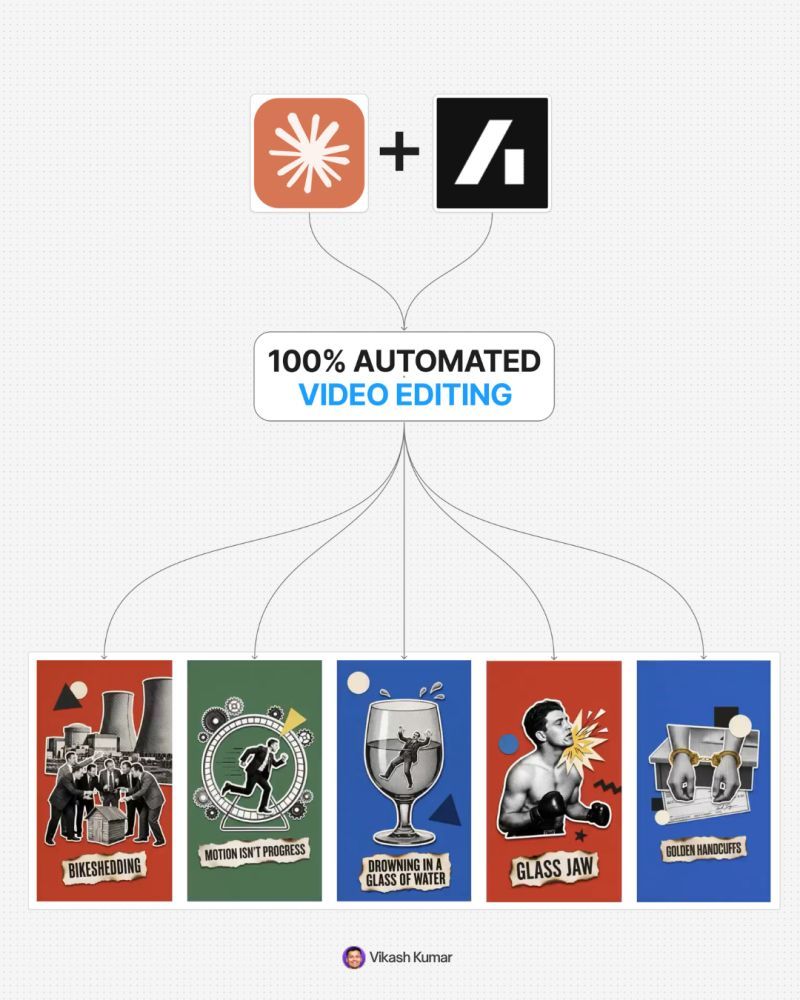
The Arcads Collage Motion skill is a Claude skill that takes a reference image (or just a brief) and produces a matching halftone paper-collage motion clip on the Arcads MCP connector. It decodes the reference into an editable spec, generates the on-brand stills with nano-banana-2, then animates a still into assemble-from-empty motion with Seedance 2.0. Your attention goes into taste and direction, not busywork.
The look: one flat bold color field, black-and-white halftone cut-outs with clean cut edges and a soft drop shadow, one sharp idea per scene, and motion that builds the frame piece by piece instead of wobbling a finished image.
Before you start
You need three things:
- The Arcads MCP connector connected to your Claude, with credits available. New to Arcads? Create your account and connect it here.
- Claude Code (or any Claude surface that can load skills and reach the Arcads connector).
- Default models the skill drives: nano-banana-2 for images, Seedance 2.0 for video. Both run through Arcads, so you do not manage them separately.
Install
- Download the arcads-collage-motion skill file (link restored shortly).
- Drop it into Claude Code as a skill.
- Make sure the Arcads connector is on.
In Claude Code, a skill is a folder with a SKILL.md file inside. Put it in ~/.claude/skills/ to use it in every project, or in .claude/skills/ inside one repository to share it with your team, then call it with /arcads-collage-motion. New to connecting Claude to outside tools? Our beginner MCP guide explains how MCP connectors work.
That is the whole setup. After this, making an ad is a short conversation.
How it works
The skill runs in two phases. You are only hands-on for direction and approval.
Phase A, Analyze. You give it a reference. It reads the medium, color field, halftone density, cut and shadow, composition, the idea, and any label, then returns three things: a plain-language breakdown, a paste-ready prompt, and a field-by-field JSON spec. Every field is independently editable, so a later “same look, change only the color” means rewriting one block.
Phase B, Build. From that spec it generates the stills with nano-banana-2, you approve them, then it animates the approved still into assemble-from-empty motion.
Step by step
- Reference. Find a look you like and paste the image into the chat with /arcads-collage-motion to activate the skill. If you have no reference, describe the brief and the skill drafts the spec fields for you. I recommend Pinterest!

2. Analyze. Say “analyze this” or “break this down”. You get the breakdown, prompt, and JSON spec.
3. Generate. Say “generate the stills”. It calls nano-banana-2 with your locked product or brand image as a reference, one image per scene, label burned in.
4. Pick. Approve the stills you like, or reroll with an adjusted prompt.


5. Motion. Say “animate these”. The stills become finished stop-motion clips.

6. Scale. Lock the look once, vary only the idea per scene, batch the rest the same way.
The motion, in two routes
The signature is that the frame builds itself: it opens on the empty color field and the cut-out pieces slide in from the edges and snap into place.
- Default, Seedance 2.0 (prompt-driven). The finished still is passed as a reference and the build is described in words. Fast and native to your usual pipeline. If a clip does not assemble cleanly, adjust the prompt and reroll.
- Guaranteed, Kling 3.0 Pro (frame interpolation). For a clip that must build exactly, generate an empty-field version of the still, then interpolate from empty to finished. Use this per clip. Do not mix Seedance and Kling across a set you want to look uniform.
Arcads now also lists Seedance 2.5 as its most advanced video model. The skill still defaults to Seedance 2.0, so if you switch models, test one clip first and keep a whole set on the same model.
Want to run this yourself? Get Arcads, drop in the skill, and start building.
FAQ
- What does the Arcads Collage Motion skill make?
- Short halftone paper-collage motion clips: a flat bold color field, black-and-white cut-outs with a soft drop shadow, and motion where the frame assembles itself piece by piece.
- Do I need a reference image?
- No. A reference image gives the closest match, but you can describe a brief instead and the skill drafts the spec fields for you.
- Which AI models does it use?
- nano-banana-2 for the stills and Seedance 2.0 for motion by default, both run through Arcads. Kling 3.0 Pro frame interpolation is the fallback when a clip must assemble exactly.
- Where do I install the skill in Claude Code?
- Place the skill folder, which contains SKILL.md, in ~/.claude/skills/ for personal use or .claude/skills/ in a project, then make sure the Arcads connector is enabled.
Want to automate more of your content pipeline with Claude? See how we pair n8n with Claude Code to build workflows faster.
Skill: arcads-collage-motion. Default image model nano-banana-2, default video Seedance 2.0. Built to run on the Arcads MCP connector.
Each button opens the assistant with the prompt already written, asking it to teach this article step by step, in simple words.
 ChatGPT
 Claude
 Grok
Grok Perplexity
 Add as a preferred source