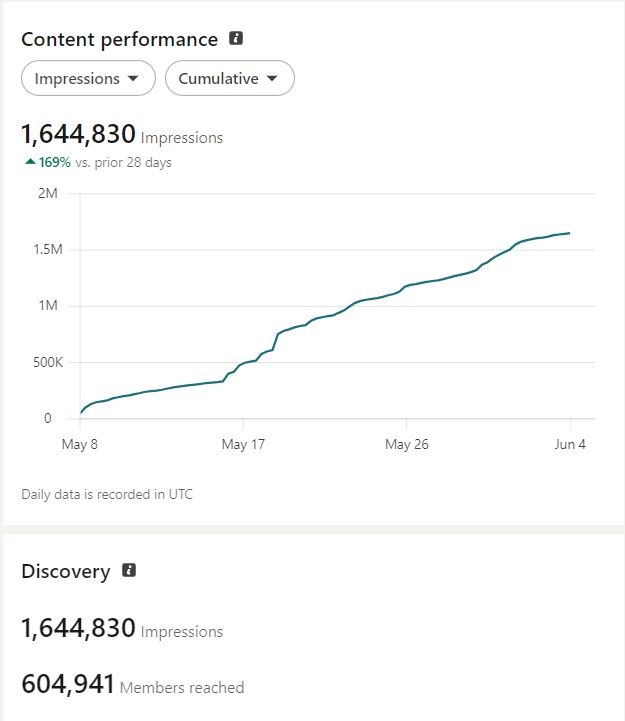
The real strategy behind 500,000+ impressions in two months — no fluff, just what works.
Most people think LinkedIn growth is about posting more. It is not. It is about understanding people — what makes them stop, think, and share. This guide breaks down exactly how to do that.
FOUNDATION
The 5 principles that actually matter
Compete on understanding, not publishing
Most creators obsess over how often they post. The best creators obsess over what their audience finds genuinely interesting. Effort does not differentiate you. Insight does.
Action: Before writing, ask — “Why would someone stop scrolling for this?”
Invest in learning before posting
Read widely. Follow creators you admire. Study why posts perform — not just which ones do. Understanding the
mechanics behind virality is more valuable than any posting schedule.
Action: Spend 15 minutes daily reading top posts in your niche. Take notes on structure, not just content.
Build relationships, not a network
Networking is transactional. Relationships are valuable. Have real conversations with people you respect. Comment meaningfully. Show up consistently in someone’s corner before you need anything.
Action: DM 3 people a week with a genuine observation — no ask attached.
Treat every post as an experiment
Some posts will get 2,000 views. Others will hit 100,000. Both are useful data. The goal is not to go viral — it is to understand what resonates and refine over time.
Action: After each post, note what worked and what did not. Build a personal swipe file.
Create value privately, not just publicly
Help people behind the scenes. Make introductions. Share ideas in DMs. The goodwill you build invisibly often drives more growth than any post. The impressions are visible — what created them usually is not.
Action: Once a week, share something useful with someone without posting about it.
WRITING
Hooks that stop the scroll
The first line is everything. If it does not pull them in, nothing else matters.
Here are the four hook types that work consistently:
CONTRARIAN
“The biggest AI companies are ones you’ve never heard of.”
Challenges a belief the reader already holds. Creates instant curiosity.
RESULT-FIRST
“Almost 500,000 impressions in two months. Here is what actually moved the needle.”
Leads with proof, earns attention before the explanation.
QUESTION
“Canva is not an AI company. Or is it?”
Opens a loop in the reader’s mind. They have to keep reading to close it.
SPECIFIC OBSERVATION
“Most people are optimizing the wrong thing on LinkedIn.”
Feels like insider knowledge. Triggers a desire to know what you know.
STRUCTURE
The anatomy of a high-performing post
- HOOK 1–2 lines max. State a bold claim, surprising result, or open a loop. This is your entire job in line one.
- BRIDGE Set the context. One short paragraph that earns the right to share your insight. Don’t bury the lead here.
- BODY The insight itself. Use short paragraphs. One idea per line. White space is your friend — dense text loses people on mobile.
- DATA Numbers add credibility. Even one specific stat makes your post feel more authoritative than a generic claim.
- TAKEAWAY Land the point cleanly. Your last 2–3 lines should feel quotable. If someone screenshots your post, it’s usually the ending.
- CTA One clear ask. Follow, comment, share, or DM. Never more than one. Keep it low friction.
AVOID
Mistakes that kill reach
❌ Posting without a hook. Starting with “I want to share something…” or “Today I learned…” signals nothing urgent. You have already lost them.
❌ Writing for yourself, not your reader. Your story is only interesting if the reader sees themselves in it. Frame everything through their lens.
❌ Posting and disappearing. The first hour after publishing matters. Reply to every comment. The algorithm rewards engagement velocity.
❌ Using hashtags like it’s 2019. Three relevant hashtags max. Stacking 15 hashtags looks spammy and adds no reach value today.
❌ Chasing virality instead of consistency. One post going viral means nothing. Showing up every week for six months means everything.
ROUTINE
Your weekly LinkedIn checklist
☑️ Post 3–5 times. Consistency beats frequency. Three great posts beat seven average ones every time.
☑️ Comment on 10 posts daily. Thoughtful comments build visibility faster than most posts. Say something worth reading.
☑️ Send 3 genuine DMs. No pitch, no ask. Just a real observation or a resource you thought was useful.
☑️ Review your analytics. What was the reach? Where did people drop off? One insight per week compounds fast over months.
☑️ Write your next week’s hooks. Batch your hooks on Sundays. Knowing what you’re posting removes the blank-page problem entirely.
Ready to grow on LinkedIn?
Follow along for more breakdowns, frameworks, and real examples from the trenches.
The real strategy behind 500,000+ impressions in two months — no fluff, just what works.
Most people think LinkedIn growth is about posting more. It is not. It is about understanding people — what makes them stop, think, and share. This guide breaks down exactly how to do that.
FOUNDATION
The 5 principles that actually matter
Compete on understanding, not publishing
Most creators obsess over how often they post. The best creators obsess over what their audience finds genuinely interesting. Effort does not differentiate you. Insight does.
Action: Before writing, ask — “Why would someone stop scrolling for this?”
Invest in learning before posting
Read widely. Follow creators you admire. Study why posts perform — not just which ones do. Understanding the
mechanics behind virality is more valuable than any posting schedule.
Action: Spend 15 minutes daily reading top posts in your niche. Take notes on structure, not just content.
Build relationships, not a network
Networking is transactional. Relationships are valuable. Have real conversations with people you respect. Comment meaningfully. Show up consistently in someone’s corner before you need anything.
Action: DM 3 people a week with a genuine observation — no ask attached.
Treat every post as an experiment
Some posts will get 2,000 views. Others will hit 100,000. Both are useful data. The goal is not to go viral — it is to understand what resonates and refine over time.
Action: After each post, note what worked and what did not. Build a personal swipe file.
Create value privately, not just publicly
Help people behind the scenes. Make introductions. Share ideas in DMs. The goodwill you build invisibly often drives more growth than any post. The impressions are visible — what created them usually is not.
Action: Once a week, share something useful with someone without posting about it.
WRITING
Hooks that stop the scroll
The first line is everything. If it does not pull them in, nothing else matters.
Here are the four hook types that work consistently:
CONTRARIAN
“The biggest AI companies are ones you’ve never heard of.”
Challenges a belief the reader already holds. Creates instant curiosity.
RESULT-FIRST
“Almost 500,000 impressions in two months. Here is what actually moved the needle.”
Leads with proof, earns attention before the explanation.
QUESTION
“Canva is not an AI company. Or is it?”
Opens a loop in the reader’s mind. They have to keep reading to close it.
SPECIFIC OBSERVATION
“Most people are optimizing the wrong thing on LinkedIn.”
Feels like insider knowledge. Triggers a desire to know what you know.
STRUCTURE
The anatomy of a high-performing post
- HOOK 1–2 lines max. State a bold claim, surprising result, or open a loop. This is your entire job in line one.
- BRIDGE Set the context. One short paragraph that earns the right to share your insight. Don’t bury the lead here.
- BODY The insight itself. Use short paragraphs. One idea per line. White space is your friend — dense text loses people on mobile.
- DATA Numbers add credibility. Even one specific stat makes your post feel more authoritative than a generic claim.
- TAKEAWAY Land the point cleanly. Your last 2–3 lines should feel quotable. If someone screenshots your post, it’s usually the ending.
- CTA One clear ask. Follow, comment, share, or DM. Never more than one. Keep it low friction.
AVOID
Mistakes that kill reach
❌ Posting without a hook. Starting with “I want to share something…” or “Today I learned…” signals nothing urgent. You have already lost them.
❌ Writing for yourself, not your reader. Your story is only interesting if the reader sees themselves in it. Frame everything through their lens.
❌ Posting and disappearing. The first hour after publishing matters. Reply to every comment. The algorithm rewards engagement velocity.
❌ Using hashtags like it’s 2019. Three relevant hashtags max. Stacking 15 hashtags looks spammy and adds no reach value today.
❌ Chasing virality instead of consistency. One post going viral means nothing. Showing up every week for six months means everything.
ROUTINE
Your weekly LinkedIn checklist
☑️ Post 3–5 times. Consistency beats frequency. Three great posts beat seven average ones every time.
☑️ Comment on 10 posts daily. Thoughtful comments build visibility faster than most posts. Say something worth reading.
☑️ Send 3 genuine DMs. No pitch, no ask. Just a real observation or a resource you thought was useful.
☑️ Review your analytics. What was the reach? Where did people drop off? One insight per week compounds fast over months.
☑️ Write your next week’s hooks. Batch your hooks on Sundays. Knowing what you’re posting removes the blank-page problem entirely.
Ready to grow on LinkedIn?
Follow along for more breakdowns, frameworks, and real examples from the trenches.