50+ InMails. Advanced Lead search. First 2 Users only

There’s no automation you can’t learn to build with BULDRR AI.

Promoted by BULDRR AI

Lara Acosta Workshop – How to turn Content into Clients

Core message: LinkedIn growth is no longer about hacks or formats — it’s about expert-led content + distribution + conversion (powered by systems + AI)

Topic: How to grow on LinkedIn in 2026 + get inbound leads using AI content systems


1) The Opening: “You don’t need to be a pro writer”

Lara starts by clearing a major objection:

  • Content creation ≠ writing
  • Content is inherently easier than people think
  • You don’t need copywriting books
  • You need expertise + a system
  • AI can handle the heavy lifting (if used correctly)

Key idea:

You don’t win because you’re a “better writer.”

You win because you’re a clear expert who can communicate.


2) “LinkedIn is too saturated” is a myth

One of the first big myths she attacks:

People say:

Her counter:

Conclusion:

Competition is lower than you think.

The real advantage is simply being consistent + clear.

She also gave a proof example:

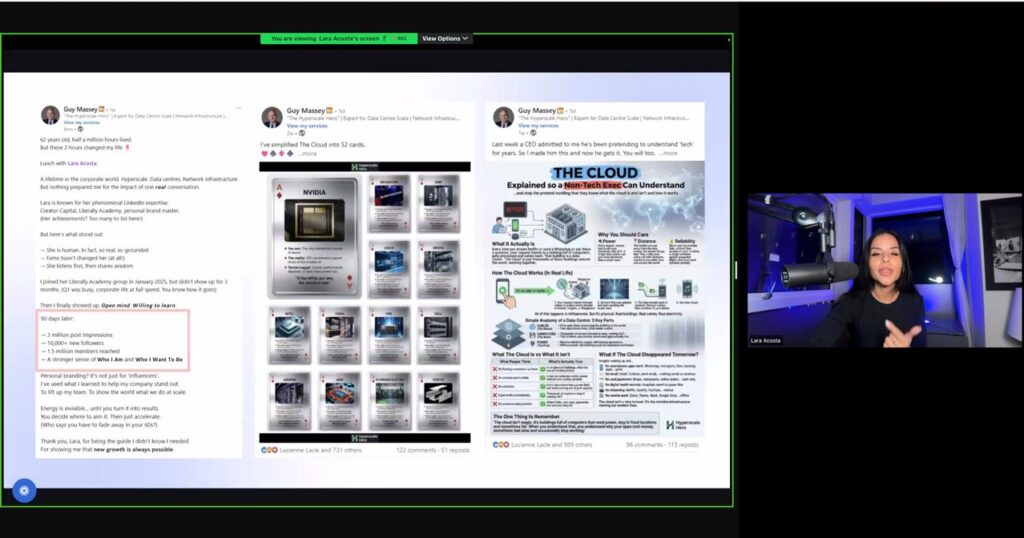
  • A client (Guy) started posting months ago
  • Now has ~50K followers
  • Goes viral in a “boring niche” (infrastructure)

Lesson:

Even “small niches” can win.

Actually, small niches can be easier.

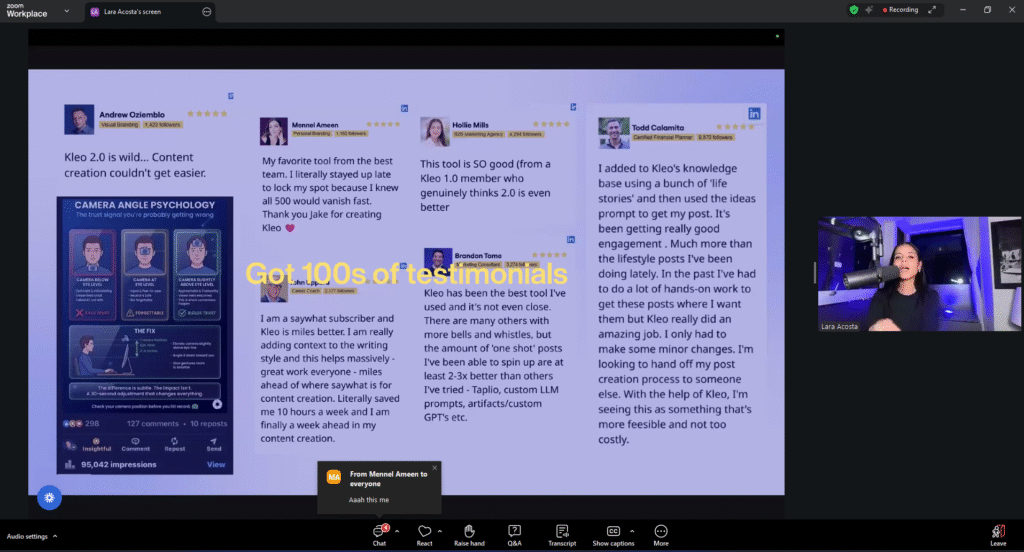
3) AI doesn’t make you generic — bad usage does

She addresses another fear:

“If I use AI, my content will sound like AI slop.”

Her point:

  • If you use generic tools without strategy → yes, it will look like slop
  • Not because AI is bad
  • Because the tool doesn’t know your expertise or positioning

She gave an example:

  • A post written by Jake was 90% AI-generated
  • Still expert-led, valuable, and viral (2.5K likes)

Lesson:

AI is a multiplier.

If your input is weak → output is weak.

If your input is structured → output is powerful.


4) What this masterclass was NOT about

Lara made it clear she’s not doing:

  • Ferrari lifestyle marketing
  • Penthouse flexing
  • Selling a crazy expensive course at the end

Instead:

  • Systems that work across industries
  • Tried-and-tested frameworks

5) The “Old LinkedIn vs New LinkedIn” shift

She explains why people feel like LinkedIn got harder:

Old LinkedIn:

  • Viral fluff
  • Generic posts
  • Low depth content could still go viral Examples she referenced:
  • Random infographics with no meaning
  • “Crying CEO” style content
  • Trendy viral formats

New LinkedIn:

  • LinkedIn prioritizes expertise
  • Expert-led creators get rewarded
  • Positioning matters more than ever

Big takeaway:

LinkedIn now belongs to people who look like specialists.

6) Algorithm Myth-Busting (3 major myths)

She broke down common beliefs and corrected them:

Myth #1: “Carousels/infographics perform best”

Her answer:

  • There is no single winning format
  • Text-only posts can perform
  • Carousels can flop
  • What matters is: what you say + how you say it

She shared examples of:

  • Text-only posts doing great
  • Carousel-trend posts doing poorly

Rule: Don’t chase formats. Chase clarity + writing.


Myth #2: “Storytelling doesn’t get distribution”

Her answer:

  • Storytelling still works if done right
  • A storytelling post from Rob hit ~30K impressions + signups

Rule: Any format can work if you use the right hook + structure.


Myth #3: “Video is dead”

Her answer:

  • Video still works (especially for lead gen)
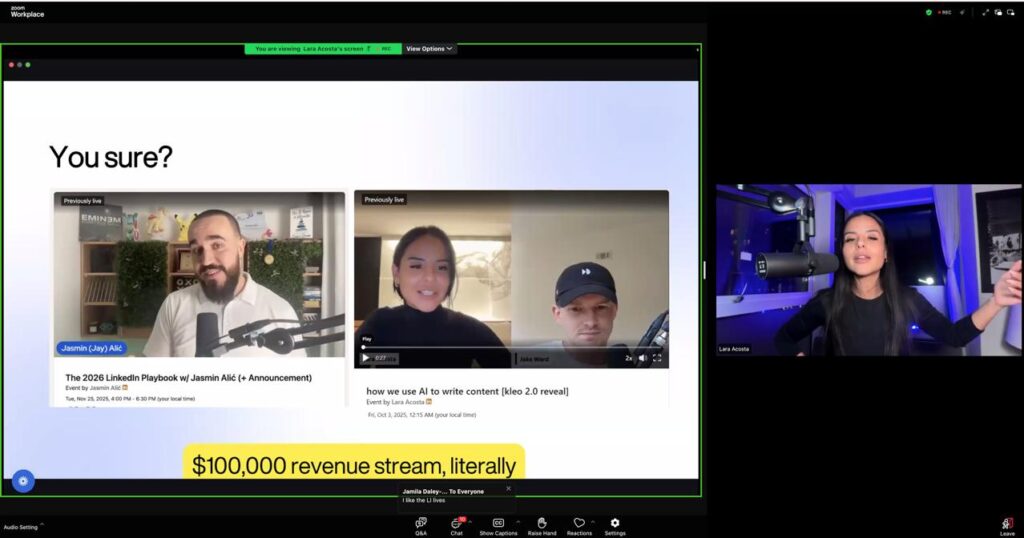
  • LinkedIn Lives + webinars build trust faster
  • With AI rising, trust matters more than ever

Why video works:

  • It proves you’re real
  • It proves you know your topic
  • It builds credibility at scale

7) The real content you should post in 2026

She clearly says it’s NOT:

  • Spray & pray content
  • Guru content
  • “Viral-only” content
  • “Carousel-only” content

It’s intentional content.

LinkedIn is rewarding:

  • Domain expertise
  • Consistent topics
  • Clear opinions
  • In-depth but concise writing

Important point:

You can’t jump between random topics anymore (food → family → business).

You need topic consistency.
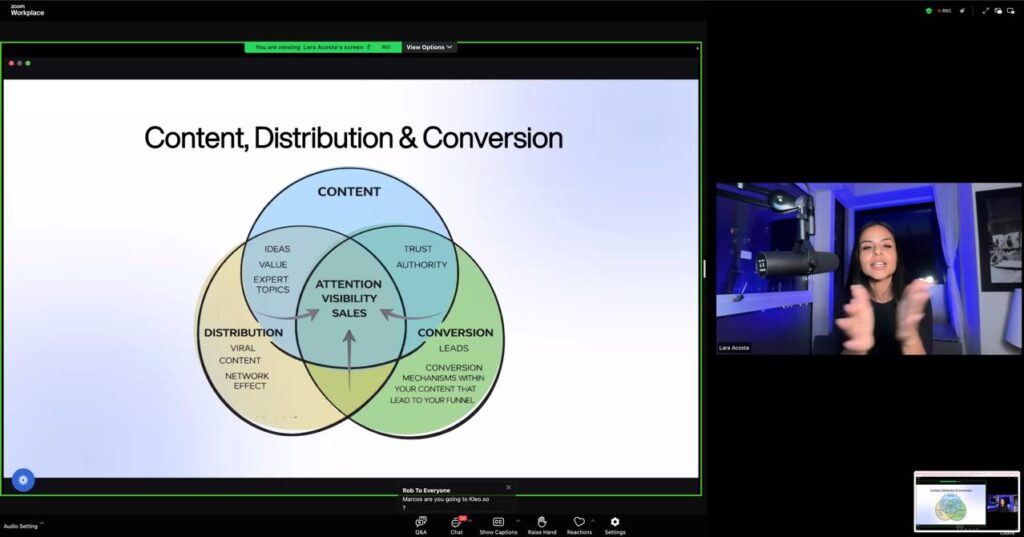

8) The 3-part system for inbound leads

This was the main framework:

1) Content

Creates attention and trust.

2) Distribution

Ensures people actually see your content.

3) Sales / Conversion

Turns attention into leads and customers.

She called this the “3 levels of conversion and attention.”


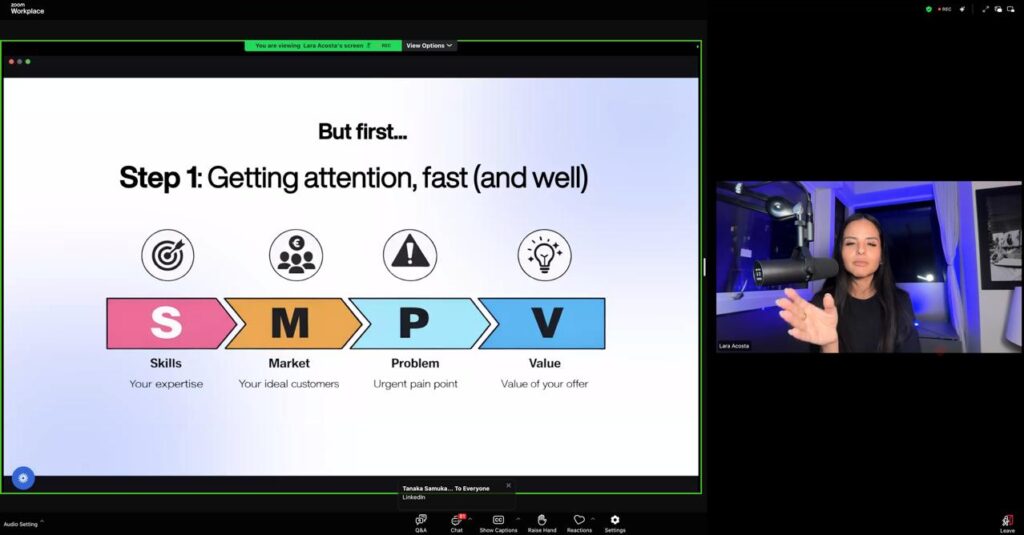
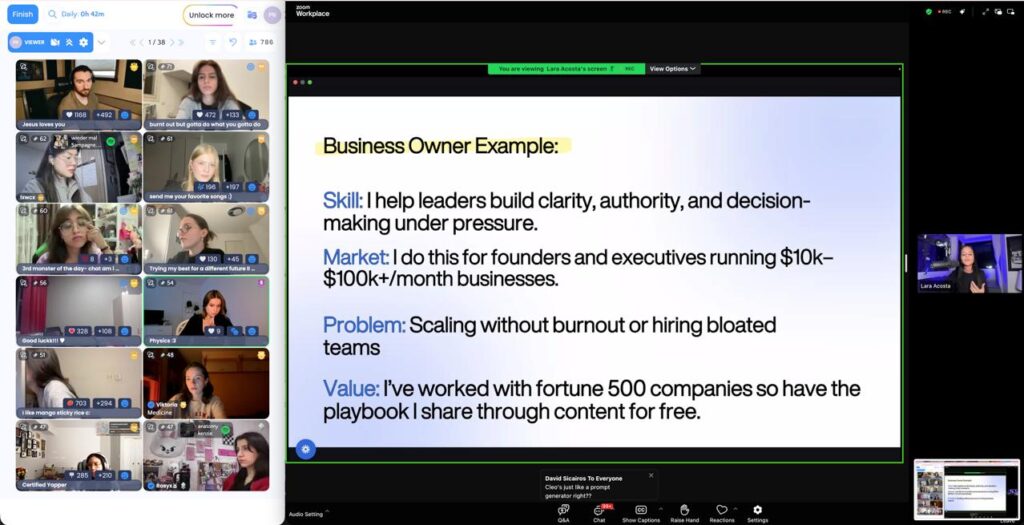
9) SMPV Framework (Positioning as an expert)

This is the framework she used to help people define their authority:

SMPV = Skill → Market → Problem → Value

She explained:

  • If you don’t know these clearly, you can’t write good content
  • Most people copy templates without clarity
  • Specificity creates authority

Lara’s own example:

  • Skill: Build online businesses through content
  • Market: Founders + business owners
  • Problem: Gain influence + authority organically (and make money)
  • Value: Step-by-step content showing how

Why this matters:

Once SMPV is clear:

  • Content ideas become easier
  • You stop staring at a blank page
  • AI becomes 10x more effective

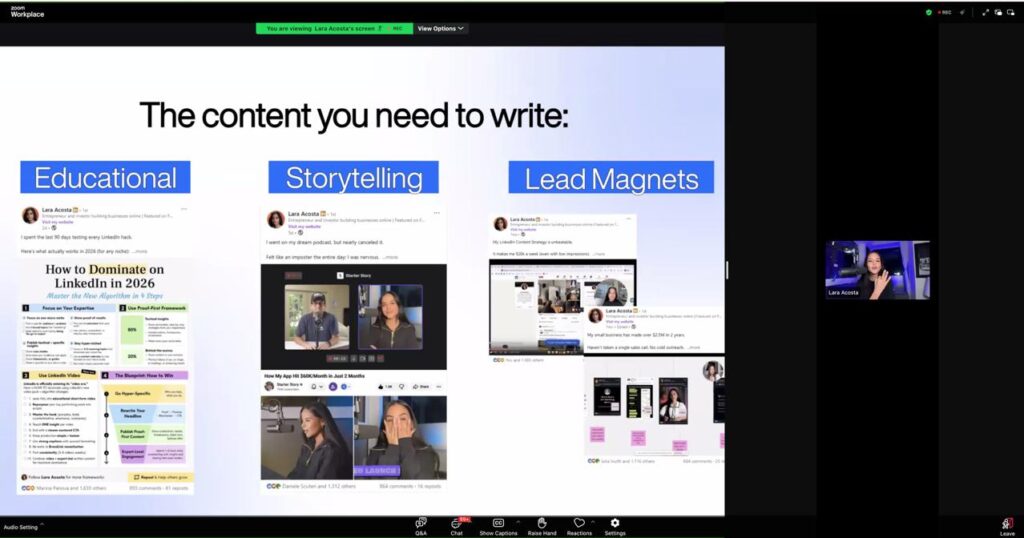
10) What “expert-led content” looks like now

She compared content styles:

What worked in 2025 (but is dying now):

What works now:

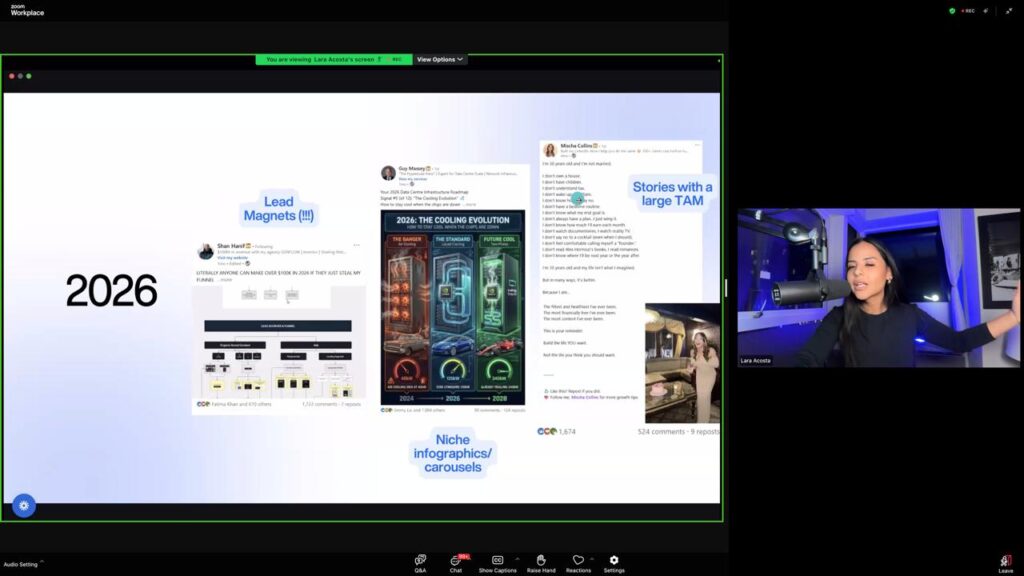
  1. Stories that relate to a large audience
    • Personal, but relevant
    • Clear lesson / insight
  2. Niche infographics / carousels
    • Specific expertise
    • Useful frameworks
    • Clear “this is what I do” content
  3. Lead magnets
    • The bridge between attention and customers

Key point:

Lead magnets are how you convert attention into paying clients.


11) The “Kleo” segment (Product demo + positioning)

Lara introduced Kleo 3.0 as the solution to the main pain:

The problem with content creation:

  • People try to create from scratch every time
  • It takes hours
  • That’s why people think content has no ROI

What Clio does:

  • Lets you select content you want to emulate
  • Uses built-in strategies/frameworks
  • Writes faster “like top creators”
  • Reduces the back-and-forth prompting with AI
  • Helps create:
    • educational content
    • storytelling content
    • niche posts
    • (and even graphics/infographics)

She emphasized:

  • It’s not just “ChatGPT”
  • It’s structured with frameworks + templates + strategies
12) Distribution in 2026 (how to get seen)

She explained distribution changed too.

What worked before:

What works now:

  • Engage 30–60 minutes/day
  • Leave thoughtful comments that start discussions
  • Network intentionally with high-value people
  • Use “halo effect” from achievements and credibility

Why engagement matters now:

LinkedIn pushes posts that create long discussions

That’s why you sometimes see “2-week old posts” resurfacing.


13) The “Halo Effect” strategy

She explained why she posts with big names / achievements:

  • It’s intentional positioning
  • Borrowed trust
  • Social proof by association

And she said:

Even small wins count:

  • first client
  • first viral post
  • first event
  • 10 followers

This makes you human + credible.

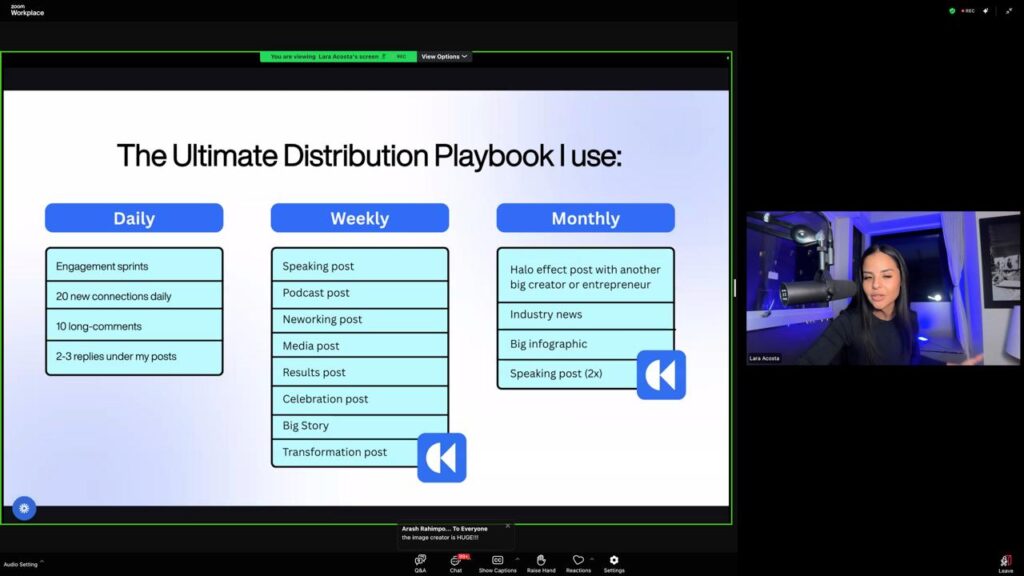
14) The Distribution Playbook (Daily / Weekly / Monthly)

She shared a “sprint” system:

Daily:

  • Engagement sprints
  • Add connections daily

Weekly:

  • Speaking/positioning post
  • Media post
  • Celebration post

Monthly:

  • Halo effect posts (events, collabs, network moments)

Core idea:

LinkedIn wants human + expert content.

15) Conversion: turning attention into clients

She explained modern conversion is easier if you do the first two steps.

Instead of:

  • hard selling
  • constant outbound
  • aggressive DMs

You do:

  1. Irresistible lead magnets
  2. Casual DM conversations
  3. Masterclass funnel

She even revealed her full funnel logic:

She said this strategy generated $2M+ for her business.


16) “EduSales” content approach (selling without being salesy)

She mentioned using the SLAY framework for content that:

  • educates
  • warms the audience
  • sells naturally

And she offered to audit profiles / write posts live.


17) Proof: Inbound sales screenshots + DM examples

She showed:

  • A launch screenshot (inbound revenue)
  • DM examples where people came inbound after lead magnets
  • She “asked permission to sell” instead of hard pitching

Key lesson:

If content builds trust, selling becomes frictionless.

18) The Offer: Kleo 3.0 packages + bonuses

She then transitioned into the offer:

Clio includes:

  • AI post generator
  • hooks + frameworks + swipe files
  • onboarding course
  • weekly live calls
  • community

Bonuses mentioned:

  • AI Power Pack (viral prompts + lead gen prompts)
  • 1:1 onboarding call (annual plan)
  • marketing team sessions (first 10)
  • priority support
  • early access features
  • 30-day risk guarantee (annual)

Pricing mentioned:

  • $99/month
  • $599/year (limited-time offer)

She positioned it against:

  • ghostwriters ($2K–$10K/month)

19) The Surprise: LinkedIn Content Review Marathon

She announced the comeback of:

LinkedIn Content Review Marathon

Meaning:

  • She + team will roast profiles
  • rewrite content
  • review funnels
  • give direct feedback
  • goes on for hours

Only for people who join live.


20) Closing + Live testimonials

Then Rob came in:

  • hyped up signups
  • shouted out names
  • confirmed annual perks

Then a customer testimonial started (Michelle Vaira):

  • loved speed of content creation
  • uploaded documents to train the system
  • tested the image generator

Finally: The Complete Masterclass in 1 Line

LinkedIn growth in 2026 = Expert positioning (SMPV) + intentional content + daily distribution + simple conversion systems — powered by AI (Kleo).

Follow us:

Your posts. Your brand. Fully automated.

I'll show how you can implement AI AGENTS to take over repetitive tasks.

Promoted by BULDRR AI

Lara Acosta Workshop – How to turn Content into Clients

Core message: LinkedIn growth is no longer about hacks or formats — it’s about expert-led content + distribution + conversion (powered by systems + AI)

Topic: How to grow on LinkedIn in 2026 + get inbound leads using AI content systems


1) The Opening: “You don’t need to be a pro writer”

Lara starts by clearing a major objection:

  • Content creation ≠ writing
  • Content is inherently easier than people think
  • You don’t need copywriting books
  • You need expertise + a system
  • AI can handle the heavy lifting (if used correctly)

Key idea:

You don’t win because you’re a “better writer.”

You win because you’re a clear expert who can communicate.


2) “LinkedIn is too saturated” is a myth

One of the first big myths she attacks:

People say:

Her counter:

Conclusion:

Competition is lower than you think.

The real advantage is simply being consistent + clear.

She also gave a proof example:

  • A client (Guy) started posting months ago
  • Now has ~50K followers
  • Goes viral in a “boring niche” (infrastructure)

Lesson:

Even “small niches” can win.

Actually, small niches can be easier.


3) AI doesn’t make you generic — bad usage does

She addresses another fear:

“If I use AI, my content will sound like AI slop.”

Her point:

  • If you use generic tools without strategy → yes, it will look like slop
  • Not because AI is bad
  • Because the tool doesn’t know your expertise or positioning

She gave an example:

  • A post written by Jake was 90% AI-generated
  • Still expert-led, valuable, and viral (2.5K likes)

Lesson:

AI is a multiplier.

If your input is weak → output is weak.

If your input is structured → output is powerful.


4) What this masterclass was NOT about

Lara made it clear she’s not doing:

  • Ferrari lifestyle marketing
  • Penthouse flexing
  • Selling a crazy expensive course at the end

Instead:

  • Systems that work across industries
  • Tried-and-tested frameworks

5) The “Old LinkedIn vs New LinkedIn” shift

She explains why people feel like LinkedIn got harder:

Old LinkedIn:

  • Viral fluff
  • Generic posts
  • Low depth content could still go viral Examples she referenced:
  • Random infographics with no meaning
  • “Crying CEO” style content
  • Trendy viral formats

New LinkedIn:

  • LinkedIn prioritizes expertise
  • Expert-led creators get rewarded
  • Positioning matters more than ever

Big takeaway:

LinkedIn now belongs to people who look like specialists.


6) Algorithm Myth-Busting (3 major myths)

She broke down common beliefs and corrected them:

Myth #1: “Carousels/infographics perform best”

Her answer:

  • There is no single winning format
  • Text-only posts can perform
  • Carousels can flop
  • What matters is: what you say + how you say it

She shared examples of:

  • Text-only posts doing great
  • Carousel-trend posts doing poorly

Rule: Don’t chase formats. Chase clarity + writing.


Myth #2: “Storytelling doesn’t get distribution”

Her answer:

  • Storytelling still works if done right
  • A storytelling post from Rob hit ~30K impressions + signups

Rule: Any format can work if you use the right hook + structure.


Myth #3: “Video is dead”

Her answer:

  • Video still works (especially for lead gen)
  • LinkedIn Lives + webinars build trust faster
  • With AI rising, trust matters more than ever

Why video works:

  • It proves you’re real
  • It proves you know your topic
  • It builds credibility at scale

7) The real content you should post in 2026

She clearly says it’s NOT:

  • Spray & pray content
  • Guru content
  • “Viral-only” content
  • “Carousel-only” content

It’s intentional content.

LinkedIn is rewarding:

  • Domain expertise
  • Consistent topics
  • Clear opinions
  • In-depth but concise writing

Important point:

You can’t jump between random topics anymore (food → family → business).

You need topic consistency.


8) The 3-part system for inbound leads

This was the main framework:

1) Content

Creates attention and trust.

2) Distribution

Ensures people actually see your content.

3) Sales / Conversion

Turns attention into leads and customers.

She called this the “3 levels of conversion and attention.”


9) SMPV Framework (Positioning as an expert)

This is the framework she used to help people define their authority:

SMPV = Skill → Market → Problem → Value

She explained:

  • If you don’t know these clearly, you can’t write good content
  • Most people copy templates without clarity
  • Specificity creates authority

Lara’s own example:

  • Skill: Build online businesses through content
  • Market: Founders + business owners
  • Problem: Gain influence + authority organically (and make money)
  • Value: Step-by-step content showing how

Why this matters:

Once SMPV is clear:

  • Content ideas become easier
  • You stop staring at a blank page
  • AI becomes 10x more effective

10) What “expert-led content” looks like now

She compared content styles:

What worked in 2025 (but is dying now):

What works now:

  1. Stories that relate to a large audience
    • Personal, but relevant
    • Clear lesson / insight
  2. Niche infographics / carousels
    • Specific expertise
    • Useful frameworks
    • Clear “this is what I do” content
  3. Lead magnets
    • The bridge between attention and customers

Key point:

Lead magnets are how you convert attention into paying clients.


11) The “Kleo” segment (Product demo + positioning)

Lara introduced Kleo 3.0 as the solution to the main pain:

The problem with content creation:

  • People try to create from scratch every time
  • It takes hours
  • That’s why people think content has no ROI

What Clio does:

  • Lets you select content you want to emulate
  • Uses built-in strategies/frameworks
  • Writes faster “like top creators”
  • Reduces the back-and-forth prompting with AI
  • Helps create:
    • educational content
    • storytelling content
    • niche posts
    • (and even graphics/infographics)

She emphasized:

  • It’s not just “ChatGPT”
  • It’s structured with frameworks + templates + strategies

12) Distribution in 2026 (how to get seen)

She explained distribution changed too.

What worked before:

What works now:

  • Engage 30–60 minutes/day
  • Leave thoughtful comments that start discussions
  • Network intentionally with high-value people
  • Use “halo effect” from achievements and credibility

Why engagement matters now:

LinkedIn pushes posts that create long discussions

That’s why you sometimes see “2-week old posts” resurfacing.


13) The “Halo Effect” strategy

She explained why she posts with big names / achievements:

  • It’s intentional positioning
  • Borrowed trust
  • Social proof by association

And she said:

Even small wins count:

  • first client
  • first viral post
  • first event
  • 10 followers

This makes you human + credible.


14) The Distribution Playbook (Daily / Weekly / Monthly)

She shared a “sprint” system:

Daily:

  • Engagement sprints
  • Add connections daily

Weekly:

  • Speaking/positioning post
  • Media post
  • Celebration post

Monthly:

  • Halo effect posts (events, collabs, network moments)

Core idea:

LinkedIn wants human + expert content.


15) Conversion: turning attention into clients

She explained modern conversion is easier if you do the first two steps.

Instead of:

  • hard selling
  • constant outbound
  • aggressive DMs

You do:

  1. Irresistible lead magnets
  2. Casual DM conversations
  3. Masterclass funnel

She even revealed her full funnel logic:

She said this strategy generated $2M+ for her business.


16) “EduSales” content approach (selling without being salesy)

She mentioned using the SLAY framework for content that:

  • educates
  • warms the audience
  • sells naturally

And she offered to audit profiles / write posts live.


17) Proof: Inbound sales screenshots + DM examples

She showed:

  • A launch screenshot (inbound revenue)
  • DM examples where people came inbound after lead magnets
  • She “asked permission to sell” instead of hard pitching

Key lesson:

If content builds trust, selling becomes frictionless.


18) The Offer: Kleo 3.0 packages + bonuses

She then transitioned into the offer:

Clio includes:

  • AI post generator
  • hooks + frameworks + swipe files
  • onboarding course
  • weekly live calls
  • community

Bonuses mentioned:

  • AI Power Pack (viral prompts + lead gen prompts)
  • 1:1 onboarding call (annual plan)
  • marketing team sessions (first 10)
  • priority support
  • early access features
  • 30-day risk guarantee (annual)

Pricing mentioned:

  • $99/month
  • $599/year (limited-time offer)

She positioned it against:

  • ghostwriters ($2K–$10K/month)

19) The Surprise: LinkedIn Content Review Marathon

She announced the comeback of:

LinkedIn Content Review Marathon

Meaning:

  • She + team will roast profiles
  • rewrite content
  • review funnels
  • give direct feedback
  • goes on for hours

Only for people who join live.


20) Closing + Live testimonials

Then Rob came in:

  • hyped up signups
  • shouted out names
  • confirmed annual perks

Then a customer testimonial started (Michelle Vaira):

  • loved speed of content creation
  • uploaded documents to train the system
  • tested the image generator

Finally: The Complete Masterclass in 1 Line

LinkedIn growth in 2026 = Expert positioning (SMPV) + intentional content + daily distribution + simple conversion systems — powered by AI (Kleo).

Follow us:

Promoted by BULDRR AI

Frequently Asked Questions

We share all our insights and resources for free, but building them isn’t cheap. Ads help us recover those costs so we can keep offering everything at no charge forever.

Yes, Ofcourse. Contact us and we’ll set it up. We also offer 100+ hours of free visibility to select brands.

No, nothing at all. In fact, many ads come with extra discounts for you.

Yes, sometimes. If you buy through our links, we may earn a small commission at no extra cost to you.