 Schedule a Call
Four AI giants launched a personal agent in seven weeks. Each one promises a worker that never sleeps, works on its own computer, and finishes jobs while you do something else.
But they are not the same worker. One is built for your business inbox, one for your personal errands, one is a whole team, and one lives inside ChatGPT.
Pick the wrong one and you pay for power you never use, or trust an agent with rules too loose for your work. This post compares all four on the things that decide that: the job, the safety rules, and who can actually get them.
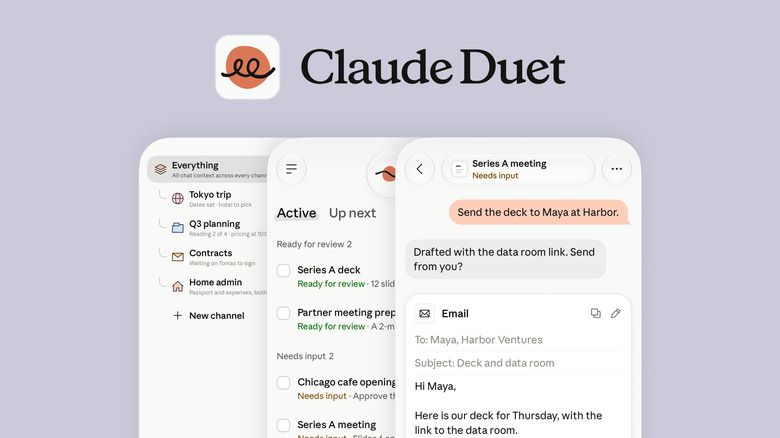
Claude Duet, the newest of the four. Image: Anthropic, via Engadget.
What you'll learn
- What each of the four agents is really built for.
- How their safety and approval rules differ.
- Who can get each one today, and where.
- The honest limits nobody puts in the launch video.
- Which one fits your business, by job, not by hype.
The short answer
- For business work with strict rules: Claude Duet.
- For personal errands, free to start: Meta Muse.
- For a team of agents that share work: GrokBot.
- For ongoing goals inside ChatGPT and Slack: OpenAI Dots.
Always on agent is an AI worker that keeps going between your messages, on its own cloud computer. All four work this way, so the real contest is focus and control, not the basic idea.
Meet the four agents
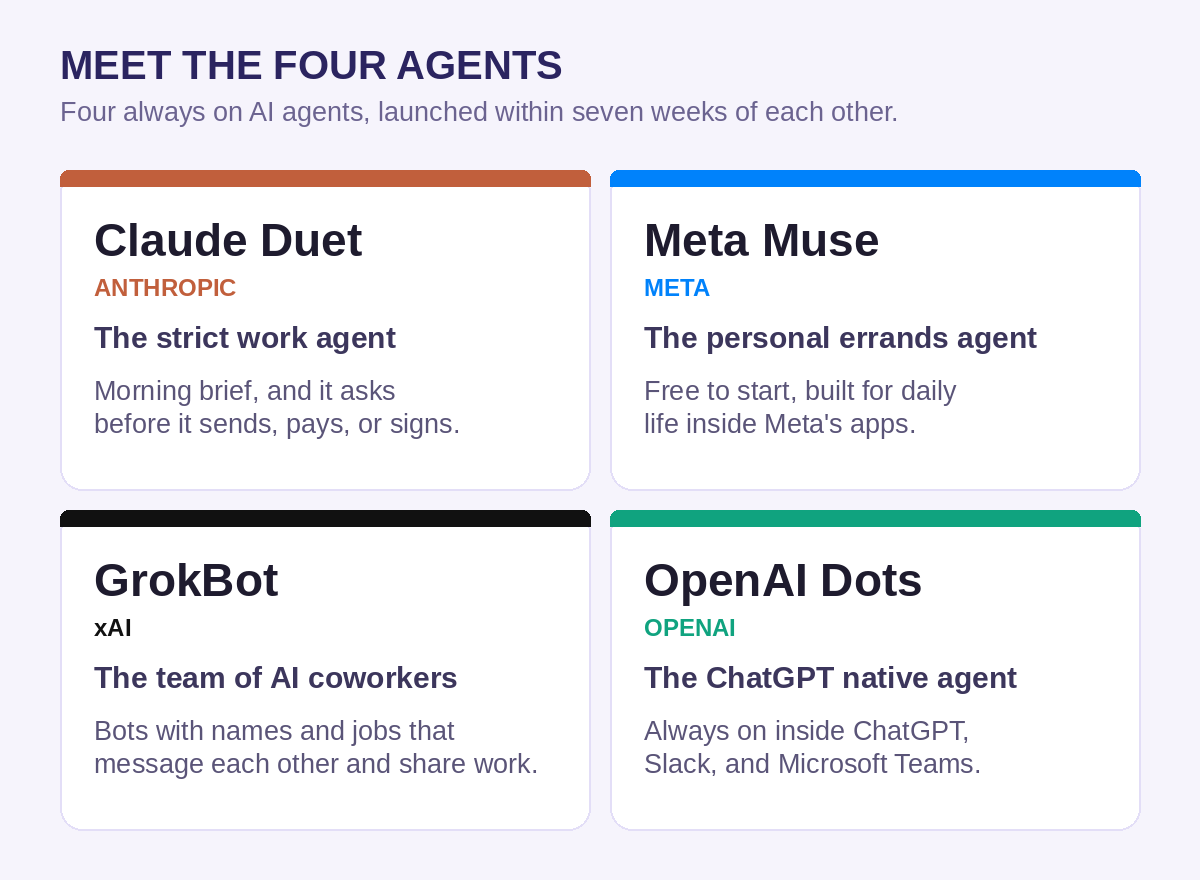
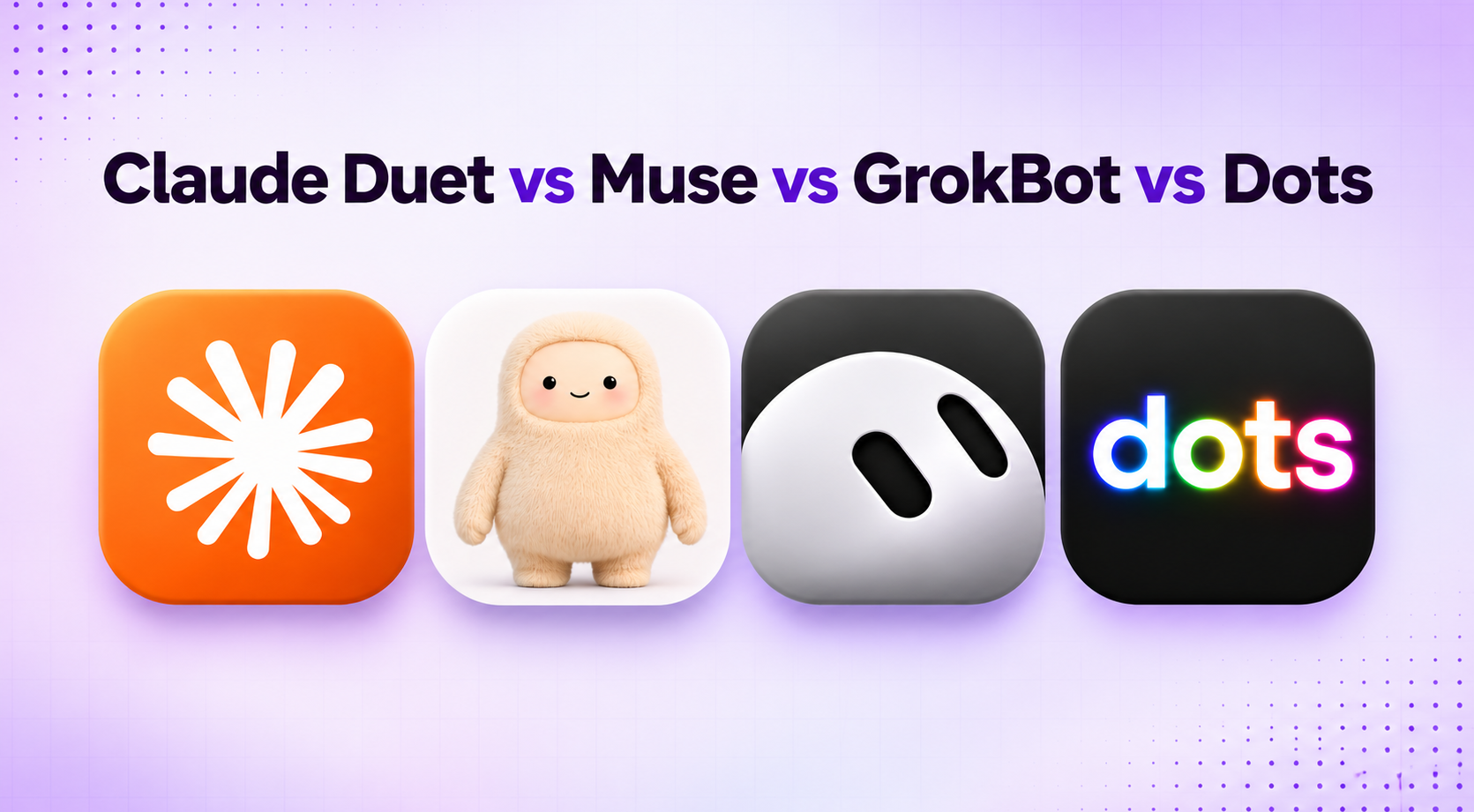
The four agents in this comparison, at a glance. Graphic: BULDRR AI.
#Agent1 Claude Duet, the strict work agent
Anthropic's Duet opened as a research preview on October 21, 2026, for US Pro and Max users on a waitlist. It sends a morning brief, checks your apps every few hours, and asks before it sends, pays, signs, or deletes.
Some actions are banned even with your approval, like trading securities or moving money between accounts. The full breakdown is in our Claude Duet guide and on the official Claude Duet page.
#Agent2 Meta Muse, the personal errands agent
Meta's Muse launched on September 8, 2026, free to start in the US and Canada. It books, shops, fills forms, and handles daily life from its app, muse.ai, and WhatsApp.
It runs on Muse Spark inside what Meta calls a Secure VM, and it asks before sensitive actions like sending an email or paying. Those details are collected in the Muse guide at AI Agents Library, checked against Meta's own documents.
People came fast: millions of downloads in the first two weeks, and about 1.8 million daily users by early October, per Sensor Tower figures reported by CryptoBriefing. We told Muse's comeback story in our post on Meta Muse and the market reaction.
#Agent3 GrokBot, the team of AI coworkers
xAI's GrokBot is not one assistant. It is a set of Bots, each with a name and a job, like Research, Sales, or Ops, and they message each other and pass work along.
The official Grok Bot documents say each Bot works on a persistent cloud computer with a browser, files, and a terminal. Show a Bot a job once and it saves the steps as a skill, then reruns it on a schedule.
Access comes bundled with paid Cursor plans and SuperGrok, not as a standalone product. In September 2026, xAI added enterprise audit logs and action recording, reported by AI Weekly from xAI's own announcement.
#Agent4 OpenAI Dots, the agent inside ChatGPT
OpenAI showed Dots at DevDay on September 29, 2026. A dot is an always on agent inside ChatGPT, with its own computer, its own memory, and a name and handle like a teammate.
You reach a dot in ChatGPT, Slack, or Microsoft Teams, or by voice, and it connects to more than 4,000 apps. The launch details are laid out in the Dots explainer at DigitalMatters.
Dots are for Pro and Business Premium users, and they skip the EEA, the UK, and Switzerland for now. We compared the first three before Duet existed in our Dots vs Muse vs GrokBot comparison.
Head to head: how they work day to day
Two designs stand out. Duet and Dots come to you first, which suits ongoing work you cannot watch all day.
GrokBot is the only true team, and the only one that learns by watching you work. Muse sits in the middle: one agent, personal jobs, the widest free reach.
Safety and control, compared honestly
Duet publishes the strictest written rules. Approvals are fixed, a few actions are banned fully, and a safety checker screens what it sends.
Dots give you Custom Rules and an auto review step for sensitive actions. OpenAI is also open that its protections do not fully stop prompt injection, as NeuralTrust's security review notes from OpenAI's own help pages.
Muse leans on its Secure VM and approvals before sensitive actions. Meta has not published banned action rules like Anthropic has.
GrokBot asks before sending, publishing, buying, or deleting, but an Always Allow setting can switch that gate off. And all Bots on one account share one computer and one set of logins, so one Bot's access is every Bot's access.
For companies, GrokBot's enterprise audit logs are the most developed control today. Duet has no Team or Enterprise plan yet, and Dots for companies is a beta that admins must switch on.
The honest limits of each
- Duet: still a preview. It can misjudge urgency, cannot show you its browser yet, and Microsoft 365 is not connected.
- Muse: built for personal life first. Some big stores block it, Amazon among them, and business controls are thin.
- GrokBot: no standalone access, shared logins across Bots, and long unattended runs are still lightly tested.
- Dots: paid plans only, big regions excluded, and you cannot inspect or edit what a dot remembers.
One shared limit matters most: disconnecting an app stops new access, but what the agent already learned can stay in its memory. Read the delete rules before you connect anything sensitive.
Which one should your business pick?
Match the agent to the job, not the launch video. If your day is inbox, invoices, and follow ups, Duet's brief and strict approvals fit best, once you can get in.
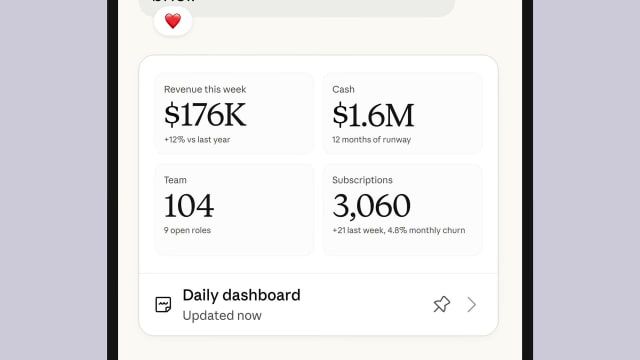
A daily dashboard Duet built in Anthropic's launch demo. Image: Anthropic, via iClarified.
If your team already lives in ChatGPT, Slack, and Teams, Dots meets you there. If you want several jobs running in parallel, like sales, support, and research, GrokBot's team design is the only real fit today.
Muse is the easy free test of the whole idea, for personal tasks. And if none of them fit yet, the pattern still works without them: our plain guide to building effective AI agents shows the same brief, check, and approve loop.
You can also start from free ready made automation workflows today, with no waitlist at all.
Watch: the first three agents, head to head
Before Duet arrived, this breakdown of Muse, GrokBot, and Dots went viral. It is still the fastest way to see how the first three actually work:
Quick Recap
- Duet is the strict work agent, Muse the personal one, GrokBot the team, Dots the ChatGPT native.
- All four run on their own cloud computers and keep working between your messages.
- Their approval rules differ more than their features. That gap is the real buying decision.
- Access is narrow today: waitlists, paid plans, and region limits everywhere.
What Should You Do Next
Here is one tiny step. Write down the one job you would hand an agent first, and the rule it must never break.
Then check the four against that single job. The right pick usually becomes obvious in five minutes.
Common Questions
- What is the main difference between Claude Duet, Muse, GrokBot, and Dots?
- Focus. Duet is a strict work agent, Muse is a personal errands agent, GrokBot is a team of agents that share work, and Dots are always on agents that live inside ChatGPT.
- Which AI agent is best for a small business?
- For inbox and invoice style work, Duet fits best once you get access. Teams already in ChatGPT and Slack should start with Dots, and parallel jobs across sales and support point to GrokBot.
- Which of these four agents is free?
- Meta Muse is free to start, with paid tiers for heavier use. Duet, Dots, and GrokBot all sit inside paid plans.
- Can these agents spend money without asking?
- They are built to ask first. Duet states this as a fixed rule, while GrokBot has an Always Allow setting that can switch its approval gate off, so check that setting before real use.
- Which agents work inside Slack or Teams?
- Dots work in ChatGPT, Slack, and Microsoft Teams. GrokBot also has a Slack team mode, while Duet and Muse live in their own apps.
- Is Claude Duet available outside the US?
- Not yet. Duet is a waitlist preview for US Pro and Max users, and Anthropic has shared no date for other countries.
Four agents, four different bets on the same future. The winner for your business is the one whose rules you can trust with your real work.
Talk to BULDRR AI. We set up AI agents and automations that do real work for your business, with approvals where they matter.
Each button opens the assistant with the prompt already written, asking it to teach this article step by step, in simple words.
 ChatGPT
 Claude
 Grok
 Perplexity
 Add as a preferred source