 Schedule a Call

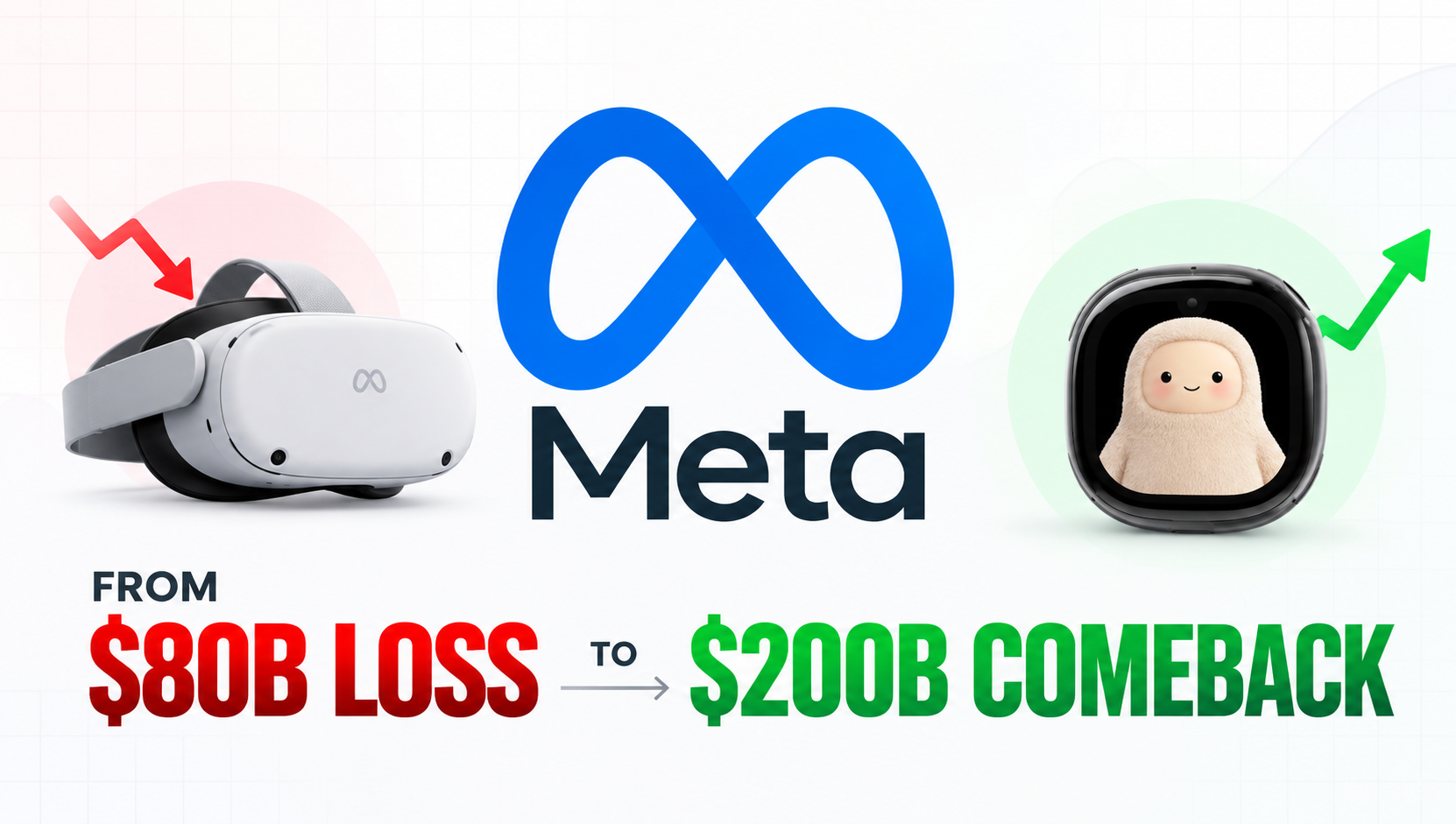
In September 2026, an Instagram carousel from @artificialIntelligence — a 1.5-million-follower AI page — told the most dramatic turnaround story in tech right now: Meta lost more than $80 billion chasing the metaverse, then bet $14.3 billion on a 29-year-old dropout. His AI agent added $200 billion in market value in about three weeks.
The carousel is fun and worth your two minutes: see the original post. But carousels skip the proof.
So I checked every claim against earnings reports, market data, and Wall Street notes. Here is what is true — and what it means for your business.
The $80 Billion Hole
Start with the bonfire: Meta's Reality Labs division — the team behind Quest headsets and Ray-Ban smart glasses — is the most expensive side project in corporate history. Here are the yearly losses, straight from Meta's earnings reports:
Look at the 2025 row: $19.2 billion lost on just $2.2 billion of revenue — about nine dollars burned for every dollar earned. Meta has since cut around 1,500 Reality Labs jobs and moved what is left toward AI wearables, as CFO Susan Li confirmed on the Q4 2025 earnings call (Motley Fool).
The $14.3 Billion Hire
By 2025, Meta had a second problem — it was falling behind in AI, with Llama 4 facing heavy criticism and rivals shipping faster. Zuckerberg's answer: in June 2025, Meta put $14.3 billion into Scale AI for a 49% stake, and the real prize of the deal wasn't the equity — it was the founder (Reuters via Business Times).
- Dropped out of MIT at 19 and co-founded Scale AI with Lucy Guo in 2016. He saw early that AI's real problem was labeled training data.
- Built Scale into the data backbone for OpenAI, Microsoft, Meta, and the US Department of Defense. Became the world's youngest self-made billionaire at 24.
- Joined Meta at 28 to lead the new Meta Superintelligence Labs. Now 29, he is Meta's first Gen Z senior executive and Chief AI Officer.
- Forbes put his net worth at $3.2 billion as of October 2025 (VnExpress).
Zuckerberg also went on a hiring spree, pulling 50+ researchers from rivals with pay packages rumored to touch nine figures. At the time, people called the $14.3 billion reckless — nobody says that now.
Enter Muse
Muse is Meta's personal AI agent, launched September 8, 2026. It doesn't just chat — it does things for you inside its own secure virtual machine: sending emails, booking travel, shopping online, filling forms. It's free with limits, with paid plans at $20 and $100 a month, and it launched in the US and Canada (what is Muse, explained).
This is what woke up Wall Street: Shopify opened its full catalog to Muse, Expedia and PayPal joined as launch partners — and Amazon blocked Muse outright, citing privacy and security. Meta keeps the app free and takes a small cut of every deal the agent closes (Motley Fool on agentic commerce).
X Went Feral
Wang didn't market like a corporate executive. He posted 300+ times on X — memes, customer stories, jabs at rivals — like a founder with a meme account. And the internet gave it right back:
That post blew up. Then Wang himself jumped into the replies to settle the great fashion debate of September 2026:
That exchange says it all: a billionaire AI chief in camo Crocs doing meme customer support. Meta's old launches were press releases — this one was a group chat (DNYUZ on the camo Crocs saga).
The $200 Billion Verdict
On September 21, Meta shares jumped 11.3% in one day — the biggest single-day gain since April 2025 — adding roughly $192 billion in market value. Since the Muse launch, the stock is up over 20% (more than $200 billion), with JPMorgan calling Muse potentially “the most widely used consumer AI app since ChatGPT” (WebProNews, NDTV Profit).
What This Means for Your Business
Forget the memes and the market cap for a second. The real signal: the chatbot era is ending, and the agent era is starting.
People don't want another text box — they want software that does the thing. And every business with repetitive work is now asking which jobs an agent could just handle.
- If you run support, sales follow-up, or scheduling on human repetition, an AI agent wired into your tools is no longer an experiment — it is what Meta just proved at scale.
- Start with one workflow, not a full rebuild. The pattern that works: AI agents compared with clear guardrails, human approval on sensitive steps, and real tool access.
- We build exactly this at BULDRR AI — n8n AI-agent workflows for your inbox, calendar, and CRM, including support agents that resolve tickets instead of just drafting replies.
Frequently Asked Questions
- How much did Meta lose on the metaverse?
- Meta's Reality Labs lost $19.2 billion in 2025 on $2.2 billion of revenue — over $85 billion in total since the end of 2020, as per Meta's earnings reports. Meta has since cut about 1,500 Reality Labs jobs and shifted the division toward AI wearables.
- What is Muse by Meta?
- Muse is Meta's personal AI agent, launched September 8, 2026 in the US and Canada. It completes multi-step tasks — emails, travel, shopping — inside its own secure virtual machine, free with limits and paid plans at $20 and $100 a month.
- Who is Alexandr Wang?
- Alexandr Wang, 29, is Meta's Chief AI Officer and head of Meta Superintelligence Labs. He dropped out of MIT at 19, co-founded Scale AI in 2016, became the world's youngest self-made billionaire at 24, and joined Meta in June 2025 through the $14.3 billion Scale AI deal.
- How fast did Muse grow compared to ChatGPT?
- Muse hit 2.8 million downloads in its first 12 days in the US and Canada, versus 1.3 million for ChatGPT over a similar period, as per Apptopia and Sensor Tower data. On iOS alone in those markets, it was 1.8 million versus 1.3 million.
Want an AI agent working inside your business the way Muse works for consumers? Talk to BULDRR AI — we design AI agents and automations that do the work, not just chat about it.
Each button opens the assistant with the prompt already written, asking it to teach this article step by step, in simple words.
 ChatGPT
 Claude
 Grok
Grok Perplexity
 Add as a preferred source