 Schedule a Call
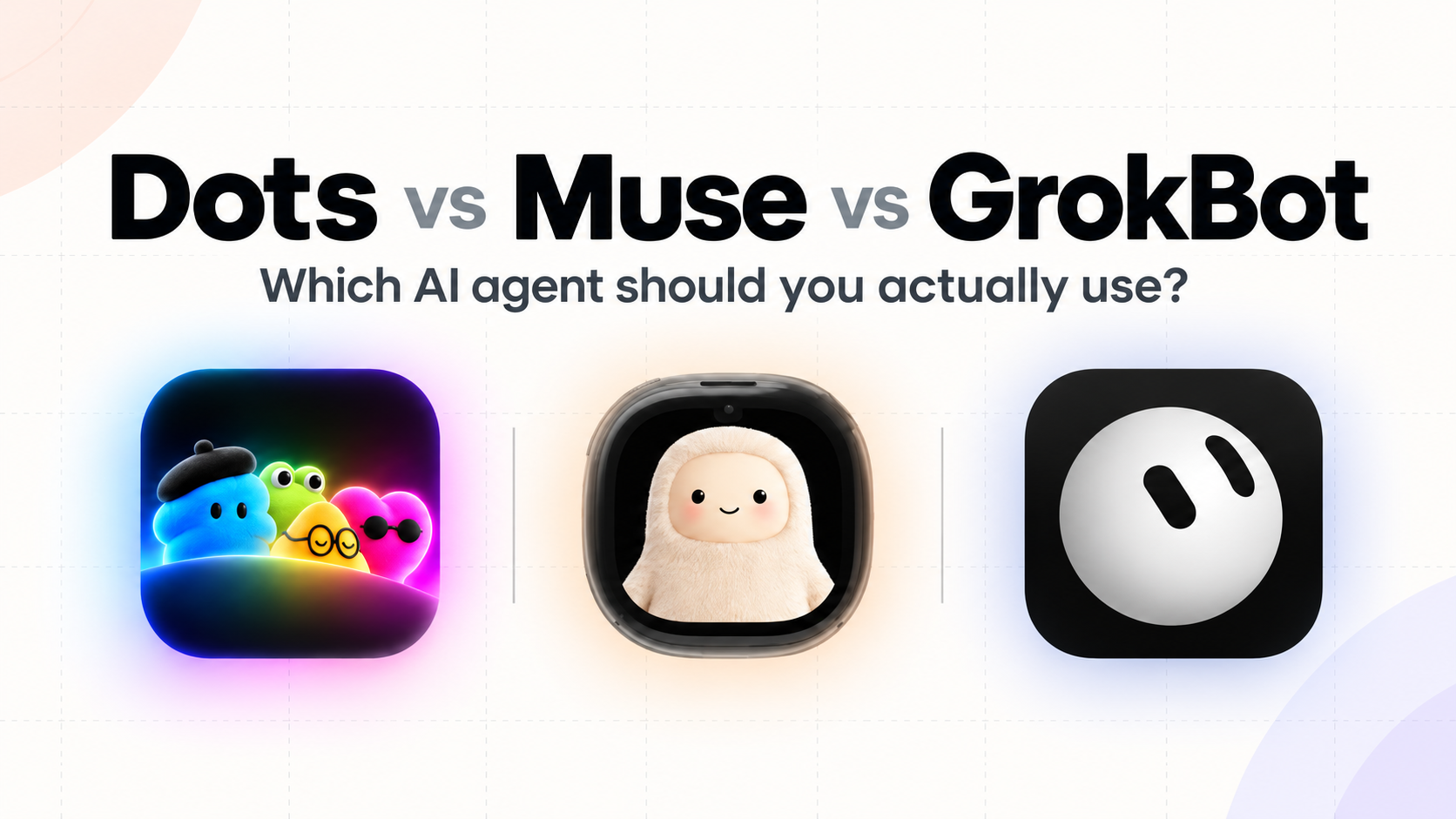
They all look the same — a friendly AI that does things for you — but they're not. In five weeks, OpenAI, Meta, and xAI each launched an AI agent, each built for a completely different job at a completely different price, and we dug into all three to see where each one truly wins (and what it costs you to pick wrong).
Dots: like hiring a $100/month employee
Sam Altman unveiled Dots at DevDay on September 29, 2026 — always-on agents that live inside ChatGPT, each with its own cloud computer and browser, remembering your preferences and working on your goals even after you close the tab. OpenAI's pitch is simple: it's like hiring a new employee — delegate work ‘the way you would to a high agency engineer or a chief of staff.’ (AI Weekly)
- Price: your first dot is included in ChatGPT Pro ($100, $200, or $500/mo) or Business Premium ($100–$125/seat). Free, Go, and Plus plans are excluded — and it's not available in the EEA, UK, or Switzerland at launch.
- Reach: ChatGPT, voice, Slack, and Microsoft Teams.
- Integrations: 4,000+ apps.
- Limits: up to 15 active tasks per Pro user, 30 runs/hour, 720/day. Chats with your dot don't count against ChatGPT limits, but tasks it runs in Work or Codex do.
- Safety: Custom Rules, an auto-review step for sensitive actions, and read-only background research. (findskill.ai; eesel.ai)
Muse: the free one for your personal life
Meta's Muse launched September 8, 2026 — the consumer play, and it's free to start. It's made for everyday personal tasks (bookings, shopping, forms, reminders), hit 2.8 million downloads in 12 days, and helped push Meta's market cap up roughly $200 billion — currently US and Canada only, with paid tiers reportedly at $20 and $100 a month. (WebProNews)
GrokBot: a $30 team that never sleeps
xAI's GrokBot entered early beta on August 11, 2026 — a ‘team of AI coworkers’ instead of one assistant. You build bots with different roles (Research, Sales, Ops) that share one computer and pass work between them — it runs on Grok 4.6 and comes with SuperGrok ($30/mo), Cursor Pro ($20/mo), or Teams ($40/seat), with weekly usage included and heavy use billed extra. (x.ai/bot)
The real-world numbers are hard to ignore: SpaceXAI put GrokBot on its own customer support and absorbed a 175% jump in tickets without hiring anyone new — cost per solved ticket fell to $0.20–$0.30. Even Musk admits Grok Bot usage is ‘growing faster than anything we've ever seen.’ (TeslaNorth)
One catch analysts keep flagging: the $30 price is a loss-leader. Every user gets a cloud computer costing at least $71 to host — xAI is betting its giant data centers and falling token costs make the math work. (Forkast)
The three, side by side
So… who actually wins?
Here's the honest truth — there is no ‘best’ agent here, because they aren't fighting for the same job:
- Drowning in ongoing work? Pick Dots. It's the only one built as a persistent worker inside ChatGPT, Slack, and Teams — if the $100/mo Pro price doesn't scare you.
- Want help with personal life stuff? Pick Muse. It's free, made for everyday tasks, and the only one that isn't trying to be your coworker.
- Need a team of AI workers? Pick GrokBot. Multiple bots, shared memory, scheduled routines — at $30/mo it's a third of Dots' price, with the best real-world cost story so far.
Our honest advice: match the agent to the job, not the hype. A $100/mo dot won't handle your packing list better than a free Muse — and a personal assistant can't run your support queue at $0.20 a ticket.
What the internet thinks
Don't just take our word for it. This breakdown of the three agents went viral — and this video walks through what each one actually does and costs:
What this means for your business
Here's what actually matters: every agent is becoming the same thing — its own computer, its own memory, working 24/7. So don't ask which demo looks coolest — ask which one plugs into your real work (inbox, CRM, calendar) without a six-month integration nightmare.
- Before you pick, browse our 10,000+ free automation workflows — the library where these agents do real work.
- For the hands-on path, see our complete n8n AI agents workflow guide.
- And if support automation is the goal, start with automated customer support escalation.
Frequently Asked Questions
- What is the difference between Dots, Muse, and GrokBot?
- Dots (OpenAI) is an always-on worker for ongoing work goals inside ChatGPT, starting at $100/mo. Muse (Meta) is a free consumer agent for everyday personal tasks; GrokBot (xAI) is a team of persistent AI coworker bots for $30/mo, built for recurring operational work.
- How much do OpenAI Dots cost?
- Your first dot is included with ChatGPT Pro ($100, $200, or $500/mo) or Business Premium ($100–$125/seat). Free, Go, and Plus plans are excluded, and the launch excludes the EEA, UK, and Switzerland.
- Is Meta Muse free?
- Yes — Muse is free to start within usage limits, with paid tiers reportedly at $20 and $100 a month. It is currently available in the US and Canada.
- How much does GrokBot cost?
- GrokBot is included with SuperGrok ($30/mo), Cursor Pro ($20/mo), and Teams ($40/seat). Weekly usage is included, with additional usage billed based on token cost.
- Which AI agent should a small business pick?
- Match the agent to the job: Dots for ongoing work projects inside ChatGPT/Slack/Teams, Muse for personal everyday tasks, and GrokBot for teams of persistent workers handling recurring operational work like support or sales follow-up.
Still confused about which agent fits your work? Talk to BULDRR AI — we wire AI agents into your real operations (inbox, CRM, calendar, support) so the agent works for your business, not the other way around.
Ai · AI Automation · OpenAI Dots · GrokBot · AI Agents
Each button opens the assistant with the prompt already written, asking it to teach this article step by step, in simple words.
 ChatGPT
 Claude
 Grok
Grok Perplexity
 Add as a preferred source