Why Pay $20/month, When you can Self Host n8n @ $3.99 only

50+ InMails. Advanced Lead search. First 2 Users only

Promoted by BULDRR AI

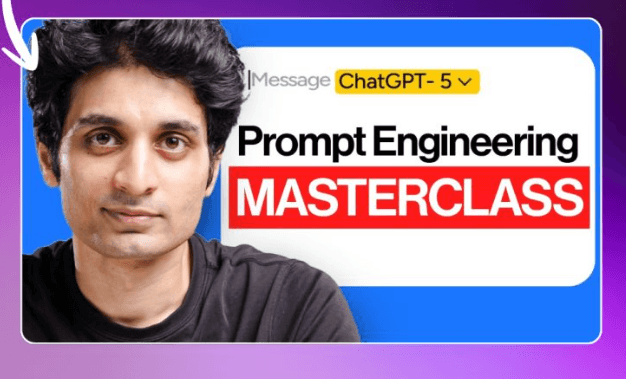
A Practical Guide to Prompting AI

Core Idea (Don’t Skip This)

Prompting is not typing commands.

Prompting is thinking clearly and building context.

The difference between people who get magic from AI and people who get garbage is how well they explain the world they want AI to operate in.

That’s it.

Everything below expands on this.


1. Prompt Engineering ≈ Management Skill

People who are good at prompting are usually:

  • Good communicators
  • Good managers
  • Clear thinkers

Why?

Because prompting is delegation.

You’re not “asking a machine” —

you’re briefing an extremely fast intern.

If your brief is vague, the output will be generic.


2. World Building Is 99% of Prompting

The Dune / Sandworm Example

Instead of saying:

“Give me a giant creature”

The transcript shows this approach:

  • Dry world
  • Everything made of sand
  • Moisture is dangerous
  • People wear moisture-absorbing suits
  • Warring clans fighting over resources

Now ask:

“If this world has giant creatures, what would they be?”

Your brain fills in sandworms.

AI does the same thing.

Key Rule

AI fills gaps using its training.

If you:

  • Give many puzzle pieces → unique output
  • Give few puzzle pieces → generic output

📌 Your job is world building, not AI’s.


3. Why Most AI Content Looks the Same

Because most prompts look like this:

  • “Give me 5 ideas”
  • “Write a script”
  • “Explain this”

No world.

No constraints.

No references.

AI defaults to the most generic world possible.


4. The Best Way to Build a World: Examples

The transcript emphasizes this strongly.

Instead of abstract rules, give examples.

This is how system prompts work internally:

  • “If user asks X → do Y”
  • “If user asks Z → refuse politely”

This is verbal if-else logic, not code.

Why Examples Work

  • They anchor behavior
  • They reduce hallucination
  • They define boundaries clearly

This is why system prompts make or break AI products.


5. Deep Research Prompting (Very Important)

Bad Prompt

“Summarize this book”

Result: Generic soup of facts.

Correct Prompt (From Transcript)

When using deep research:

  1. Summarize the book
  2. Extract red-pill insights (things most people don’t believe)
  3. Give actionable evidence

Extra instruction used:

“Give insights the world generally disagrees with, but the book argues for.”

This is how you force non-obvious output.


6. Breaking Down Costs & Complex Claims

AI is powerful for cost deconstruction.

Transcript example:

  • Someone says: “AAA games cost $100M”

Prompt AI to:

  • Break down development vs marketing
  • Break down salaries role-by-role
  • Compare US vs India costs
  • Calculate realistic alternatives

This reveals:

  • Assumptions people repeat without understanding
  • Hidden leverage points others miss

📌 AI helps you see possibilities others ignore.


7. Meta-Prompting (AI Helps You Write Prompts)

If you don’t know how to prompt:

Do THIS instead:

  • Explain your idea casually to AI
  • Then say:

“Now convert this into a prompt for a diffusion model / GPT / tool.”

AI understands:

  • What parts matter
  • What parts are noise

This is especially useful for:

  • Image generation
  • Complex specs
  • Long workflows

8. Prompting AI to Design Like Stripe

Bad prompt:

“Make a page like Stripe”

Correct method from transcript:

  1. Ask AI to break Stripe’s page into components
  2. Ask for modifiable elements
  3. Ask for exact specifications
    • Colors
    • Gradients
    • Layout logic
    • Spacing
    • Typography

This turns vague taste into concrete control.


9. Personas & Teaching Modes

Instead of:

“Explain this simply”

Use personas:

  • “Act as a teacher”
  • “Teach me like I’m 5”
  • “Teach me like a first-year student”
  • “Teach me like a graduate student”

Transcript example:

  • Faraday’s Law explained in three modes
  • From intuition → formulas → deep theory

📌 Understanding = zooming in layers, not one explanation.


10. Study Mode & Knowledge Retention

Mentioned directly:

  • Use study modes that quiz you
  • Check understanding at every step
  • Force active recall

This is better than textbooks, because:

  • You can say “make it dumber”
  • Then say “make it deeper”

11. Gap Finder Prompt (Extremely Powerful)

Prompt used regularly:

“Based on what you know about me, what are the gaps in my knowledge?”

Why this works:

  • Humans hate being criticized
  • AI is a safe mirror

Transcript example:

  • Immune system understanding revealed as simplistic
  • Exposed missing layers (cells, cytokines, regulation)

This prompt helps with:

  • Career growth
  • Leadership
  • Learning paths
  • Blind spots

12. Ask AI What You Should Learn Next

Exact idea from transcript:

“Based on what you know about me, what should I learn next?”

Result:

  • AI suggests new intellectual paths
  • Leads to books from different eras
  • Expands worldview

AI isn’t replacing learning —

it’s curating better learning paths.


13. Confidence Scores to Reduce Hallucination

Important prompt technique:

  • Ask AI to:
    • Answer only if confident
    • Provide a confidence score

If confidence < 90%:

  • Treat answer cautiously

Why this matters:

  • Models try to please you
  • They sound confident even when wrong

Confidence scoring exposes uncertainty.


14. Voice Prompting for Lazy Typers

If you can’t type long prompts:

Do this:

  • Use voice input
  • Speak freely for minutes
  • Let AI convert it into text

This massively improves:

  • World building
  • Context richness
  • Output quality

⚠️ Not live conversation.

Use voice → text → prompt.


15. Removing “AI-Sounding” Writing

AI giveaway patterns:

  • “X isn’t just Y”
  • “X goes beyond Y”
  • Over-balanced negations

Fix:

  • Use direct affirmative sentences
  • Vary structure
  • Mix multiple writing styles

Advanced method:

  • Feed AI your pre-AI writing
  • Ask it to write in your voice
  • Combine with removal of generic AI phrases

16. Mixing Styles Instead of Copying One

Instead of:

“Write like Paul Graham”

Use:

“Write like Paul Graham + X + Y”

This avoids imitation and creates hybrid originality.


17. Ask AI What You’re Missing Regularly

Weekly prompt from transcript:

“What am I missing in my reasoning?”

This helps you:

  • Spot flawed assumptions
  • Improve thinking quality
  • Become harder to fool

18. Emotional Prompting (Dark but Effective)

Research shows:

  • Emotional language increases accuracy
  • “Take a deep breath”
  • “Think carefully”

Why?

  • LLMs inherit patterns from human writing
  • Emotion correlates with deeper reasoning

Used carefully, this:

  • Reduces hallucination
  • Improves math & logic accuracy

19. Local Models & Unlimited Learning (Students)

Key idea:

  • You don’t need paid subscriptions
  • Buy a good laptop once
  • Run open-source models locally

Benefits:

  • No token limits
  • Unlimited experimentation
  • Learn without fear

Final Takeaway

AI is not about:

  • Getting work done faster

AI is about:

  • Understanding yourself better
  • Finding gaps in your thinking
  • Learning what to learn next

Good prompts don’t make AI smarter.

They make YOU clearer.


Follow,

VIKASH KUMAR on linkedin, for more useful tips like this.

Learn how to Build this Workflow with AI:

Follow us:

There’s no automation you can’t learn to build with BULDRR AI.

I'll show how you can implement AI AGENTS to take over repetitive tasks.

Promoted by BULDRR AI

A Practical Guide to Prompting AI

Core Idea (Don’t Skip This)

Prompting is not typing commands.

Prompting is thinking clearly and building context.

The difference between people who get magic from AI and people who get garbage is how well they explain the world they want AI to operate in.

That’s it.

Everything below expands on this.


1. Prompt Engineering ≈ Management Skill

People who are good at prompting are usually:

  • Good communicators
  • Good managers
  • Clear thinkers

Why?

Because prompting is delegation.

You’re not “asking a machine” —

you’re briefing an extremely fast intern.

If your brief is vague, the output will be generic.


2. World Building Is 99% of Prompting

The Dune / Sandworm Example

Instead of saying:

“Give me a giant creature”

The transcript shows this approach:

  • Dry world
  • Everything made of sand
  • Moisture is dangerous
  • People wear moisture-absorbing suits
  • Warring clans fighting over resources

Now ask:

“If this world has giant creatures, what would they be?”

Your brain fills in sandworms.

AI does the same thing.

Key Rule

AI fills gaps using its training.

If you:

  • Give many puzzle pieces → unique output
  • Give few puzzle pieces → generic output

📌 Your job is world building, not AI’s.


3. Why Most AI Content Looks the Same

Because most prompts look like this:

  • “Give me 5 ideas”
  • “Write a script”
  • “Explain this”

No world.

No constraints.

No references.

AI defaults to the most generic world possible.


4. The Best Way to Build a World: Examples

The transcript emphasizes this strongly.

Instead of abstract rules, give examples.

This is how system prompts work internally:

  • “If user asks X → do Y”
  • “If user asks Z → refuse politely”

This is verbal if-else logic, not code.

Why Examples Work

  • They anchor behavior
  • They reduce hallucination
  • They define boundaries clearly

This is why system prompts make or break AI products.


5. Deep Research Prompting (Very Important)

Bad Prompt

“Summarize this book”

Result: Generic soup of facts.

Correct Prompt (From Transcript)

When using deep research:

  1. Summarize the book
  2. Extract red-pill insights (things most people don’t believe)
  3. Give actionable evidence

Extra instruction used:

“Give insights the world generally disagrees with, but the book argues for.”

This is how you force non-obvious output.


6. Breaking Down Costs & Complex Claims

AI is powerful for cost deconstruction.

Transcript example:

  • Someone says: “AAA games cost $100M”

Prompt AI to:

  • Break down development vs marketing
  • Break down salaries role-by-role
  • Compare US vs India costs
  • Calculate realistic alternatives

This reveals:

  • Assumptions people repeat without understanding
  • Hidden leverage points others miss

📌 AI helps you see possibilities others ignore.


7. Meta-Prompting (AI Helps You Write Prompts)

If you don’t know how to prompt:

Do THIS instead:

  • Explain your idea casually to AI
  • Then say:

“Now convert this into a prompt for a diffusion model / GPT / tool.”

AI understands:

  • What parts matter
  • What parts are noise

This is especially useful for:

  • Image generation
  • Complex specs
  • Long workflows

8. Prompting AI to Design Like Stripe

Bad prompt:

“Make a page like Stripe”

Correct method from transcript:

  1. Ask AI to break Stripe’s page into components
  2. Ask for modifiable elements
  3. Ask for exact specifications
    • Colors
    • Gradients
    • Layout logic
    • Spacing
    • Typography

This turns vague taste into concrete control.


9. Personas & Teaching Modes

Instead of:

“Explain this simply”

Use personas:

  • “Act as a teacher”
  • “Teach me like I’m 5”
  • “Teach me like a first-year student”
  • “Teach me like a graduate student”

Transcript example:

  • Faraday’s Law explained in three modes
  • From intuition → formulas → deep theory

📌 Understanding = zooming in layers, not one explanation.


10. Study Mode & Knowledge Retention

Mentioned directly:

  • Use study modes that quiz you
  • Check understanding at every step
  • Force active recall

This is better than textbooks, because:

  • You can say “make it dumber”
  • Then say “make it deeper”

11. Gap Finder Prompt (Extremely Powerful)

Prompt used regularly:

“Based on what you know about me, what are the gaps in my knowledge?”

Why this works:

  • Humans hate being criticized
  • AI is a safe mirror

Transcript example:

  • Immune system understanding revealed as simplistic
  • Exposed missing layers (cells, cytokines, regulation)

This prompt helps with:

  • Career growth
  • Leadership
  • Learning paths
  • Blind spots

12. Ask AI What You Should Learn Next

Exact idea from transcript:

“Based on what you know about me, what should I learn next?”

Result:

  • AI suggests new intellectual paths
  • Leads to books from different eras
  • Expands worldview

AI isn’t replacing learning —

it’s curating better learning paths.


13. Confidence Scores to Reduce Hallucination

Important prompt technique:

  • Ask AI to:
    • Answer only if confident
    • Provide a confidence score

If confidence < 90%:

  • Treat answer cautiously

Why this matters:

  • Models try to please you
  • They sound confident even when wrong

Confidence scoring exposes uncertainty.


14. Voice Prompting for Lazy Typers

If you can’t type long prompts:

Do this:

  • Use voice input
  • Speak freely for minutes
  • Let AI convert it into text

This massively improves:

  • World building
  • Context richness
  • Output quality

⚠️ Not live conversation.

Use voice → text → prompt.


15. Removing “AI-Sounding” Writing

AI giveaway patterns:

  • “X isn’t just Y”
  • “X goes beyond Y”
  • Over-balanced negations

Fix:

  • Use direct affirmative sentences
  • Vary structure
  • Mix multiple writing styles

Advanced method:

  • Feed AI your pre-AI writing
  • Ask it to write in your voice
  • Combine with removal of generic AI phrases

16. Mixing Styles Instead of Copying One

Instead of:

“Write like Paul Graham”

Use:

“Write like Paul Graham + X + Y”

This avoids imitation and creates hybrid originality.


17. Ask AI What You’re Missing Regularly

Weekly prompt from transcript:

“What am I missing in my reasoning?”

This helps you:

  • Spot flawed assumptions
  • Improve thinking quality
  • Become harder to fool

18. Emotional Prompting (Dark but Effective)

Research shows:

  • Emotional language increases accuracy
  • “Take a deep breath”
  • “Think carefully”

Why?

  • LLMs inherit patterns from human writing
  • Emotion correlates with deeper reasoning

Used carefully, this:

  • Reduces hallucination
  • Improves math & logic accuracy

19. Local Models & Unlimited Learning (Students)

Key idea:

  • You don’t need paid subscriptions
  • Buy a good laptop once
  • Run open-source models locally

Benefits:

  • No token limits
  • Unlimited experimentation
  • Learn without fear

Final Takeaway

AI is not about:

  • Getting work done faster

AI is about:

  • Understanding yourself better
  • Finding gaps in your thinking
  • Learning what to learn next

Good prompts don’t make AI smarter.

They make YOU clearer.


Follow,

VIKASH KUMAR on linkedin, for more useful tips like this.

Learn how to Build this Workflow with AI:

Follow us:

Promoted by BULDRR AI

Our AI Articles

Learn from our AI Articles to excel in your profession ;)

THE RUBEN HASSID BLUEPRINT: Complete Creator & Channel Analysis

A comprehensive breakdown of Ruben Hassid’s digital presence, covering actionable insights, proven frameworks, and structured analysis designed for clarity, usability,...

Workflow Orchestration

1. Plan Node Default 2. Subagent Strategy 3. Self-Improvement Loop 4. Verification Before Done 5. Demand Elegance (Balanced) 6. Autonomous...

How to Use OpenClaw Skills — A Complete Beginner’s Guide

What is OpenClaw? OpenClaw is an open-source AI assistant designed as “AI that actually does things.” It doesn’t just chat....

Build a $10,000 RAG system using Gemini + Claude Code

This ‘$10,000 RAG system’ isn’t about expensive infrastructure—it’s about how you structure retrieval....

Free OpenRouter API Keys & Free Models List [Updated April 2026]

Get a free OpenRouter API key in minutes. See all free models available in 2026, rate limits, and how to...

7 AI Agents Clients Are Paying $2,000+/Month For in 2026 [Real Examples]

Discover the 7 AI agents businesses are actively buying in 2026 — with real pricing, use cases, and how to...

Comprehensive Channel Analysis: Alex Hormozi

Alex Hormozi gives away what others sell for $10K—not to make money from content, but to manufacture million-dollar businesses at...

Beginner to Pro Guide: Using the Agentic SEO Claude Skill

This isn’t just an SEO audit—it’s a feedback loop where your system analyzes, prioritizes, and answers based on your data,...

Top 60 Claude Skills, Workflows & GitHub Repos for AI

This isn’t just a list. It’s a full-stack AI toolkit: from coding agents → to frameworks → to workflows →...

How to Use Claude Code for Free in 2026 (No Subscription Needed)

Yes, you can use Claude Code for free. This guide shows exactly how — free tier limits, local model workarounds,...

Frequently Asked Questions

We share all our insights and resources for free, but building them isn’t cheap. Ads help us recover those costs so we can keep offering everything at no charge forever.

Yes, Ofcourse. Contact us and we’ll set it up. We also offer 100+ hours of free visibility to select brands.

No, nothing at all. In fact, many ads come with extra discounts for you.

Yes, sometimes. If you buy through our links, we may earn a small commission at no extra cost to you.

1:1 Free Strategy Session
Your competitors are already automating. Are you still paying for it manually?

Do you want to adopt AI Automation?

Every hour your team does repetitive work, you're burning real money.
While you wait, faster businesses are cutting costs and moving quicker.
AI and automations aren't the future anymore — they're the present.

Book a live 1-on-1 session where we show you exactly which of your daily tasks can be automated — and what it’s costing you not to.