
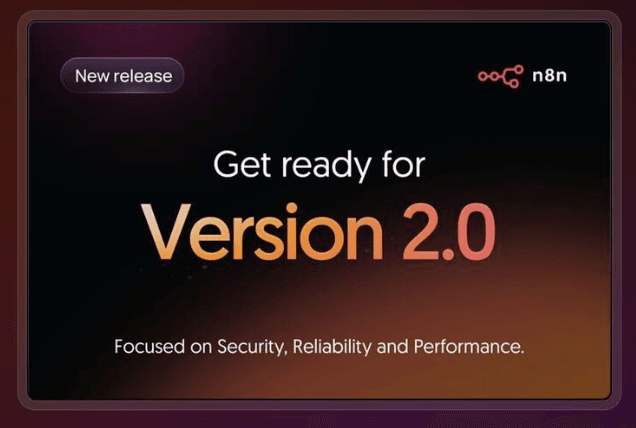
n8n 2.0 is the biggest release since 1.0 — not because of flashy features alone, but because it redefines security, reliability, and how workflows work under the hood. It launched in beta on December 8, 2025 with the stable version following mid-December.


🎯 1) Why the 2.0 Release Matters

Version 2.0 isn’t just a UI tweak — it’s a major architectural upgrade.

Unlike minor updates, this release includes breaking changes, meaning some behavior or defaults have changed in ways that could affect your workflows.

The main themes of 2.0 are:

Security (secure by default)

Reliability and stability

Performance improvements

Modernizing legacy behavior


🛡️ 2) Security Enhancements (Big Deal for Production)

n8n 2.0 introduces stricter defaults and safer behavior, making it more suitable for business and enterprise environments:

Task Runners enabled by default

Code nodes now run in isolated environments instead of potentially unprotected containers.

Blocked environment variable access in Code nodes by default

This prevents careless exposure of sensitive data.

Dangerous nodes disabled by default

Nodes like ExecuteCommand and LocalFileTrigger are off to reduce risks.

Required authentication on OAuth callbacks

Strengthens integration security.

These defaults heighten safety out of the box; they can be changed, but now require deliberate configuration.


⚙️ 3) Workflow Lifecycle Changes

The way you manage workflow versions has changed:

Save vs Publish

Save stores your draft edits

Publish pushes changes live

This prevents accidental production updates and prepares for future features like autosave (coming soon after stable).

Autosave — a major user request — is planned soon after the stable release.


🔁 4) Sub-Workflow Behavior Changed

One of the most impactful changes:

Sub-workflows that wait (e.g., human approvals, webhook responses) now return the actual output data to the parent workflow.

Before, only input data was sent back, which limited real conditional logic.

Now advanced orchestration becomes much easier.


📊 5) Performance & Reliability Improvements

n8n 2.0 also brings multiple under-the-hood boosts:

  • A more efficient SQLite pooling driver — significantly faster workflow operations.

• Better handling for binary data and resource isolation.

• Removal of legacy backends and features that slowed execution or caused odd bugs.

The goal is predictable performance even under heavy load.


🧠 6) UI & Developer Experience Updates

More subtle but helpful changes:

Cleaner, smoother workflow canvas

Updated sidebar navigation

New animated processing indicators

More modern visual styling

Autosave planned shortly after 2.0

These don’t change capability, but they make building and editing workflows much more pleasant.


🚧 7) Breaking Changes You Should Know

These changes might require action before upgrading:

📌 Environment config changes

Defaults around env access and file settings can break existing workflows if you rely on old behavior.

📌 Removed legacy nodes & drivers

Pyodide Python, outdated database drivers, and older binary features have been removed.

📌 MySQL/MariaDB support dropped

If your setup depends on older storage drivers or binary modes, prepare to adjust.

To help with this, n8n includes a Migration Report tool that scans workflows for compatibility issues before you upgrade.


📋 8) Migration & Upgrade Strategy

Before updating production:

✅ Check your Migration Report (Settings → Migration Report).

This shows workflow- and instance-level issues with severity tags.

✅ Test version 2.0 in a staging environment.

✅ Update workflows that rely on older behavior (sub-workflow waits, env access, disabled nodes).

The migration tool guides you step-by-step — extremely useful if you have many workflows.


📆 Release Timeline

  • Beta: December 8, 2025

Stable: December 15, 2025

Autosave: expected early 2026


📌 Summary — Should You Upgrade?

Yes — but do it properly.

n8n 2.0 improves security and reliability dramatically, modernizes the platform, and fixes long-standing workflow limitations. But because it includes breaking changes, upgrading without checking compatibility can break running automations.

Handled correctly, 2.0 is a major improvement for long-term automation stability.


Follow Vikash Kumar on LinkedIn for more n8n and AI-related updates!

n8n 2.0 is the biggest release since 1.0 — not because of flashy features alone, but because it redefines security, reliability, and how workflows work under the hood. It launched in beta on December 8, 2025 with the stable version following mid-December.


🎯 1) Why the 2.0 Release Matters

Version 2.0 isn’t just a UI tweak — it’s a major architectural upgrade.

Unlike minor updates, this release includes breaking changes, meaning some behavior or defaults have changed in ways that could affect your workflows.

The main themes of 2.0 are:

Security (secure by default)

Reliability and stability

Performance improvements

Modernizing legacy behavior


🛡️ 2) Security Enhancements (Big Deal for Production)

n8n 2.0 introduces stricter defaults and safer behavior, making it more suitable for business and enterprise environments:

Task Runners enabled by default

Code nodes now run in isolated environments instead of potentially unprotected containers.

Blocked environment variable access in Code nodes by default

This prevents careless exposure of sensitive data.

Dangerous nodes disabled by default

Nodes like ExecuteCommand and LocalFileTrigger are off to reduce risks.

Required authentication on OAuth callbacks

Strengthens integration security.

These defaults heighten safety out of the box; they can be changed, but now require deliberate configuration.


⚙️ 3) Workflow Lifecycle Changes

The way you manage workflow versions has changed:

Save vs Publish

Save stores your draft edits

Publish pushes changes live

This prevents accidental production updates and prepares for future features like autosave (coming soon after stable).

Autosave — a major user request — is planned soon after the stable release.


🔁 4) Sub-Workflow Behavior Changed

One of the most impactful changes:

Sub-workflows that wait (e.g., human approvals, webhook responses) now return the actual output data to the parent workflow.

Before, only input data was sent back, which limited real conditional logic.

Now advanced orchestration becomes much easier.


📊 5) Performance & Reliability Improvements

n8n 2.0 also brings multiple under-the-hood boosts:

  • A more efficient SQLite pooling driver — significantly faster workflow operations.

• Better handling for binary data and resource isolation.

• Removal of legacy backends and features that slowed execution or caused odd bugs.

The goal is predictable performance even under heavy load.


🧠 6) UI & Developer Experience Updates

More subtle but helpful changes:

Cleaner, smoother workflow canvas

Updated sidebar navigation

New animated processing indicators

More modern visual styling

Autosave planned shortly after 2.0

These don’t change capability, but they make building and editing workflows much more pleasant.


🚧 7) Breaking Changes You Should Know

These changes might require action before upgrading:

📌 Environment config changes

Defaults around env access and file settings can break existing workflows if you rely on old behavior.

📌 Removed legacy nodes & drivers

Pyodide Python, outdated database drivers, and older binary features have been removed.

📌 MySQL/MariaDB support dropped

If your setup depends on older storage drivers or binary modes, prepare to adjust.

To help with this, n8n includes a Migration Report tool that scans workflows for compatibility issues before you upgrade.


📋 8) Migration & Upgrade Strategy

Before updating production:

✅ Check your Migration Report (Settings → Migration Report).

This shows workflow- and instance-level issues with severity tags.

✅ Test version 2.0 in a staging environment.

✅ Update workflows that rely on older behavior (sub-workflow waits, env access, disabled nodes).

The migration tool guides you step-by-step — extremely useful if you have many workflows.


📆 Release Timeline

  • Beta: December 8, 2025

Stable: December 15, 2025

Autosave: expected early 2026


📌 Summary — Should You Upgrade?

Yes — but do it properly.

n8n 2.0 improves security and reliability dramatically, modernizes the platform, and fixes long-standing workflow limitations. But because it includes breaking changes, upgrading without checking compatibility can break running automations.

Handled correctly, 2.0 is a major improvement for long-term automation stability.


Follow Vikash Kumar on LinkedIn for more n8n and AI-related updates!

Author

Written By

Vikash Kumar

Building AI agents, n8n workflows and end-to-end automation for 30+ Brands across India, the US, Europe, Dubai & Australia. 7+ years of Experience saving founders real hours every week - no code required.

Ask more Questions about this Blog with AI:

Our AI Articles

Learn from our AI Articles to excel in your profession ;)

Complete Guide To Claude Code Agent Teams

Agent Teams are one of the most advanced features inside Claude Code. Instead of using one AI agent to complete...

How To Build Realistic AI Voice Agents With 11Labs + Make.com

How Agent Teams turn Claude Code into a collaborative AI workforce for building complex systems....

100 SECRET CLAUDE PROMPT CODES

Practical Claude prompt systems that improve writing, research, strategy, automation, and workflows....

The Real Claude AI Business Guide for 2026

5 Claude AI business models solving expensive problems businesses already pay for in 2026....

Complete Guide: How To Build A Claude Skill For SEO Content Writing

Reusable Claude workflows that turn generic AI writing into personalized, scalable SEO systems....

Complete Breakdown: How To Build AI Backlink Systems Using Claude Skills + Automation

Complete Breakdown: How To Build AI Backlink Systems Using Claude Skills + Automation...

Claude AI SEO Automation Guide

This AI SEO workflow automates content creation, optimization, publishing, and indexing at scale....

Complete AI Lead Generation Workflow Using Claude AI + ChatGPT

AI workflow to automate lead generation, outreach emails, and scalable client acquisition....

Use Amazon Bedrock To Try Claude, OpenAI, DeepSeek, And More

Beginner guide to using Amazon Bedrock with Claude, OpenAI, DeepSeek, APIs, and AI workflows....

Build n8n Automations With Claude Code

This guide shows how to build AI automation systems using Cursor, Claude Code, n8n, MCP, and agents....
1:1 Free Strategy Session
Your competitors are already automating. Are you still paying for it manually?

Do you want to adopt AI Automation?

Every hour your team does repetitive work, you're burning real money.
While you wait, faster businesses are cutting costs and moving quicker.
AI and automations aren't the future anymore — they're the present.

Book a live 1-on-1 session where we show you exactly which of your daily tasks can be automated — and what it’s costing you not to.