
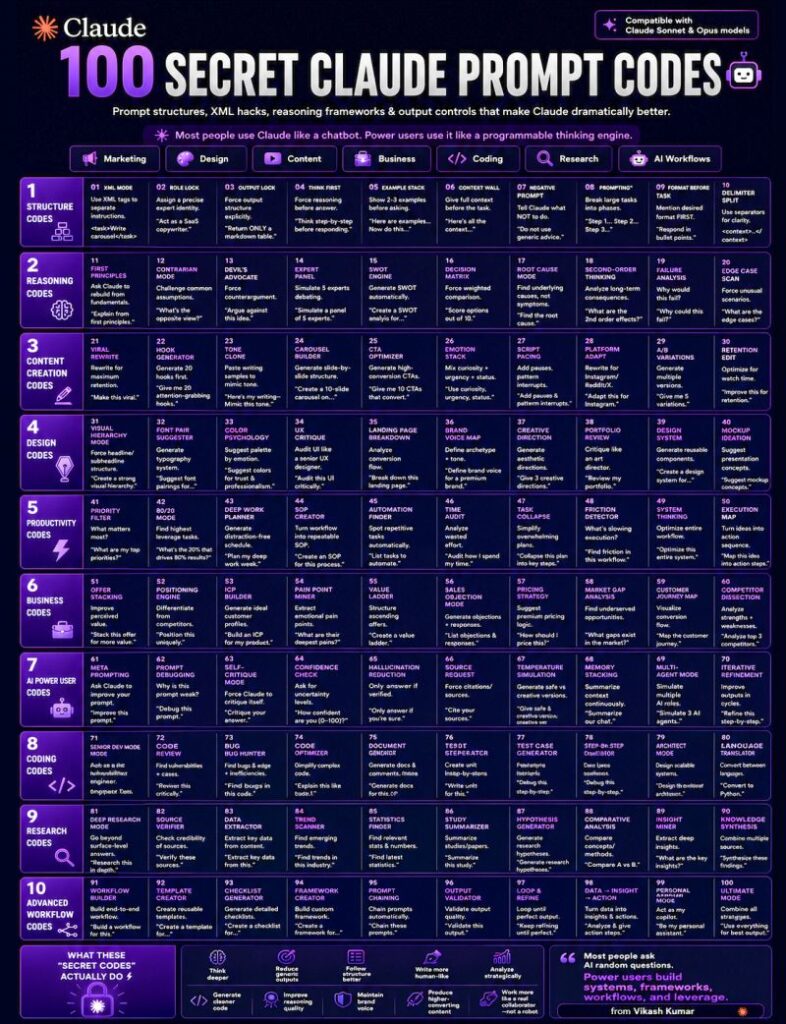
100 SECRET CLAUDE PROMPT CODES

Claude Prompt

Table of Contents

The Real CLAUDE PROMPT Systems I Use To Get Better Outputs

Most people use Claude like a basic chatbot.

That’s why their outputs still sound generic.

Claude Prompt performs best when:

  • Claude Prompts are structured
  • reasoning is guided
  • context is layered properly
  • outputs are controlled
  • constraints are clear

This guide is not random “AI hacks.”

These are practical Claude Prompt systems that materially improve:

  • writing
  • strategy
  • research
  • content creation
  • design direction
  • workflows
  • automation
  • execution quality

No fluff.Only techniques that actually improve outputs.


WHO THIS GUIDE IS FOR

Useful for:

  • creators
  • designers
  • marketers
  • founders
  • freelancers
  • agency owners
  • developers
  • strategists
  • students
  • AI automation builders
  • researchers
  • copywriters

Especially if:

  • outputs still sound generic
  • AI loses context
  • prompts feel inconsistent
  • ideas feel shallow
  • content lacks originality
  • workflows are messy

SECTION 1 — STRUCTURE CODES

01 — XML STRUCTURING

Use XML tags to separate instructions clearly.

02 — ROLE LOCKING

Assign Claude a precise expert identity.

03 — OUTPUT LOCKING

Define exact output format upfront.

04 — THINK STEP-BY-STEP

Force reasoning before answers.

05 — EXAMPLE STACKING

Provide 2–3 examples before prompting.

06 — CONTEXT LOADING

Give detailed background and goals.

07 — NEGATIVE PROMPTING

Specify what Claude should avoid.

08 — CHAIN PROMPTING

Break tasks into sequential stages.

09 — FORMAT FIRST

Mention format before instructions.

10 — DELIMITER SPLITTING

Separate sections clearly using tags.


SECTION 2 — REASONING CODES

11 — FIRST PRINCIPLES THINKING

Rebuild ideas from fundamentals.

12 — CONTRARIAN MODE

Challenge common assumptions.

13 — DEVIL’S ADVOCATE

Force counterarguments.

14 — EXPERT PANEL

Simulate multiple expert viewpoints.

15 — SWOT ANALYSIS

Generate strengths, weaknesses, opportunities, threats.

16 — DECISION MATRIX

Score options using weighted logic.

17 — ROOT CAUSE ANALYSIS

Identify underlying problems.

18 — SECOND-ORDER THINKING

Analyze long-term consequences.

19 — FAILURE ANALYSIS

Ask why execution could fail.

20 — EDGE CASE DETECTION

Identify unusual scenarios and risks.


SECTION 3 — CONTENT CREATION CODES

21 — VIRAL REWRITING

Optimize for retention and shareability.

22 — HOOK GENERATION

Generate multiple hook variations.

23 — TONE CLONING

Match exact writing style examples.

24 — CAROUSEL STRUCTURING

Build slide-by-slide content flow.

25 — CTA OPTIMIZATION

Generate multiple CTA styles.

26 — EMOTION STACKING

Combine curiosity, urgency, aspiration, status.

27 — SCRIPT PACING

Improve rhythm and flow.

28 — PLATFORM ADAPTATION

Rewrite for different platforms.

29 — A/B VARIATIONS

Generate multiple content versions.

30 — RETENTION OPTIMIZATION

Improve watch time and engagement.


SECTION 4 — DESIGN CODES

31 — VISUAL HIERARCHY

Structure information visually.

32 — FONT PAIRING

Generate typography systems.

33 — COLOR PSYCHOLOGY

Create palettes based on emotion.

34 — UX CRITIQUE

Audit interfaces like a senior UX designer.

35 — LANDING PAGE ANALYSIS

Identify conversion bottlenecks.

36 — BRAND VOICE MAPPING

Define tone and archetype.

37 — CREATIVE DIRECTION

Generate aesthetic concepts.

38 — PORTFOLIO REVIEW

Analyze presentation quality.

39 — DESIGN SYSTEM THINKING

Create reusable design systems.

40 — MOCKUP IDEATION

Generate showcase and mockup ideas.


SECTION 5 — PRODUCTIVITY CODES

41 — PRIORITY FILTERING

Identify highest-impact actions.

42 — 80/20 ANALYSIS

Find highest leverage tasks.

43 — DEEP WORK PLANNING

Build distraction-free schedules.

44 — SOP GENERATION

Turn workflows into repeatable systems.

45 — AUTOMATION DETECTION

Identify repetitive tasks.

46 — TIME AUDITING

Analyze time inefficiencies.

47 — TASK SIMPLIFICATION

Reduce complexity in execution.

48 — FRICTION DETECTION

Identify bottlenecks slowing progress.

49 — SYSTEM THINKING

Optimize entire workflows.

50 — EXECUTION ROADMAPPING

Convert ideas into actionable phases.


SECTION 6 — BUSINESS CODES

51 — POSITIONING ENGINE

Differentiate from competitors.

52 — ICP GENERATION

Build detailed ideal customer profiles.

53 — OFFER STACKING

Increase perceived value.

54 — PAIN POINT MINING

Extract emotional pain points.

55 — VALUE LADDER DESIGN

Structure ascending offers.

56 — SALES OBJECTION HANDLING

Generate objections and responses.

57 — PREMIUM PRICING STRATEGY

Improve pricing perception.

58 — MARKET GAP ANALYSIS

Find underserved opportunities.

59 — CUSTOMER JOURNEY MAPPING

Visualize conversion stages.

60 — COMPETITOR DISSECTION

Analyze strengths and weaknesses.


SECTION 7 — AI POWER USER CODES

61 — META PROMPTING

Ask Claude to improve prompts.

62 — PROMPT DEBUGGING

Identify weak prompt areas.

63 — SELF-CRITIQUE MODE

Force Claude to critique outputs.

64 — CONFIDENCE CHECKING

Ask for uncertainty levels.

65 — HALLUCINATION REDUCTION

Restrict unverifiable answers.

66 — SOURCE REQUESTING

Force citations and references.

67 — CREATIVE VS SAFE OUTPUTS

Generate conservative and creative versions.

68 — MEMORY STACKING

Continuously summarize context.

69 — MULTI-AGENT SIMULATION

Simulate multiple AI roles.

70 — ITERATIVE REFINEMENT

Improve outputs repeatedly.


SECTION 8 — CODING CODES

71 — SENIOR ENGINEER MODE

Generate production-level solutions.

72 — CODE REVIEWING

Analyze vulnerabilities and inefficiencies.

73 — BUG HUNTING

Debug systematically.

74 — REFACTORING

Improve readability and performance.

75 — DOCUMENTATION GENERATION

Explain code clearly.

76 — API DESIGN

Generate scalable endpoints.

77 — TEST CASE GENERATION

Create edge-case testing.

78 — SECURITY AUDITING

Check exploit vulnerabilities.

79 — CLEAN ARCHITECTURE

Improve code organization.

80 — BUILD ROADMAPPING

Generate phased implementation plans.


SECTION 9 — RESEARCH CODES

81 — PAPER SUMMARIZATION

Simplify academic papers.

82 — DATA EXTRACTION

Pull insights from large documents.

83 — TREND ANALYSIS

Identify emerging patterns.

84 — SIGNAL VS NOISE

Separate valuable information.

85 — KNOWLEDGE MAPPING

Visualize topic relationships.

86 — ARGUMENT BREAKDOWN

Analyze logic quality.

87 — BIAS DETECTION

Identify hidden biases.

88 — FACT CHECKING

Verify questionable claims.

89 — SYNTHESIS MODE

Combine multiple sources into insights.

90 — SIMPLE TEACHING MODE

Explain complex ideas simply.


SECTION 10 — ADVANCED SECRET CODES

91 — PLAN → VERIFY → REVISE

Use 3-pass refinement workflows.

92 — RESPONSE PREFILLING

Start Claude’s response yourself.

93 — SCORING RUBRICS

Define evaluation criteria first.

94 — OUTPUT EXAMPLES

Show exact desired outputs.

95 — THINKING TAGS

Use dedicated reasoning tags.

96 — STYLE CONSTRAINTS

Force strict writing rules.

97 — TOKEN EFFICIENCY

Keep prompts modular and concise.

98 — CONTEXT COMPRESSION

Summarize long conversations efficiently.

99 — PROMPT-AS-SYSTEM

Treat prompts like operating systems.

100 — THE Claude Prompt OPERATING SYSTEM

Combine:

  • role
  • context
  • examples
  • reasoning
  • constraints
  • output structure

into one master framework.


THE MASTER Claude Prompt FRAMEWORK

<role>

Who Claude should act as

</role>

<context>

Relevant information

</context>

<goal>

Desired outcome

</goal>

<constraints>

What to avoid

</constraints>

<examples>

Reference examples

</examples>

<output>

Exact output structure

</output>

This framework alone performs better than most random prompts people use daily.

What you just saw is not a prompt cheat sheet.

It’s a system for turning Claude into an actual AI execution engine.

Most people still use Claude one prompt at a time:asking random questions,rewriting instructions repeatedly,and manually doing work AI should already be systemizing.

That approach is slow and impossible to scale.

Power users build systems instead:

  • reusable workflows
  • persistent context
  • automation pipelines
  • AI-assisted operations
  • repeatable execution frameworks

That’s where the real advantage comes from.

The goal is not just:“Get better responses.”

The goal is to build a setup that can:

  • think
  • organize
  • generate
  • analyze
  • execute
  • scale with you

Once you understand workflow architecture, context systems, and Claude Prompt structuring, Claude stops behaving like a chatbot and starts working like an operating system for your content, business, and execution.

Most users stay at:“Write this for me.”

Power users move toward:“Build me a repeatable system that produces high-quality outputs with minimal manual work.”

That shift changes everything.

Table of Contents

The Real CLAUDE PROMPT Systems I Use To Get Better Outputs

Most people use Claude like a basic chatbot.

That’s why their outputs still sound generic.

Claude Prompt performs best when:

  • Claude Prompts are structured
  • reasoning is guided
  • context is layered properly
  • outputs are controlled
  • constraints are clear

This guide is not random “AI hacks.”

These are practical Claude Prompt systems that materially improve:

  • writing
  • strategy
  • research
  • content creation
  • design direction
  • workflows
  • automation
  • execution quality

No fluff.Only techniques that actually improve outputs.


WHO THIS GUIDE IS FOR

Useful for:

  • creators
  • designers
  • marketers
  • founders
  • freelancers
  • agency owners
  • developers
  • strategists
  • students
  • AI automation builders
  • researchers
  • copywriters

Especially if:

  • outputs still sound generic
  • AI loses context
  • prompts feel inconsistent
  • ideas feel shallow
  • content lacks originality
  • workflows are messy

SECTION 1 — STRUCTURE CODES

01 — XML STRUCTURING

Use XML tags to separate instructions clearly.

02 — ROLE LOCKING

Assign Claude a precise expert identity.

03 — OUTPUT LOCKING

Define exact output format upfront.

04 — THINK STEP-BY-STEP

Force reasoning before answers.

05 — EXAMPLE STACKING

Provide 2–3 examples before prompting.

06 — CONTEXT LOADING

Give detailed background and goals.

07 — NEGATIVE PROMPTING

Specify what Claude should avoid.

08 — CHAIN PROMPTING

Break tasks into sequential stages.

09 — FORMAT FIRST

Mention format before instructions.

10 — DELIMITER SPLITTING

Separate sections clearly using tags.


SECTION 2 — REASONING CODES

11 — FIRST PRINCIPLES THINKING

Rebuild ideas from fundamentals.

12 — CONTRARIAN MODE

Challenge common assumptions.

13 — DEVIL’S ADVOCATE

Force counterarguments.

14 — EXPERT PANEL

Simulate multiple expert viewpoints.

15 — SWOT ANALYSIS

Generate strengths, weaknesses, opportunities, threats.

16 — DECISION MATRIX

Score options using weighted logic.

17 — ROOT CAUSE ANALYSIS

Identify underlying problems.

18 — SECOND-ORDER THINKING

Analyze long-term consequences.

19 — FAILURE ANALYSIS

Ask why execution could fail.

20 — EDGE CASE DETECTION

Identify unusual scenarios and risks.


SECTION 3 — CONTENT CREATION CODES

21 — VIRAL REWRITING

Optimize for retention and shareability.

22 — HOOK GENERATION

Generate multiple hook variations.

23 — TONE CLONING

Match exact writing style examples.

24 — CAROUSEL STRUCTURING

Build slide-by-slide content flow.

25 — CTA OPTIMIZATION

Generate multiple CTA styles.

26 — EMOTION STACKING

Combine curiosity, urgency, aspiration, status.

27 — SCRIPT PACING

Improve rhythm and flow.

28 — PLATFORM ADAPTATION

Rewrite for different platforms.

29 — A/B VARIATIONS

Generate multiple content versions.

30 — RETENTION OPTIMIZATION

Improve watch time and engagement.


SECTION 4 — DESIGN CODES

31 — VISUAL HIERARCHY

Structure information visually.

32 — FONT PAIRING

Generate typography systems.

33 — COLOR PSYCHOLOGY

Create palettes based on emotion.

34 — UX CRITIQUE

Audit interfaces like a senior UX designer.

35 — LANDING PAGE ANALYSIS

Identify conversion bottlenecks.

36 — BRAND VOICE MAPPING

Define tone and archetype.

37 — CREATIVE DIRECTION

Generate aesthetic concepts.

38 — PORTFOLIO REVIEW

Analyze presentation quality.

39 — DESIGN SYSTEM THINKING

Create reusable design systems.

40 — MOCKUP IDEATION

Generate showcase and mockup ideas.


SECTION 5 — PRODUCTIVITY CODES

41 — PRIORITY FILTERING

Identify highest-impact actions.

42 — 80/20 ANALYSIS

Find highest leverage tasks.

43 — DEEP WORK PLANNING

Build distraction-free schedules.

44 — SOP GENERATION

Turn workflows into repeatable systems.

45 — AUTOMATION DETECTION

Identify repetitive tasks.

46 — TIME AUDITING

Analyze time inefficiencies.

47 — TASK SIMPLIFICATION

Reduce complexity in execution.

48 — FRICTION DETECTION

Identify bottlenecks slowing progress.

49 — SYSTEM THINKING

Optimize entire workflows.

50 — EXECUTION ROADMAPPING

Convert ideas into actionable phases.


SECTION 6 — BUSINESS CODES

51 — POSITIONING ENGINE

Differentiate from competitors.

52 — ICP GENERATION

Build detailed ideal customer profiles.

53 — OFFER STACKING

Increase perceived value.

54 — PAIN POINT MINING

Extract emotional pain points.

55 — VALUE LADDER DESIGN

Structure ascending offers.

56 — SALES OBJECTION HANDLING

Generate objections and responses.

57 — PREMIUM PRICING STRATEGY

Improve pricing perception.

58 — MARKET GAP ANALYSIS

Find underserved opportunities.

59 — CUSTOMER JOURNEY MAPPING

Visualize conversion stages.

60 — COMPETITOR DISSECTION

Analyze strengths and weaknesses.


SECTION 7 — AI POWER USER CODES

61 — META PROMPTING

Ask Claude to improve prompts.

62 — PROMPT DEBUGGING

Identify weak prompt areas.

63 — SELF-CRITIQUE MODE

Force Claude to critique outputs.

64 — CONFIDENCE CHECKING

Ask for uncertainty levels.

65 — HALLUCINATION REDUCTION

Restrict unverifiable answers.

66 — SOURCE REQUESTING

Force citations and references.

67 — CREATIVE VS SAFE OUTPUTS

Generate conservative and creative versions.

68 — MEMORY STACKING

Continuously summarize context.

69 — MULTI-AGENT SIMULATION

Simulate multiple AI roles.

70 — ITERATIVE REFINEMENT

Improve outputs repeatedly.


SECTION 8 — CODING CODES

71 — SENIOR ENGINEER MODE

Generate production-level solutions.

72 — CODE REVIEWING

Analyze vulnerabilities and inefficiencies.

73 — BUG HUNTING

Debug systematically.

74 — REFACTORING

Improve readability and performance.

75 — DOCUMENTATION GENERATION

Explain code clearly.

76 — API DESIGN

Generate scalable endpoints.

77 — TEST CASE GENERATION

Create edge-case testing.

78 — SECURITY AUDITING

Check exploit vulnerabilities.

79 — CLEAN ARCHITECTURE

Improve code organization.

80 — BUILD ROADMAPPING

Generate phased implementation plans.


SECTION 9 — RESEARCH CODES

81 — PAPER SUMMARIZATION

Simplify academic papers.

82 — DATA EXTRACTION

Pull insights from large documents.

83 — TREND ANALYSIS

Identify emerging patterns.

84 — SIGNAL VS NOISE

Separate valuable information.

85 — KNOWLEDGE MAPPING

Visualize topic relationships.

86 — ARGUMENT BREAKDOWN

Analyze logic quality.

87 — BIAS DETECTION

Identify hidden biases.

88 — FACT CHECKING

Verify questionable claims.

89 — SYNTHESIS MODE

Combine multiple sources into insights.

90 — SIMPLE TEACHING MODE

Explain complex ideas simply.


SECTION 10 — ADVANCED SECRET CODES

91 — PLAN → VERIFY → REVISE

Use 3-pass refinement workflows.

92 — RESPONSE PREFILLING

Start Claude’s response yourself.

93 — SCORING RUBRICS

Define evaluation criteria first.

94 — OUTPUT EXAMPLES

Show exact desired outputs.

95 — THINKING TAGS

Use dedicated reasoning tags.

96 — STYLE CONSTRAINTS

Force strict writing rules.

97 — TOKEN EFFICIENCY

Keep prompts modular and concise.

98 — CONTEXT COMPRESSION

Summarize long conversations efficiently.

99 — PROMPT-AS-SYSTEM

Treat prompts like operating systems.

100 — THE Claude Prompt OPERATING SYSTEM

Combine:

  • role
  • context
  • examples
  • reasoning
  • constraints
  • output structure

into one master framework.


THE MASTER Claude Prompt FRAMEWORK

<role>

Who Claude should act as

</role>

<context>

Relevant information

</context>

<goal>

Desired outcome

</goal>

<constraints>

What to avoid

</constraints>

<examples>

Reference examples

</examples>

<output>

Exact output structure

</output>

This framework alone performs better than most random prompts people use daily.

What you just saw is not a prompt cheat sheet.

It’s a system for turning Claude into an actual AI execution engine.

Most people still use Claude one prompt at a time:asking random questions,rewriting instructions repeatedly,and manually doing work AI should already be systemizing.

That approach is slow and impossible to scale.

Power users build systems instead:

  • reusable workflows
  • persistent context
  • automation pipelines
  • AI-assisted operations
  • repeatable execution frameworks

That’s where the real advantage comes from.

The goal is not just:“Get better responses.”

The goal is to build a setup that can:

  • think
  • organize
  • generate
  • analyze
  • execute
  • scale with you

Once you understand workflow architecture, context systems, and Claude Prompt structuring, Claude stops behaving like a chatbot and starts working like an operating system for your content, business, and execution.

Most users stay at:“Write this for me.”

Power users move toward:“Build me a repeatable system that produces high-quality outputs with minimal manual work.”

That shift changes everything.

Author

Written By

Vikash Kumar

Building AI agents, n8n workflows and end-to-end automation for 30+ Brands across India, the US, Europe, Dubai & Australia. 7+ years of Experience saving founders real hours every week - no code required.

Ask more Questions about this Blog with AI:

Our AI Articles

Learn from our AI Articles to excel in your profession ;)

The Real Claude AI Business Guide for 2026

5 Claude AI business models solving expensive problems businesses already pay for in 2026....

Complete Guide: How To Build A Claude Skill For SEO Content Writing

Reusable Claude workflows that turn generic AI writing into personalized, scalable SEO systems....

Complete Breakdown: How To Build AI Backlink Systems Using Claude Skills + Automation

Complete Breakdown: How To Build AI Backlink Systems Using Claude Skills + Automation...

Claude AI SEO Automation Guide

This AI SEO workflow automates content creation, optimization, publishing, and indexing at scale....

Complete AI Lead Generation Workflow Using Claude AI + ChatGPT

AI workflow to automate lead generation, outreach emails, and scalable client acquisition....

Use Amazon Bedrock To Try Claude, OpenAI, DeepSeek, And More

Beginner guide to using Amazon Bedrock with Claude, OpenAI, DeepSeek, APIs, and AI workflows....

Build n8n Automations With Claude Code

This guide shows how to build AI automation systems using Cursor, Claude Code, n8n, MCP, and agents....

Anthropic’s Prompt Engineering Guide, Explained Simply

Anthropic’s workshop reveals prompt engineering is about context, structure, and iteration — not magic words....

Building Effective AI Agents

A practical breakdown of Barry’s Anthropic talk on AI agents, workflows, orchestration systems, and production deployment....

Tools Stack

A curated AI tools stack covering research, coding, automation, creativity, sales, and learning workflows....
1:1 Free Strategy Session
Your competitors are already automating. Are you still paying for it manually?

Do you want to adopt AI Automation?

Every hour your team does repetitive work, you're burning real money.
While you wait, faster businesses are cutting costs and moving quicker.
AI and automations aren't the future anymore — they're the present.

Book a live 1-on-1 session where we show you exactly which of your daily tasks can be automated — and what it’s costing you not to.