
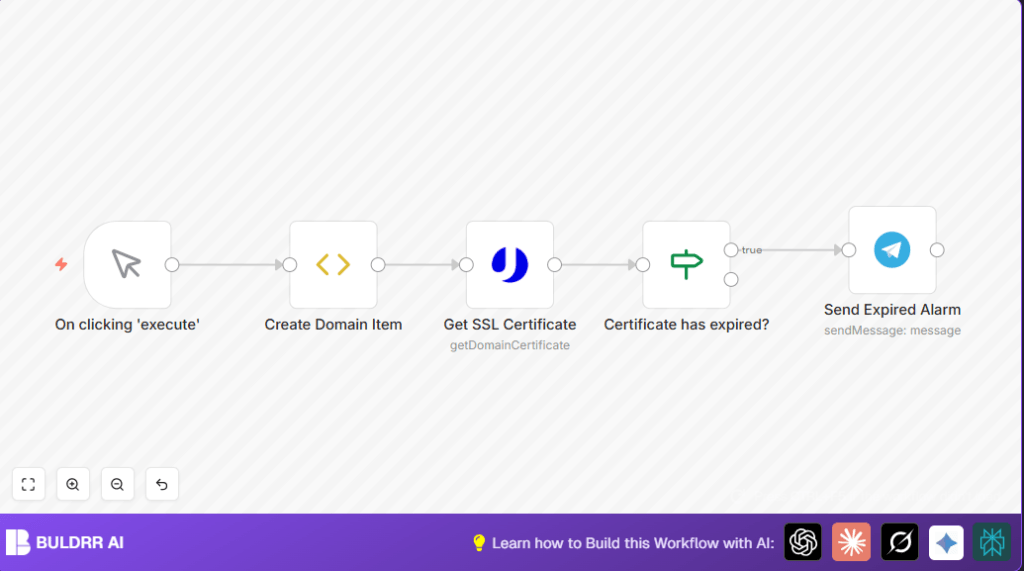

What this workflow does
This n8n workflow checks if an SSL certificate for a website domain has expired. It solves the problem of missing expired certificates that cause security warnings and loss of trust. The workflow tells you by sending a message if the certificate is no longer valid. This helps avoid manual checking and stops you from missing important expiry dates.
The workflow works by being started manually, sending a request to get the certificate info, deciding if it is expired, and sending an alert if needed.
Who should use this workflow
This is for website admins, owners, or IT teams who manage domains with SSL certificates. It is useful when multiple domains must be checked regularly to prevent security issues. Anyone who wants to save time by automating certificate monitoring can use it.
Tools and services used
- n8n: Automation platform where the workflow runs.
- Uproc API: Service to fetch SSL certificate details for a domain.
- Telegram Bot API: To send alert messages if certificates expire.
How the workflow works (Inputs → Process → Output)
Inputs
- Manual Trigger: Starts the workflow when you click execute.
- Domain name: Set internally in the workflow (default is “n8n.io” but can be changed).
- Telegram Bot Token and Chat ID: Needed to send alerts.
- Uproc API credentials: Needed to fetch SSL certificate info.
Processing steps
- The workflow gets a domain name defined in a Function Item node.
- The Uproc node queries SSL certificate details using the domain.
- An If node compares if the certificate is valid or expired.
- If expired, the workflow sends a Telegram message warning about the expiry.
Output
- An instant Telegram alert if the SSL certificate is expired.
- No alert sent if the certificate is still valid.
Beginner step-by-step: How to use this workflow in n8n production
Step 1: Importing the workflow
- Download the workflow file using the Download button on this page.
- Open your n8n editor.
- Go to the menu and select Import from File.
- Choose the downloaded file to load the workflow.
Step 2: Configure credentials and settings
- Add your Uproc API credentials in the Get SSL Certificate node.
- Add your Telegram Bot token and target chat ID in the Send Expired Alarm node.
- If needed, change the domain name inside the Create Domain Item node by updating the JavaScript code that sets the domain.
Step 3: Testing and activating
- Run the workflow manually by clicking Execute on the manual trigger node.
- Check your Telegram for any alert messages if the certificate is expired.
- If everything works, activate the workflow to run whenever you want or automate it later.
If using self-host n8n, this will all work the same. Configure API access and credentials before testing. self-host n8n offers guidance on hosting and setup.
Customizations and ideas
- You can check many domains by changing the domain code to produce a list for looping.
- Change alerts from Telegram to Slack or email by swapping notification nodes.
- Run automatic scheduled checks by replacing the manual trigger with a Cron trigger.
- Add expiry date details in alert messages to know when certificates end.
Possible issues and how to fix them
- Telegram alerts not sent: Check the Bot token and chat ID are correct and the bot has permission.
- Uproc node shows no certificate data: Make sure the domain is written properly and the API service is running.
Summary of results
✓ Saves time by automating SSL certificate checks
✓ Sends alerts instantly if a certificate is expired
✓ Reduces risk of unnoticed certificate expiry
→ Keeps websites secure and trusted without manual work
