

What This Workflow Does
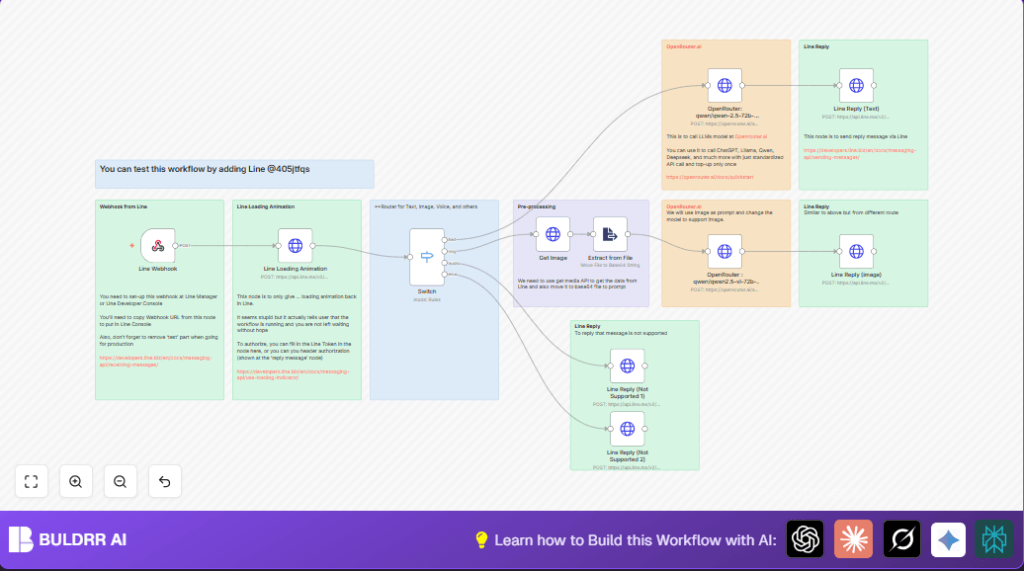
This workflow helps automatically translate messages on Line into Chinese characters, pinyin, and English meaning.
It stops the user from spending hours manually translating text and images daily.
When new messages come in, it checks the type and sends the message or image to an AI for fast, correct translation.
Then it replies to the person on Line with clear translated text.
Unsupported messages get a polite error reply.
The workflow saves time, cuts mistakes, and gives quick, full translations for text or images inside Line chat.
Who Should Use This Workflow
Anyone who gets many text or picture messages needing Chinese translation on Line.
This is great for tutors, content creators, or customer service handling language support.
It fits users who want faster, accurate answers without manual typing or switching apps.
Tools and Services Used
- Line Messaging API: Receives and sends messages in Line chat.
- n8n Automation Platform: Runs the workflow and logic nodes.
- OpenRouter.ai LLM Models: Processes text and image data to create Chinese translations.
- HTTP Request Nodes: Make API calls to Line and OpenRouter.ai.
- Webhook Node: Listens to incoming Line messages.
- Switch Node: Routes messages based on their type.
- Extract From File Node: Converts image binary to base64.
Workflow Inputs, Processing Steps, and Outputs
Inputs
- Incoming Line chat messages (text, images, audio, others) via webhook.
- Message content or image media IDs from Line.
Processing Steps
- Detect message type: Using a Switch node to check text, image, audio or unsupported.
- Send loading animation: Calls Line API to show user a “loading” signal.
- Text translation: Sends text to OpenRouter.qwen AI for Chinese, pinyin, and English translation.
- Image translation: Gets image content via Line API, converts to base64, and sends to OpenRouter.ai for text extraction and translation.
- Reply message: Posts formatted translation text back to the user on Line.
- Unsupported message reply: Sends a polite message asking the user to retry.
Outputs
- Translated text including Chinese characters, pinyin, and English explanations sent as Line messages.
- Loading animation feedback in chat during processing.
- Error reply for unsupported formats.
Beginner Step-by-Step: How to Use This Workflow in n8n Production
1. Import the Workflow
- Download the workflow JSON file using the Download button on this page.
- Open n8n editor where you want to run the automation (supports self-host n8n or cloud).
- Click the menu, choose “Import from File”, and select the downloaded JSON file.
2. Configure Credentials and Settings
- Add your Line Messaging API Channel Access Token as an HTTP Header Authentication credential.
- Enter your OpenRouter.ai API Key in another HTTP Header Authentication credential.
- Check webhook URLs and replace any example IDs, reply tokens, or user IDs if needed.
3. Test the Workflow
- Trigger the workflow by sending a text or image message from your Line official account.
- Confirm the loading animation appears in Line chat promptly.
- Check if the translated text replies correctly with Chinese characters, pinyin, and English.
4. Activate the Workflow
- Turn on the workflow toggle in n8n editor to enable it fully.
- Monitor executions in n8n’s dashboard to ensure smooth running.
Follow these clear steps to run the automatic Chinese translation immediately without building from scratch.
Step-By-Step Workflow Explanation
Step 1: Receive Messages with Webhook node
The webhook listens for new messages sent to your Line official account.
It waits for text, image, or other message types to start the process.
Step 2: Show Loading Indicator with HTTP Request Node
Right after a message arrives, the workflow calls Line’s loading API to send a “loading” animation.
This tells the user the message is being processed and keeps them engaged.
Step 3: Determine Message Type with Switch node
The message type is checked against “text”, “image”, “audio”, or “else”.
The workflow routes the message path based on this, allowing different processing for each type.
Step 4a: Process Text Messages via OpenRouter.ai
A POST request sends the text to OpenRouter’s Qwen LLM.
This AI returns Chinese characters, pinyin, and English meanings using the system prompt given.
Below is the prompt structure used to get consistent results:
{
  "model": "qwen/qwen-2.5-72b-instruct:free",
  "messages": [
    {
      "role": "system",
      "content": "please provide chinese character, pinyin and translation in english. if the input is in english, you will translate and also provide chinese character, pinyin and translation in english for each word"
    },
     {
      "role": "user",
      "content": "{{ $('Line Webhook').item.json.body.events[0].message.text }}"
    }
  ]
}
Step 4b: Process Image Messages
The workflow fetches the image bytes from Line using message ID.
An Extract From File node converts the image to base64.
A POST request sends the base64 image data to OpenRouter for text recognition and translation.
Here is the JSON payload template for this request:
{
  "model": "qwen/qwen2.5-vl-72b-instruct:free",
  "messages": [
    {
      "role": "system",
      "content": "please provide chinese character, pinyin and translation in english for all the text in the image"
    },
    {
      "role": "user",
      "content": [
        {
          "type": "image_url",
          "image_url": {
            "url": "data:image/jpeg;base64,{{ $json.img_prompt }}"
          }
        }
      ]
    }
  ]
}
Step 5: Send Replies Back to the User
For text and image translations, the workflow sends the reply using Line’s reply API.
It uses a POST request with the reply token and the clean translated message.
This removes markdown, tags, and unwanted characters to send plain translated text.
Here is the reply JSON body:
{
  "replyToken": "{{ $('Line Webhook').item.json.body.events[0].replyToken }}",
  "messages": [
    {
      "type": "text",
      "text": "{{ $json.choices[0].message.content.replaceAll("\n","\\n").replaceAll("\n","").removeMarkdown().removeTags().replaceAll('"','') }}"
    }
  ]
}
Step 6: Handle Unsupported Messages
If the message type is audio or anything else not supported, the workflow sends a polite reply asking the user to try again.
This keeps users informed and prevents silent failures.
Customization Ideas
- Add audio transcription before translation to support voice messages.
- Modify system prompts to add other languages or output formats.
- Change reply message formatting to include markdown or emojis.
- Manage multiple Line bots by duplicating webhook and credentials.
- Adjust the loading animation time to match average processing duration.
Troubleshooting Common Issues
- Webhook not receiving messages: Check webhook URL in Line Developer Console and confirm it is active.
- OpenRouter API errors: Verify the API Key is valid and not expired.
- Line reply messages failing: Confirm that the Channel Access Token in n8n HTTP Header Auth is correct.
Pre-Production Checklist
- Send sample text and image messages and check translated replies.
- Verify loading animation appears quickly in the chat.
- Confirm OpenRouter returns correct Chinese characters, pinyin, and English.
- Test all output paths from the Switch node.
- Backup workflow and credentials before going live.
Deployment Advice
Switch the workflow to active in n8n after checking all parts.
Watch executions for any errors and adjust loading time or error replies based on user feedback.
Invite users to send test messages to keep validating performance.
Summary
✓ Automatically translates Line chat messages into Chinese with pinyin and English.
✓ Saves hours by automating manual translation tasks.
✓ Processes text and images accurately with AI.
✓ Sends loading feedback and clear translated replies in chat.
✓ Handles unsupported inputs with polite error messages.
✓ Easy to import, configure, and run inside n8n.
