
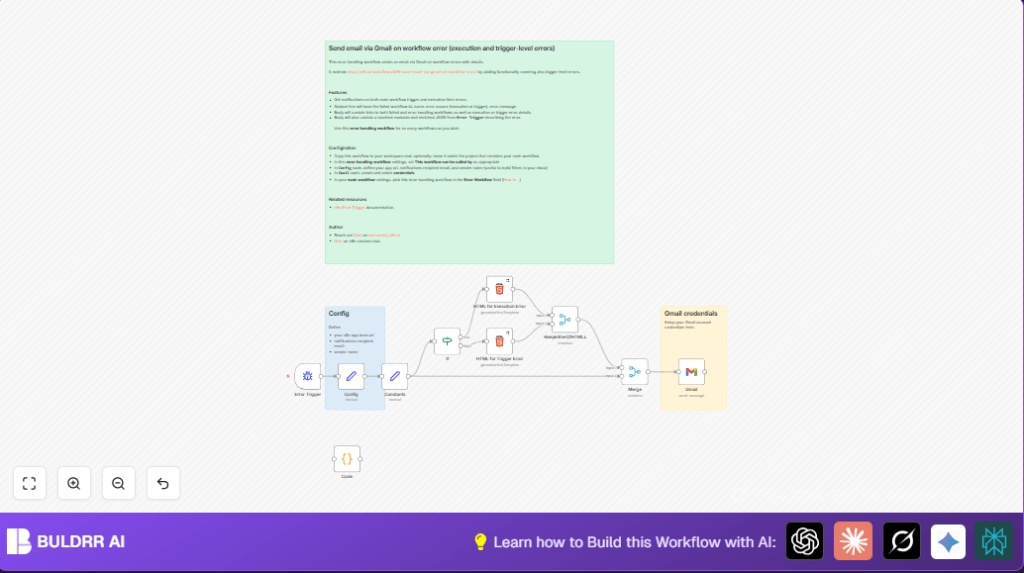

Robust Error Handling with n8n and Gmail for Workflow Failures

This n8n workflow provides comprehensive error handling for both execution and trigger-level errors in your automation workflows. By sending detailed Gmail notifications with error context, it helps you quickly identify and resolve issues, minimizing downtime and improving reliability.
errorTrigger
gmail
merge
+5
Workflow Identifier: 1935
NODES in Use: Error Trigger, Set, Merge, If, HTML, Gmail, Code, Sticky Note

Press CTRL+F5 if the workflow didn't load.

Learn how to Build this Workflow with AI:

Visit through Desktop for Best experience

Opening Problem Statement

Meet Sophie, a project manager who relies heavily on n8n workflows to automate her team’s daily data processing and notification tasks. Recently, Sophie’s team experienced a major setback. One of their critical workflows failed unexpectedly due to a trigger error, and no one was immediately notified. The issue went undetected for hours, delaying important updates and costing the team precious time and client trust.

Despite setting up basic alerts, Sophie found that many of her workflows only notified her of execution errors, missing trigger-level failures entirely. This gap meant incomplete visibility into workflow issues, leading to time wasted manually checking logs, increased error resolution time, and an ever-growing risk of operational mishaps. She needed a solution that would capture all error types and deliver detailed notifications promptly.

What This Automation Does

This n8n workflow acts as a dedicated error handling system, designed to catch and notify you about both execution and trigger errors from any monitored workflow. When an error occurs, it sends a detailed, formatted email through Gmail containing valuable diagnostic information and direct links for quick access.

  • Detects execution errors – errors occurring during the workflow’s runtime.
  • Captures trigger errors – issues occurring at the workflow trigger level before execution.
  • Generates rich HTML summaries of errors including stack traces, timestamps, and error context.
  • Combines error data intelligently to include both types of errors in one notification when needed.
  • Sends detailed Gmail notifications with customizable sender name and recipient addresses.
  • Links to the failed workflows and executions for easy investigation and follow-up.

By automating comprehensive error reporting, this workflow can save hours of manual log-checking, reduce resolution times, and drastically improve operational reliability across n8n workflows.

Prerequisites ⚙️

  • n8n account with access to create and manage workflows (Cloud or self-hosted)8⏱️9
  • Gmail account with OAuth2 credentials configured in n8n8📧🔑9 to send email notifications
  • An existing main workflow(s) configured to use this error handling workflow as its “Error Workflow”
  • A web-accessible base URL for your n8n instance to generate links in emails

Step-by-Step Guide

Step 1: Understand the Trigger – Error Trigger Node

Navigate to your error handling workflow and locate the Error Trigger node. This special node listens for any errors triggered from other workflows. It automatically captures error data from both execution and trigger-level failures.

This node doesn’t require additional configuration – it acts as the start of the error handling process.

Common mistake: Forgetting to enable this error handling workflow to be called by other workflows will stop error events from being caught.

Step 2: Configure Notification Settings Using the Config Node

Go to the Config node. Here you define key parameters:

  • config.appUrl: the base URL of your n8n instance, e.g., https://YourAccountName.app.n8n.cloud/
  • config.emailing.sendTo: recipient email, e.g., [email protected]
  • config.emailing.senderName: display name for the sender on Gmail, e.g., Marvin the Yeoman Warder

Make sure to replace these with your own values to personalize notifications.

Expected outcome: These settings are used downstream to format the notification email.

Common mistake: Using an invalid or non-existent email address will cause the Gmail node to fail.

Step 3: Prepare Constants and Data Assignments in the Constants Node

Open the Constants node next. It dynamically builds URLs and flags based on the input data from the error trigger and configuration. This node:

  • Creates full URLs to your workflows and error handling workflow
  • Determines if the error was during execution or trigger
  • Stores IDs and names for workflows involved in the error event

This logical setup is crucial for creating contextual information used in email notifications.

Common mistake: Altering JSON expressions incorrectly here may break data mapping.

Step 4: Evaluate Error Type with the If Node

Go to the If node which checks if the incoming error is an execution error. The condition tests a boolean flag set in the Constants node.

Based on this, the workflow directs the error data to one of two paths for formatting the email body.

Expected outcome: Execution errors take one path, trigger errors another.

Common mistake: Modifying the condition logic without understanding can cause misclassification of errors.

Step 5: Format Execution Errors with HTML for Execution Error Node

On the execution error path, open HTML for Execution Error. This node generates an HTML snippet showing:

  • Link to the execution details
  • Error message and stack trace
  • Execution mode, last node executed, retry info

This structured error summary improves readability for email recipients.

Common mistake: Removing or corrupting the HTML tags can lead to unreadable emails.

Step 6: Format Trigger Errors with HTML for Trigger Error Node

On the trigger error path (If node false branch), the HTML for Trigger Error node composes an HTML report describing the trigger failure:

  • Error name, message, and description
  • Timestamps in readable format
  • Error context and stack trace
  • Details of cause including code and status

This comprehensive trigger error report ensures you get all relevant info up front.

Common mistake: Forgetting to update the date formatting expression can display invalid dates.

Step 7: Merge HTML Error Reports

Both error HTML branches then feed into the KeepEitherOfHTMLs merge node. It combines the two HTML blocks while retaining unpaired data, ensuring the email always has error content.

Common mistake: Misconfiguring merge options can omit sections of the email body.

Step 8: Prepare Final Merge for Gmail Node

The merged HTML is then combined with the constant data in the Merge node. This combined JSON data is what the Gmail node uses to build the final email.

Step 9: Send Notification Email Via Gmail Node

Check Gmail node, configured to:

  • Send emails to the recipient defined in the Config node
  • Use the sender name (e.g., “Marvin the Yeoman Warder”)
  • Build a subject line dynamically with the workflow ID, name, error type, and error message
  • Insert the HTML error details in the email body

Expected outcome: On any triggered error, you get an email notification packed with troubleshooting info.

Common mistake: Missing or invalid Gmail credentials will cause email sending to fail silently.

Customizations ✏️

  • Change Recipient Email: In the Config node, update config.emailing.sendTo to your team’s shared mailbox or personal address for different notification flows.
  • Add More Recipients: Modify the Gmail node’s sendTo field from a single email to a comma-separated list for group alerts.
  • Customize Email Sender Name: In the Config node, change config.emailing.senderName to a name matching your brand or bot persona.
  • Extend Error Details: Add extra fields to the HTML nodes to include contextual tags or relevant metadata from your main workflows.
  • Switch Email Provider: Replace Gmail node with SMTP or other email nodes if your organization uses different email infrastructure.

Troubleshooting 🔧

Problem: “Gmail node failed to send email with ‘Invalid Credentials’ error.”
Cause: OAuth2 credentials expired or incorrectly configured.
Solution: Go to Credentials in n8n, refresh or recreate Gmail OAuth2 credentials, then re-link in Gmail node.

Problem: “The error handling workflow does not trigger on workflow errors.”
Cause: Main workflows not assigned this workflow as their error workflow.
Solution: In your main workflow settings, set this workflow under the ‘Error Workflow’ field and activate both workflows.

Problem: “Email notifications lack detailed error information or missing stack traces.”
Cause: HTML template nodes misconfigured or data not properly mapped.
Solution: Check HTML for Execution/Trigger Error nodes and ensure correct JSON expression mapping.

Pre-Production Checklist ✅

  • Verify Gmail credentials are valid and connected correctly.
  • Confirm that your main workflows have this error handling workflow set as their error workflow.
  • Test both execution error and trigger error scenarios to ensure emails are sent.
  • Check email formatting by sending test executions with sample error payloads.
  • Backup your error handling workflow before making structural changes.

Deployment Guide

Activate this workflow and make sure error handling is enabled in your main workflows by setting this as their Error Workflow in the workflow settings panel. Monitor email inbox for notifications during initial testing phases.

Regularly review logs or email delivery status within n8n to ensure ongoing functionality.

FAQs

Q: Can this workflow handle errors from multiple workflows simultaneously?
A: Yes, you can assign multiple main workflows to use this error handling workflow. It distinguishes errors via workflow IDs in email content.

Q: Does sending emails via Gmail consume API credits or quotas?
A: Gmail accounts have daily sending limits. Be mindful to stay within those limits to avoid temporary blocks.

Q: Is my error data secure in this process?
A: Emails sent via Gmail are as secure as your email provider setup. Avoid including extremely sensitive info in notifications if needed.

Conclusion

By setting up this dedicated error handling workflow, you’ve equipped your n8n environment with a robust mechanism to catch all workflow failures—whether trigger or execution errors—and instantly notify the right people via Gmail. This means less time chasing unexplained silent failures and more time focusing on productive work.

With detailed, contextual email alerts delivered right when problems happen, your team can quickly investigate and resolve issues, saving hours weekly and reducing costly downtime. Next, consider automating error resolution steps or integrating with messaging platforms like Slack for real-time alerts.

Keep refining this workflow as your automations evolve, and you’ll maintain high confidence in your digital operations.

Promoted by BULDRR AI

Related Workflows

Automate Viral UGC Video Creation Using n8n + Degaus (Beginner-Friendly Guide)

Learn how to automate viral UGC video creation using n8n, AI prompts, and Degaus. This beginner-friendly guide shows how to import, configure, and run the workflow without technical complexity.
Form Trigger
Google Sheets
Gmail
+37
Free

AI SEO Blog Writer Automation in n8n

A complete beginner guide to building an AI-powered SEO blog writer automation using n8n.
AI Agent
Google Sheets
httpRequest
+5
Free

Automate CrowdStrike Alerts with VirusTotal, Jira & Slack

This workflow automates processing of CrowdStrike detections by enriching threat data via VirusTotal, creating Jira tickets for incident tracking, and notifying teams on Slack for quick response. Save hours daily by transforming complex threat data into actionable alerts effortlessly.
scheduleTrigger
httpRequest
jira
+5
Free

Automate Telegram Invoices to Notion with AI Summaries & Reports

Save hours on financial tracking by automating invoice extraction from Telegram photos to Notion using Google Gemini AI. This workflow extracts data, records transactions, and generates detailed spending reports with charts sent on schedule via Telegram.
lmChatGoogleGemini
telegramTrigger
notion
+9
Free

Automate Email Replies with n8n and AI-Powered Summarization

Save hours managing your inbox with this n8n workflow that uses IMAP email triggers, AI summarization, and vector search to draft concise replies requiring minimal review. Automate business email processing efficiently with AI guidance and Gmail integration.
emailReadImap
vectorStoreQdrant
emailSend
+12
Free

Automate Email Campaigns Using n8n with Gmail & Google Sheets

This n8n workflow automates personalized email outreach campaigns by integrating Gmail and Google Sheets, saving hours of manual follow-up work and reducing errors in email sequences. It ensures timely follow-ups based on previous email interactions, optimizing communication efficiency.
googleSheets
gmail
code
+5
Free