
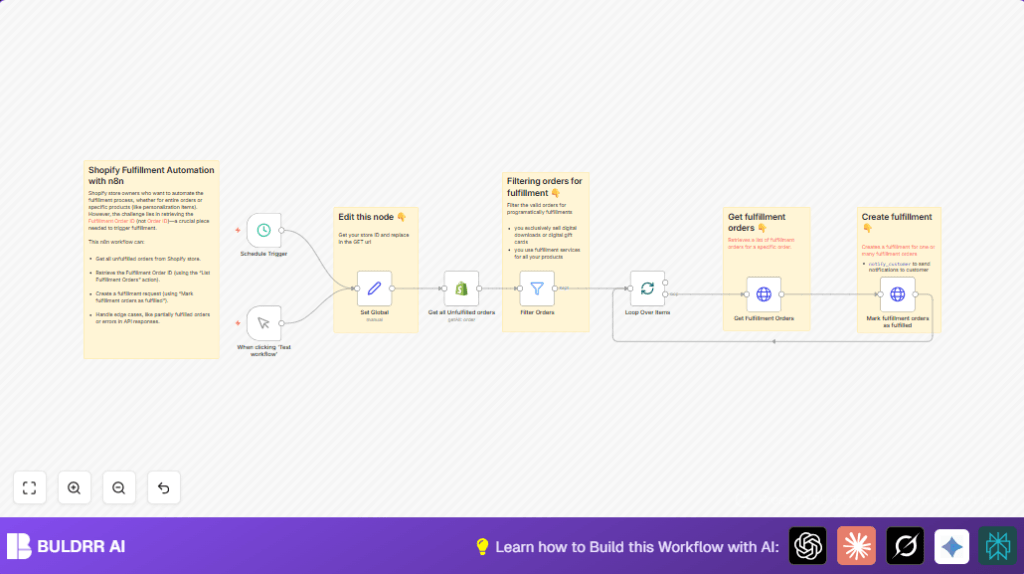

What This Automation Does
This workflow takes unfulfilled Shopify orders older than 24 hours and automatically marks them fulfilled.
It finds the right fulfillment order IDs and sends fulfillment notifications.
This helps to save time, reduce errors, and speed up letting customers know their orders are done.
The workflow gets unfulfilled orders via Shopify API, filters old orders, loops through them, fetches fulfillment orders, and creates fulfillment.
It works in batches so big order lists don’t overload the system.
How Much Time Does This Actually Save?
Here’s what Shopify order fulfillment looks like before and
after this workflow:
| Task | Before (Manual) | After (Automated) |
|---|---|---|
| Check unfulfilled orders | 15 min/day | 0 min |
| Match fulfillment order IDs | 20 min/day | 0 min |
| Mark orders as fulfilled | 20 min/day | 0 min |
| Send customer notifications | 10 min/day | 0 min |
| Total per day | ~65 minutes | 0 minutes |
| Total per week | ~5 hours | 0 hours |
For a store processing 50–200 orders a day, manual fulfillment
is a part-time job. This workflow runs on a schedule — every
hour, every day — and handles all of it without anyone touching
a single order.
Who Should Use This Workflow
This automation fits Shopify store owners who sell digital items or gift cards.
It suits those who get many orders each day and want to stop manual fulfillment work.
Users must have Shopify API access and some knowledge of n8n to set it up.
Also good for anyone wanting to reduce mistakes and speed up customer updates.
The 3 Tasks This Workflow Handles Automatically
Every time the workflow runs, it handles these three tasks
without any manual input:
1. Fulfill Orders
Fetches all unfulfilled Shopify orders older than 24 hours,
retrieves the correct fulfillment order IDs, and marks them
as fulfilled via Shopify API — in bulk, in batches, without
errors.
2. Notify Customers
Sends fulfillment notifications to customers automatically
the moment an order is marked fulfilled. No delayed emails,
no forgotten notifications, no support tickets asking
“where is my order?”
3. Update Inventory
As orders are fulfilled and closed, Shopify’s inventory
count reflects the change automatically — keeping your
stock levels accurate without any manual adjustment after
each fulfillment run.
All three run on a schedule you control — hourly, daily,
or at custom intervals — without anyone opening Shopify
manually.
Tools / Services Used
- Shopify API: To get orders and send fulfillment updates.
- n8n Automation: To run workflow nodes and logic.
- HTTP Request Node: To fetch fulfillment orders and send fulfillment requests.
Inputs, Processing Steps, and Output
Inputs
- Shopify Store ID and Access Token.
- Unfulfilled orders from Shopify store.
Processing Steps
- Get orders filtered by unfulfilled status.
- Filter orders older than 24 hours to avoid early fulfillment.
- Loop over orders in batches to handle large volumes.
- Request fulfillment orders linked to each main order using Shopify API.
- Send fulfillment requests to Shopify with correct fulfillment order IDs, and notify customers.
Output
- Orders marked as fulfilled in Shopify.
- Customers get notified of fulfillment automatically.
- Time saved by automating manual tasks.
Beginner Step-by-Step: How to Use This Workflow in n8n
Step 1: Import the Workflow
- Download the workflow file using the Download button on this page.
- Open your n8n editor.
- Use the menu to select “Import from File” and upload the downloaded workflow file.
Step 2: Configure Credentials and Settings
- Open the Set node named “Set Global” and input your Shopify store ID exactly (example: “myawesome-store”).
- Go to the Shopify node and HTTP Request nodes. Add your Shopify API access token credentials.
- If needed, update any IDs, emails, or other variables in nodes based on your store’s setup.
Step 3: Test the Workflow
- Run the workflow manually using the Manual Trigger node.
- Check the output to confirm orders are fetched and marked fulfilled correctly.
Step 4: Activate for Production
- Switch to the Schedule Trigger node to run this workflow automatically at intervals you set.
- Save and activate the workflow to automate fulfillment without manual work.
Using the workflow after import requires no deep coding. Just configure credentials, store ID, test it, and activate.
If using self-host n8n, ensure connectivity to Shopify API is set up.
Customization Ideas
- Turn off customer notification by setting “notify_customer” to false in fulfillment POST request.
- Change the 24-hour filter to other hour values to fit your store’s pace.
- Modify looping logic to fulfill multiple or partial fulfillment orders per main order by iterating all IDs.
- Adjust schedule frequency in the Schedule Trigger node for hourly, daily, or custom runs.
Using This Workflow With a 3PL Provider
Most growing Shopify stores don’t fulfill orders in-house —
they use a Third-Party Logistics (3PL) provider like Ship Bob,
Ship Station, Easy ship, or Fulfillment by Amazon (FBA).
This is where the biggest pain point lives: your 3PL ships
the order, but Shopify still shows it as “unfulfilled” —
because no one updated it.
This workflow solves that gap.
Here’s how to connect it to your 3PL setup:
→Ship Station / Ship Bob — These platforms push fulfillment
web hooks when an order ships. Use n8n’s Web hook node as the
trigger instead of the Schedule Trigger to fire the fulfillment
update in Shopify the moment your 3PL marks it shipped.
→ Fulfillment by Amazon (FBA) — Use an HTTP Request node to
poll the Amazon MWS or SP-API for fulfillment status, then
trigger this workflow to update Shopify when Amazon confirms
the shipment.
→ Any 3PL with web hook support — Replace the Schedule Trigger
with a Web hook node. When your 3PL fires a “shipped” event,
n8n catches it and immediately marks the Shopify order fulfilled
with customer notification.
The core fulfillment logic — fetching order IDs, creating
fulfillment, notifying customers — stays exactly the same.
Only the trigger changes depending on your 3PL’s setup.
Troubleshooting
- HTTP Request node returns 404 Not Found: Check store ID in Set node, confirm correct API version in URL.
- No orders retrieved from Shopify node: Verify Shopify API credentials and that unfulfilled orders exist in store.
- Workflow stops after first order: Ensure the continuation branch from SplitInBatches node connects back to loop nodes correctly.
Pre-Production Checklist
- Confirm Shopify API credentials are valid in n8n credentials settings.
- Manually test the workflow to confirm orders are fetched and filtered correctly.
- Verify that the 24-hour filter works as intended by checking timestamps.
- Test fulfillment creation for a single order before running large batches.
- Backup Shopify order data, or export it as fallback before running bulk fulfillment automation.
Deployment Guide
Once testing passes, activate the Schedule Trigger node.
This runs the workflow automatically at your chosen intervals without manual steps.
Monitor workflow runs in n8n UI for possible errors or retries.
Remember to rotate API keys regularly to keep Shopify connection secure.
Summary
✓ Save hours each day by automating fulfillment of old, unfulfilled Shopify orders.
✓ Reduce human mistakes by fetching and matching fulfillment order IDs automatically.
✓ Notify customers fast about their order status without manual work.
✓ Scale as order volume grows with batch processing logic.
→ The workflow inputs unfulfilled orders, processes fulfillment order data, and outputs marked fulfilled orders plus notifications.
→ Perfect for Shopify owners needing easy, reliable shipping automation.
