

What This Workflow Solves
This workflow is for anyone using n8n who needs to get quick answers from emails, calendar, and tasks using Telegram.
You can send a voice or text message to your Telegram bot.
The workflow listens, understands your request, checks Google Calendar, Gmail, Baserow tasks and contacts, and sends back a clear answer.
It stops you wasting hours searching mail, tasks, calendar, or missing something. You get one fast summary, every time.
Who Should Use This Workflow
- People who work with many emails and meetings daily.
- Anyone using n8n, Google Calendar, Gmail, Telegram, and Baserow for tasks.
- Beginners who want automation with easy steps, not coding.
Tools & Services Used
- Telegram Bot API: Receives user messages.
- OpenAI API: Transcribes voice and generates replies.
- Google Calendar API: Brings upcoming events.
- Gmail API: Collects unread emails after set date.
- Baserow API: Gets tasks and contacts.
- n8n Workflow Automation: Links all steps together.
Inputs → Processing Steps → Output
Inputs
- Telegram voice message or text message
- Google Calendar account
- Gmail inbox
- Baserow tasks and contacts database
- OpenAI API Key
Processing Steps
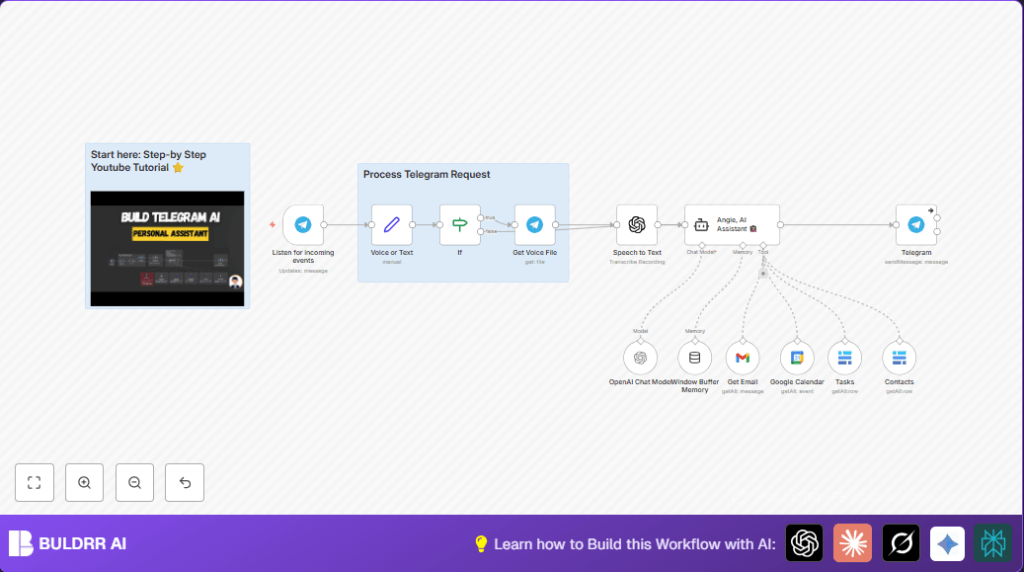
- The Telegram Trigger node listens for messages.
- If the message is voice, the workflow uses OpenAI Speech to Text to change voice to text.
- If message is text, it keeps the text directly.
- The text is passed through a Set node to keep context.
- Get Email node checks Gmail for new emails after a date.
- Google Calendar node collects events from your calendar after the set date.
- Tasks and Contacts from Baserow are pulled using their node.
- The LangChain Agent node reads all this info, gets what is most important, and writes a reply.
- The Telegram node sends the reply to you via chat.
Output
- One single Telegram reply message with the summary from your emails, calendar, and tasks.
Beginner step-by-step: How to build this in n8n
Step A: Get The Workflow
- Find the Download button for this workflow on the page.
- Click it and save the file to your computer.
Step B: Import In n8n
- Inside n8n editor, click the menu (upper right) and select ‘Import from File’.
- Choose the file you downloaded. The workflow will load.
Step C: Update Credentials
- Add your Telegram Bot API key to every Telegram Trigger or Telegram node.
- Add your OpenAI API Key where needed.
- Add OAuth2 for Google Calendar and Gmail. Follow n8n’s screen for credentials.
- Add your Baserow API Key for the Tasks and Contacts nodes.
Step D: Set Up IDs and Filters
- In the Google nodes, pick your email and calendar account.
- Update any database, table, or folder IDs in the Baserow nodes for tasks and contacts.
Step E: Test The Workflow
- Send a message to your Telegram bot (text or voice).
- Wait for the reply — if it works, it will summarize your email, calendar, tasks.
- If no reply, check each node for correct API Key or OAuth errors.
Step F: Activate Workflow
- If test works, switch workflow to ‘Active’ at top right.
- The workflow is now live.
- Remember, you must keep your n8n online. If you want privacy, you can self-host n8n easily.
Customization Ideas
- Change Date Search: In both Google nodes, change the filter date for a bigger or smaller search window.
- Edit AI Reply Style: In the LangChain Agent node, look for system message. Make the reply more short or more detailed by editing the prompt.
- Add More Data: You can add Slack, CRM, or more sources. Make a new node and link it to the LangChain Agent node.
- Multi-Language: Use translation in OpenAI before the reply node to reply in your language.
Common Edge Cases and Troubleshooting
- No reply from Telegram bot.
Check the Telegram Trigger node webhook URL. Make sure n8n is active and online, and the workflow open for incoming messages. - Emails do not appear in reply.
Check the “receivedAfter” setting in Get Email node. Make sure Gmail permissions allow inbox access. - Wrong data in reply.
Make sure your Google and Baserow nodes have correct IDs — not sample ones. - API quota or credential error.
Update API Key, OAuth2 info, or check if limits are reached.
Summary / Final Result
- ✓ Save up to 2 hours per day not checking emails or tasks one by one
- ✓ Get a combined answer from email, calendar, and tasks in one Telegram message
- ✓ No coding or technical skills needed
- → Start quickly and edit later if your workflows change
- → Add new tools anytime—just connect new nodes
