
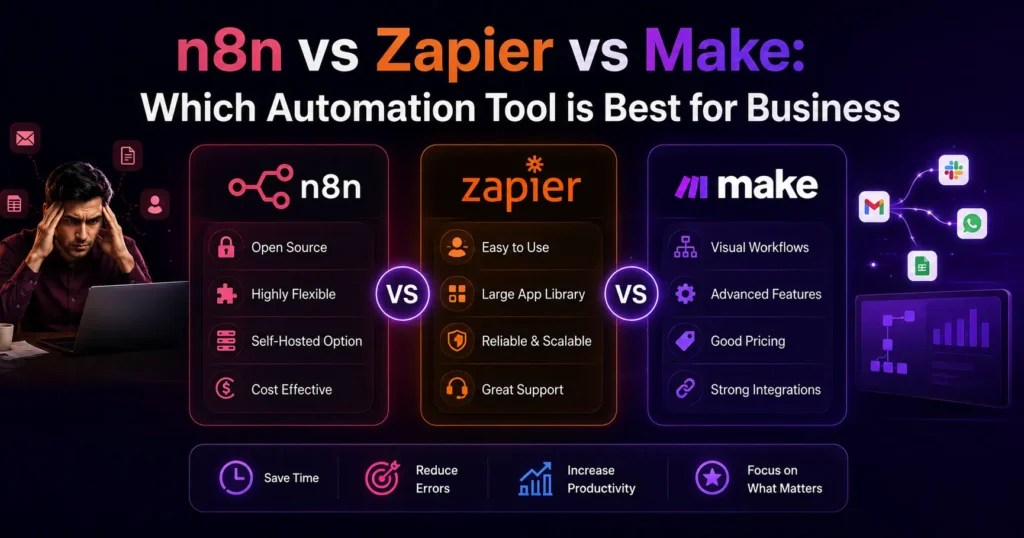
n8n vs Zapier vs Make: Which Automation Tool is Best for Business

n8n vs Zapier vs Make
Updated: August 11, 2026

n8n is the best fit for businesses that want self-hosting, unlimited executions, and deep AI-agent capability and have some technical capacity; Zapier is best for non-technical teams that want the widest app library and the fastest setup; Make sits in between, offering strong visual workflow design at a lower cost than Zapier without requiring code. Zapier leads with 7,000+ integrations and the simplest UX, Make delivers visual workflow power at roughly 60% lower cost than Zapier, and n8n is the only option with true self-hosting and unlimited executions.

Choosing between these three platforms used to be mostly a price comparison. In 2026 it’s a more layered decision, shaped by how AI-heavy your workflows are, whether data residency matters to your business, and how much technical capacity your team actually has.

The core difference: how each platform charges you

This is where the three tools diverge the most, and it’s the single biggest factor in long-term cost:

  • Zapier bills per task — every individual action inside a workflow counts against your quota.
  • Make bills per operation — similar concept to Zapier but generally more operations per dollar.
  • n8n bills per execution — an entire multi-step workflow run counts as one execution, regardless of how many steps it has.

For a 10-step workflow running 10,000 times a month, n8n can cut costs by 80–90% compared to Zapier, because Zapier would be counting each of those 10 steps separately across 10,000 runs. This gap widens as your workflows get more complex — the more steps a single automation has, the more n8n’s execution-based pricing pulls ahead.

Pricing snapshot (2026)

n8n starts from $20/mo or is free when self-hosted, Zapier starts from $19.99/mo, and Make starts from $9/mo. But sticker price isn’t the full story — at real production volume, the picture changes considerably. Running a workflow 10,000 times a month with 8 steps per run, n8n Cloud costs around $50/month, Make would need roughly $150–200/month across tiers, and Zapier could run $250–400+/month for the equivalent task volume.

Self-hosted n8n removes execution-based billing entirely — the source-available license allows self-hosting for personal and commercial use without a subscription fee, meaning the only ongoing cost is server hosting, often under $10–15/month for small-to-mid workloads.

Integration breadth: Zapier’s clear advantage

If breadth of pre-built app connections matters most to your team, Zapier still wins by a wide margin. Zapier dominates with 8,000+ pre-built integrations, so if you need to connect a niche SaaS tool quickly without any technical setup, Zapier likely already supports it out of the box. n8n and Make both close this gap with a universal HTTP/API request node that can connect to virtually any service with a REST API — n8n’s generic HTTP Request node allows connecting to any service using REST/GraphQL, handling custom authentication, and parsing complex JSON responses — but that requires more technical comfort than clicking a pre-built Zapier integration.

AI capabilities: where n8n has pulled ahead

All three platforms added meaningful AI features going into 2026, but the depth differs. n8n 2.0 introduced LangChain integration and 70+ AI nodes, Make launched Maia AI and Make AI Agents, and Zapier released Zapier Agents for autonomous task execution. n8n offers the most advanced technical capabilities for complex, highly customized AI solutions; Make takes an intermediate approach integrating existing AI services with good functional depth; and Zapier focuses on making AI accessible without technical knowledge but with more limited customization.

n8n’s AI Agent Tool Node enables multi-agent orchestration with native LangChain integration, which is a meaningfully deeper capability than either competitor offers for teams building genuinely custom AI-driven workflows — like a lead-qualification agent that reasons through multiple decision branches, not just a single AI-enhanced action step.

Self-hosting and data control: n8n’s structural advantage

This is the feature Zapier and Make simply can’t match, because they’re closed SaaS platforms. n8n is open-source and can be run entirely on infrastructure you control — as an open-source solution, n8n offers something neither Zapier nor Make can match: complete data sovereignty. For businesses in regulated industries, or those with strict data-residency requirements, this alone can be the deciding factor regardless of pricing.

Which one should you actually choose?

  • Choose Zapier if you have a non-technical team, need the broadest possible app coverage immediately, and value simplicity over cost efficiency at scale.
  • Choose Make if you want visual, branching workflow logic at a meaningfully lower cost than Zapier, and your team is comfortable with a moderate learning curve.
  • Choose n8n if you have some technical capacity (in-house or via an agency), want unlimited executions and full data control through self-hosting, or are building AI-agent-driven workflows that need real orchestration depth.

If you’re on Zapier and considering a move, the common trigger is a monthly bill north of $300 or unexpected AI-credit charges — teams in that position often migrate to self-hosted n8n for cost control, with payback typically in 8–12 weeks once migration time is included.

Why businesses partner with an agency for the n8n path

n8n’s power comes with a steeper setup curve than Zapier or Make — self-hosting, custom nodes, and AI-agent orchestration all require technical judgment calls that a non-technical team may not want to own alone. This is exactly the gap an n8n automation agency fills: getting the cost and data-control advantages of n8n without needing an in-house engineer to manage the infrastructure from day one.

FAQs

Is n8n cheaper than Zapier?

Generally yes, especially for multi-step workflows run at volume, because n8n bills per workflow execution rather than per individual task step — and self-hosted n8n has no per-execution cost at all beyond server hosting.

Is n8n harder to learn than Zapier?

Yes, n8n has a steeper learning curve, particularly for self-hosting and advanced logic, though its visual canvas is still no-code-friendly for straightforward workflows.

Can I migrate from Zapier to n8n?

Yes, though it requires manually rebuilding workflows in n8n’s interface rather than a one-click import — this is one of the most common reasons businesses bring in an automation agency for the migration.

Which is best for AI-powered workflows: n8n, Zapier, or Make?

n8n currently offers the deepest AI-agent orchestration capability of the three, making it the strongest choice for businesses building genuinely custom, multi-step AI-driven automations rather than single AI-enhanced actions.

Conclusion

There’s no universal winner in the n8n vs Zapier vs Make comparison — the right choice depends on your team’s technical capacity, how complex your workflows are, and whether cost efficiency or out-of-the-box simplicity matters more. Zapier wins on breadth and ease, Make wins on visual power at a mid-tier price, and n8n wins on cost efficiency at scale, data control, and AI-agent depth for businesses willing to invest a bit more setup effort — often through an experienced automation partner rather than going it alone.

n8n is the best fit for businesses that want self-hosting, unlimited executions, and deep AI-agent capability and have some technical capacity; Zapier is best for non-technical teams that want the widest app library and the fastest setup; Make sits in between, offering strong visual workflow design at a lower cost than Zapier without requiring code. Zapier leads with 7,000+ integrations and the simplest UX, Make delivers visual workflow power at roughly 60% lower cost than Zapier, and n8n is the only option with true self-hosting and unlimited executions.

Choosing between these three platforms used to be mostly a price comparison. In 2026 it’s a more layered decision, shaped by how AI-heavy your workflows are, whether data residency matters to your business, and how much technical capacity your team actually has.

The core difference: how each platform charges you

This is where the three tools diverge the most, and it’s the single biggest factor in long-term cost:

  • Zapier bills per task — every individual action inside a workflow counts against your quota.
  • Make bills per operation — similar concept to Zapier but generally more operations per dollar.
  • n8n bills per execution — an entire multi-step workflow run counts as one execution, regardless of how many steps it has.

For a 10-step workflow running 10,000 times a month, n8n can cut costs by 80–90% compared to Zapier, because Zapier would be counting each of those 10 steps separately across 10,000 runs. This gap widens as your workflows get more complex — the more steps a single automation has, the more n8n’s execution-based pricing pulls ahead.

Pricing snapshot (2026)

n8n starts from $20/mo or is free when self-hosted, Zapier starts from $19.99/mo, and Make starts from $9/mo. But sticker price isn’t the full story — at real production volume, the picture changes considerably. Running a workflow 10,000 times a month with 8 steps per run, n8n Cloud costs around $50/month, Make would need roughly $150–200/month across tiers, and Zapier could run $250–400+/month for the equivalent task volume.

Self-hosted n8n removes execution-based billing entirely — the source-available license allows self-hosting for personal and commercial use without a subscription fee, meaning the only ongoing cost is server hosting, often under $10–15/month for small-to-mid workloads.

Integration breadth: Zapier’s clear advantage

If breadth of pre-built app connections matters most to your team, Zapier still wins by a wide margin. Zapier dominates with 8,000+ pre-built integrations, so if you need to connect a niche SaaS tool quickly without any technical setup, Zapier likely already supports it out of the box. n8n and Make both close this gap with a universal HTTP/API request node that can connect to virtually any service with a REST API — n8n’s generic HTTP Request node allows connecting to any service using REST/GraphQL, handling custom authentication, and parsing complex JSON responses — but that requires more technical comfort than clicking a pre-built Zapier integration.

AI capabilities: where n8n has pulled ahead

All three platforms added meaningful AI features going into 2026, but the depth differs. n8n 2.0 introduced LangChain integration and 70+ AI nodes, Make launched Maia AI and Make AI Agents, and Zapier released Zapier Agents for autonomous task execution. n8n offers the most advanced technical capabilities for complex, highly customized AI solutions; Make takes an intermediate approach integrating existing AI services with good functional depth; and Zapier focuses on making AI accessible without technical knowledge but with more limited customization.

n8n’s AI Agent Tool Node enables multi-agent orchestration with native LangChain integration, which is a meaningfully deeper capability than either competitor offers for teams building genuinely custom AI-driven workflows — like a lead-qualification agent that reasons through multiple decision branches, not just a single AI-enhanced action step.

Self-hosting and data control: n8n’s structural advantage

This is the feature Zapier and Make simply can’t match, because they’re closed SaaS platforms. n8n is open-source and can be run entirely on infrastructure you control — as an open-source solution, n8n offers something neither Zapier nor Make can match: complete data sovereignty. For businesses in regulated industries, or those with strict data-residency requirements, this alone can be the deciding factor regardless of pricing.

Which one should you actually choose?

  • Choose Zapier if you have a non-technical team, need the broadest possible app coverage immediately, and value simplicity over cost efficiency at scale.
  • Choose Make if you want visual, branching workflow logic at a meaningfully lower cost than Zapier, and your team is comfortable with a moderate learning curve.
  • Choose n8n if you have some technical capacity (in-house or via an agency), want unlimited executions and full data control through self-hosting, or are building AI-agent-driven workflows that need real orchestration depth.

If you’re on Zapier and considering a move, the common trigger is a monthly bill north of $300 or unexpected AI-credit charges — teams in that position often migrate to self-hosted n8n for cost control, with payback typically in 8–12 weeks once migration time is included.

Why businesses partner with an agency for the n8n path

n8n’s power comes with a steeper setup curve than Zapier or Make — self-hosting, custom nodes, and AI-agent orchestration all require technical judgment calls that a non-technical team may not want to own alone. This is exactly the gap an n8n automation agency fills: getting the cost and data-control advantages of n8n without needing an in-house engineer to manage the infrastructure from day one.

FAQs

Is n8n cheaper than Zapier?

Generally yes, especially for multi-step workflows run at volume, because n8n bills per workflow execution rather than per individual task step — and self-hosted n8n has no per-execution cost at all beyond server hosting.

Is n8n harder to learn than Zapier?

Yes, n8n has a steeper learning curve, particularly for self-hosting and advanced logic, though its visual canvas is still no-code-friendly for straightforward workflows.

Can I migrate from Zapier to n8n?

Yes, though it requires manually rebuilding workflows in n8n’s interface rather than a one-click import — this is one of the most common reasons businesses bring in an automation agency for the migration.

Which is best for AI-powered workflows: n8n, Zapier, or Make?

n8n currently offers the deepest AI-agent orchestration capability of the three, making it the strongest choice for businesses building genuinely custom, multi-step AI-driven automations rather than single AI-enhanced actions.

Conclusion

There’s no universal winner in the n8n vs Zapier vs Make comparison — the right choice depends on your team’s technical capacity, how complex your workflows are, and whether cost efficiency or out-of-the-box simplicity matters more. Zapier wins on breadth and ease, Make wins on visual power at a mid-tier price, and n8n wins on cost efficiency at scale, data control, and AI-agent depth for businesses willing to invest a bit more setup effort — often through an experienced automation partner rather than going it alone.

Author
Written By
Ankit Sharma
Ask more Questions about this Blog with AI:

Our AI Articles

Learn from our AI Articles to excel in your profession ;)

10 Best n8n Workflows Every Business Should Automate

Manual work is killing business speed. In 2026, companies that still copy-paste data between apps are already behind. This is...

Automating the First 14 Days After Someone Buys From You

How to automate the first 14 days after a sale closes — welcome messages, account setup, kickoff booking, and day-7/day-14...

10 Questions to Ask Before Hiring an n8n Automation Agency

Before hiring an n8n automation agency, ask about their pricing model (per-workflow vs retainer), who owns the finished workflows, how...

How to Use OpenRouter with n8n: Free AI Workflows (No Card Needed)

You keep hearing about AI automation but every option seems to cost money. ChatGPT Plus is $20 a month. Claude...

How to Automate Lead Follow-Up Calls with AI: A Step-by-Step Guide

Here is a number that should worry every business owner: leads that are called within five minutes of showing interest...

10 Claude Tips: From Using 10% of Claude to Actually Using It

A practical guide to getting more out of Claude, this post shares 10 tips from beginner to advanced, including choosing...

How Claude Killed Prompt Engineering (And What To Do Instead)

Anthropic’s latest Claude updates suggest a shift away from long, rule-heavy prompts toward minimal, goal-first context. This post explains Record...

Why AI Recommends the Business With Recent Reviews, Not Just More of Them

Why AI search tools like ChatGPT and Google AI Overviews weigh review recency and response rate above raw review count...

Build a Second Brain for Your Business With Claude Code and Obsidian

This guide shows how to build a business second brain with Claude Code and Obsidian in under 10 minutes. Using...

Does AI Actually Care How Old Your Content Is?

Does content freshness really affect AI citations? Yes, but it's one of 23 factors, not the deciding one, and the...

Does Your “About Us” Page Actually Help AI Trust Your Business?

Does an About Us page actually help AI trust your business? Yes, it's a core E-E-A-T signal Google's own quality...

Kimi K3 Setup Guide: Add It to Claude Code, Codex CLI, Cursor & Aider Free

Learn how to set up Kimi K3, Moonshot AI’s powerful open-source model, as the default in Claude Code, Codex CLI,...
1:1 Free Strategy Session
Your competitors are already automating. Are you still paying for it manually?

Do you want to adopt AI Automation?

Every hour your team does repetitive work, you're burning real money.
While you wait, faster businesses are cutting costs and moving quicker.
AI and automations aren't the future anymore — they're the present.

Book a live 1-on-1 session where we show you exactly which of your daily tasks can be automated — and what it’s costing you not to.