
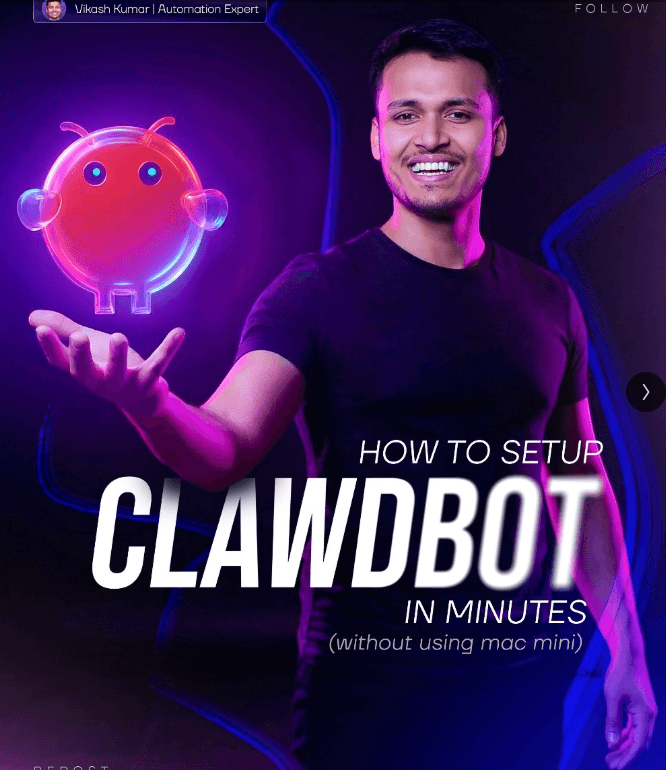
This VPS guide picks up where that guide ends — it assumes
you know what ClawdBot does and focuses entirely on how to
deploy it safely on a server so it runs 24/7 without your
laptop being on.
This guide shows how to safely deploy ClawdBot on a Virtual Private Server (VPS) so it runs 24/7 and stays isolated from your personal computer.
Why use a VPS instead of a Mac Mini?
ClawdBot is open source and has full access to its environment.
That means:
- It can run commands
- It can read files
- It can access apps and services
Putting it on your main laptop is risky.
People buy Mac Minis to isolate it.
A VPS does the same thing, for much less money.
VPS Cost Comparison — Hetzner, Hostinger, DigitalOcean
The Mac Mini people buy for ClawdBot isolation costs $599–$799
upfront, plus electricity running 24/7.
A VPS does the same isolation job for a fraction of that.
Here’s how the main providers compare for a ClawdBot-ready spec
(2 vCPU, 8GB RAM, Ubuntu 24.04):
| Provider | Plan | Monthly Cost | Annual Cost | Notes |
|---|---|---|---|---|
| Hostinger | KVM2 | ~$8–12/mo | ~$96–144 | Used in this guide, easy UI |
| Hetzner | CX22 | ~$4–6/mo | ~$48–72 | Cheapest, EU-based servers |
| DigitalOcean | Basic Droplet | ~$12–18/mo | ~$144–216 | Good docs, US/global regions |
Which one to choose:
→ Hetzner — cheapest option, excellent for Europe-based users,
slightly more technical setup. Best value if you’re comfortable
with Linux.
→ Hostinger — what this guide uses. Best balance of price and
beginner-friendliness. VPS dashboard is cleaner to navigate.
→ DigitalOcean — slightly more expensive but the best
documentation and support ecosystem. Good if you plan to scale.
All three run Ubuntu 24.04 LTS and support the exact same
ClawdBot setup steps in this guide — only Step 1 differs
(choosing your provider).
What you need before starting
- A VPS account (Hostinger used in this guide)
- A computer with a terminal (Mac, Windows, or Linux)
- A Telegram account
- An Anthropic API key
→ Recommended: read the ClawdBot Practical Usage Guide
before starting this setup.
Step 1. Create a VPS
- Go to Hostinger VPS hosting
- Choose a VPS plan
Recommended plan used here:
- KVM2
- 2 vCPU
- 8 GB RAM
- 100 GB storage
- 8 TB bandwidth
This is more than enough for ClawdBot.
- Choose a billing period
- 12 or 24 months gives the best price
- Optional discount code can reduce cost further
- Choose server location
- Choose operating system
- Ubuntu 24.04 LTS
- Confirm and pay
Step 2. Set your root password
After payment:
- Create a strong root password
- Save it safely
You will need this password multiple times.
SSH keys are optional and can be added later.
Step 3. Open the VPS dashboard
- Click “Manage VPS”
- Skip onboarding questions
- You should now see:
- IP address
- System status
- VPS metrics
Step 4. Connect to the VPS using SSH
Open your terminal or command prompt.
In the Hostinger dashboard, copy the SSH command:
ssh root@YOUR_VPS_IP
Paste it into your terminal and press Enter.
When asked:
- Type yes
- Enter the root password
You are now inside the VPS.
Step 5. Create a dedicated user for ClawdBot
Never run ClawdBot as root.
Create a new user:
adduser claude
Set a password when prompted.
Skip optional profile details.
Give admin permissions:
usermod -aG sudo claude
Switch to the new user:
su – claude
Your prompt should change, confirming you are now logged in as this user.
Step 6. Install ClawdBot
Use the official one-line installer provided by ClawdBot.
Paste the installer command and press Enter.
What happens next:
- OS is detected
- Node.js is installed
- Dependencies are installed
- ClawdBot is installed
This can take 2 to 10 minutes.
Do not interrupt the process.
Step 7. Start the onboarding flow
After installation, onboarding starts automatically.
- Read the security warning
- Confirm that you understand the risks
- Choose Quick Start
Step 8. Configure the AI model
- Select Anthropic as the provider
- Enter your Anthropic API key
- Choose default model
- Opus 4.5
Step 9. Choose a messaging channel
When prompted, select:
- Telegram Bot API
Step 10. Create a Telegram bot
Open Telegram.
- Search for BotFather
- Send the command: /newbot
- Choose:
- Bot name
- Bot username (must end with “bot”)
- BotFather gives you a bot token
Copy this token and paste it into the terminal when ClawdBot asks for it.
Step 11. Select skills
When asked to install skills:
- Choose npm
- Select optional skills using Space
- Claude Hub
- Google tools if needed
You can add more skills later.
If a skill fails to install, continue.
It can be fixed later.
Step 12. Finish onboarding
When onboarding completes:
- ClawdBot is installed
- A local dashboard URL is shown
If you open it in your browser, it will not work yet.
This is expected.
Step 13. Start the ClawdBot gateway
Make sure you are logged in as the correct user:
whoami
Start the gateway:
ClawdBot gateway start
You should see a message confirming:
- Gateway is listening on a port
Step 14. Create an SSH tunnel
Open a new terminal window on your computer.
Run:
ssh -N -L 18789:localhost:18789 claude@YOUR_VPS_IP
Enter the claude user password.
Step 15. Open the web dashboard
In your browser, open:
You should now see:
- ClawdBot web dashboard
- Health status showing OK
Step 16. Pair Telegram with ClawdBot
- Open your Telegram bot
- Press Start
- Telegram provides a pairing code
Send this pairing code inside the ClawdBot web chat.
ClawdBot confirms the pairing.
Step 17. Test Telegram control
Send a message to the Telegram bot:
Hello
ClawdBot should reply.
This confirms:
- Telegram integration works
- ClawdBot is live
Step 18. Enable auto-start on reboot
This ensures ClawdBot runs 24/7.
Enable the service:
ClawdBot service enable
Start it:
ClawdBot service start
Check status:
ClawdBot service status
You should see the service running.
Step 19. Verify remote access
Close your SSH tunnel and terminal.
Send a message from Telegram again.
If ClawdBot responds:
- Your setup is complete
- ClawdBot is running independently
Security warnings you must understand
Treat ClawdBot like a human assistant with admin access.
Key risks:
- It can run system commands
- It can read files
- It can access services you connect
Best practices:
- Use separate email accounts
- Avoid personal calendars and vaults
- Prefer read-only permissions
- Never expose secrets casually
A VPS isolates damage if something goes wrong.
Finally
You now have:
- ClawdBot running on a VPS
- Telegram control from anywhere
- No Mac Mini required
- Reduced security risk
???? New to ClawdBot? Read the complete ClawdBot setup and
usage guide first:
→ ClawdBot Complete Guide — What It Is, How It Works, and What You Can Build With It
