THE RUBEN HASSID BLUEPRINT: Complete Creator & Channel Analysis

RUBEN HASSID

Here is the comprehensive, deep-dive report on RUBEN HASSID. I have structured this to be highly readable, breaking down his massive digital footprint into actionable insights, core frameworks, and visual data representations.


🎛️ INFOGRAPHIC: The RUBEN HASSID Ecosystem Dashboard

MetricCurrent StatusThe “How” (Engine)
LinkedIn Following500,000+ FollowersHigh-frequency, 80/20 educational posts
Total Impressions100M+ Organic ViewsContrarian takes, zero-fluff frameworks
Newsletter (Substack)442,000+ Subs (#1 in Ed)Lead magnets, free prompt vaults
SaaS Revenue (EasyGen)$33,000+ MRR (in 5 months)Solving the “robotic AI” problem
Video Reach60,000,000+ ViewsAI Avatar scaling (Synthesia)

1. Origin & Trajectory: From Underground Techno to AI Vanguard

Ruben’s background perfectly positioned him for the AI revolution. At 29 years old, the French entrepreneur (now based in Tel Aviv) didn’t start as a software engineer. His roots are in marketing and music.

  • The Early Days: Ran two music labels, mastering the art of getting the right message to the right audience to push underground techno artists to millions of views.
  • The Pivot: Worked as an International Social Media Manager (Trade Republic) and later as a ghostwriter managing freelancers.
  • The Catalyst: November 2022. When ChatGPT launched, Ruben realized it wasn’t just a writing tool; it was an entire content infrastructure. Within two years, he transformed from a 25-year-old ghostwriter into LinkedIn’s #1 AI Creator and a SaaS founder.

2. The Core Philosophy: “Master AI Before It Masters You”

Ruben’s approach is defined by treating AI as an amplifier of human intelligence, not a replacement for it. He actively fights against “lazy AI.”

⚙️ INFOGRAPHIC: The RUBEN HASSID Workflow Engine

Key Directives:

  • Don’t Schedule Posts: Scheduling kills reach. The algorithm measures the first 60 minutes. If you aren’t in the comments actively replying, your post is dead on arrival.
  • The 80/20 Rule: 80% of your content must deliver raw, immediate value. Only 20% can be personal branding. Nobody cares about you; they care about how you can help them.
  • AI Avatars are the Future: He removed the stigma of AI video by using Synthesia to clone himself. This allowed him to generate over 60 million views while traveling seamlessly between the US, Europe, and Israel.

3. The Tool Stack: Agnosticism over Loyalty

Ruben has zero brand loyalty to AI models. He uses whatever solves the specific bottleneck the fastest.

The ObjectiveRuben’s Tool of ChoiceWhy He Uses It
Deep ResearchPerplexityReplaces Google; cites sources instantly.
Human-Like TextClaude / EasyGenBypasses the generic “ChatGPT tone.”
Visual AssetsMidjourneyHighest quality for professional, custom imagery.
Personal MentorNotebookLMFeeds it custom data to create hyper-specific guides.
Video ScalingSynthesia / PikaAllows daily video publishing without a camera.

4. RUBEN HASSID YouTube Strategy: Micro-Masterclasses

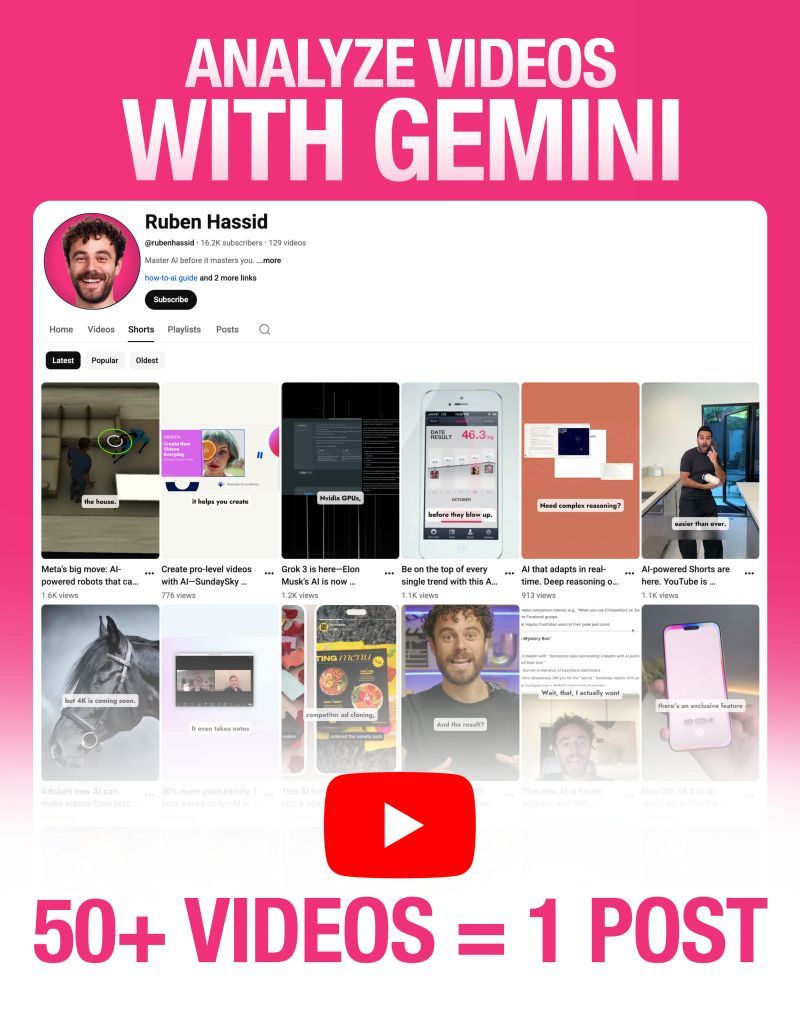
His YouTube channel (@rubenhassid) is a tactical extension of his written content. He avoids long-winded, theoretical 2-hour masterclasses.

Format Breakdown:

  • Live Demonstrations: Identifies a tool, shares his screen, and builds a workflow live. The viewer gets a usable asset by the end of the video.
  • Anti-Prompting Masterclasses: He hates 500-word prompts. He teaches that a well-structured 29-word prompt built on a solid logic framework will outperform a massive, confusing prompt every time.
  • LinkedIn Demystified: He converts his massive LinkedIn success into YouTube tutorials, teaching users how to build hooks, analyze the “Outlier Index,” and repurpose content seamlessly.

5. The Business Ecosystem (The Funnel)

Everything Ruben creates points back to a highly optimized monetization and lead-capture ecosystem.

  1. Top of Funnel (Attention): Viral LinkedIn posts and YouTube Shorts.
  2. Middle of Funnel (Trust): “How to AI” Substack (442k+ readers). He gives away massive value for free, building immense goodwill.
  3. Bottom of Funnel (Monetization):
    • EasyGen: His bootstrapped SaaS tool that natively integrates agentic workflows to write LinkedIn posts.
    • Prompt Vault & AI Hub: Premium, curated libraries of his exact prompts and systems.
    • Keynote Speaking: High-ticket offline engagements, such as the RAISE Summit in Paris.

“Most people aren’t failing at AI automation because they lack technical skills. They’re failing because they are building cool things that nobody is willing to pay for.”


6. Advanced Prompting Mechanics: The “Anti-AI” Doctrine

Ruben doesn’t just teach people how to use AI; he teaches them how to hide the fact that they are using AI. He believes lengthy, complex prompts are the mark of an amateur.

  • The 29-Word Rule: Instead of feeding ChatGPT a 500-word essay of instructions, he uses ultra-concise, 29-word prompts that focus solely on context and constraints.
  • The “Anti-AI” Style File: He built a system where you feed the AI a document containing all the overused, robotic phrases (e.g., “In today’s fast-paced digital world,” “Delve,” “Tapestry”). By strictly banning these words, the output instantly reads like a human wrote it.
  • System Prompts over Chat: He advocates heavily for using Claude’s “System Prompts” to permanently alter the AI’s core behavior, rather than having to re-prompt it in every single new chat window.

7. The LinkedIn Growth Architecture

Generating 100 million organic views is not luck; it’s a mathematical system. Ruben approaches LinkedIn like a data scientist.

📈 INFOGRAPHIC: The Viral Anatomy

The VariableRuben’s FrameworkThe “Why”
The HookForced Click MechanicsThe hook’s only job is to get them to click “See more.” He uses ChatGPT to generate 20 variations before picking one.
The FormattingHigh White SpacePeople skim before they read. Short sentences, bullet points, and visual breaks keep viewers engaged.
The DataThe Outlier IndexHe analyzes which posts perform mathematically higher than the account average and mercilessly doubles down on those formats.

8. Macro Mindset & Future Predictions

Ruben’s philosophical content operates as a wake-up call for knowledge workers. He doesn’t sugarcoat the trajectory of generative AI.

  • “Quit ChatGPT in 2026”: He actively warns his audience not to get too comfortable with the current iteration of ChatGPT, urging them to constantly test frontier models (like DeepSeek, new Claude versions, or Gemini) so they don’t get locked into a legacy workflow.
  • AI Detection is a Scam: He is highly critical of AI detection tools, arguing they are fundamentally flawed and create false positives. His focus is on the value of the output, not whether a machine generated the first draft.
  • The Raised Minimum Standard: He teaches that AI isn’t going to replace top-tier humans; it is going to replace average humans. AI has permanently raised the baseline for what is considered “acceptable” work.

9. The SaaS Founder Pipeline (Building EasyGen)

One of the most fascinating aspects of Ruben’s journey is how he transitioned from a content creator to a software founder.

  • Solving His Own Bottleneck: He didn’t build EasyGen because he wanted to be a tech CEO; he built it because he was deeply frustrated with how poorly ChatGPT handled LinkedIn post generation.
  • Agentic Workflows: Instead of a simple API wrapper, EasyGen uses an “agent workflow” where multiple AI models talk to each other to draft, critique, and finalize the post before the user sees it.
  • The Result: He scaled this to $33,000+ MRR (Monthly Recurring Revenue) in just 5 months, proving that his audience is willing to pay for implementation, not just information.

10. The Ultimate Repurposing Engine

Ruben is obsessed with leverage. He teaches his audience how to stop being on the “content treadmill” by turning one macro-asset into dozens of micro-assets.

Here is the comprehensive, deep-dive report on RUBEN HASSID. I have structured this to be highly readable, breaking down his massive digital footprint into actionable insights, core frameworks, and visual data representations.


🎛️ INFOGRAPHIC: The RUBEN HASSID Ecosystem Dashboard

MetricCurrent StatusThe “How” (Engine)
LinkedIn Following500,000+ FollowersHigh-frequency, 80/20 educational posts
Total Impressions100M+ Organic ViewsContrarian takes, zero-fluff frameworks
Newsletter (Substack)442,000+ Subs (#1 in Ed)Lead magnets, free prompt vaults
SaaS Revenue (EasyGen)$33,000+ MRR (in 5 months)Solving the “robotic AI” problem
Video Reach60,000,000+ ViewsAI Avatar scaling (Synthesia)

1. Origin & Trajectory: From Underground Techno to AI Vanguard

Ruben’s background perfectly positioned him for the AI revolution. At 29 years old, the French entrepreneur (now based in Tel Aviv) didn’t start as a software engineer. His roots are in marketing and music.

  • The Early Days: Ran two music labels, mastering the art of getting the right message to the right audience to push underground techno artists to millions of views.
  • The Pivot: Worked as an International Social Media Manager (Trade Republic) and later as a ghostwriter managing freelancers.
  • The Catalyst: November 2022. When ChatGPT launched, Ruben realized it wasn’t just a writing tool; it was an entire content infrastructure. Within two years, he transformed from a 25-year-old ghostwriter into LinkedIn’s #1 AI Creator and a SaaS founder.

2. The Core Philosophy: “Master AI Before It Masters You”

Ruben’s approach is defined by treating AI as an amplifier of human intelligence, not a replacement for it. He actively fights against “lazy AI.”

⚙️ INFOGRAPHIC: The RUBEN HASSID Workflow Engine

Key Directives:

  • Don’t Schedule Posts: Scheduling kills reach. The algorithm measures the first 60 minutes. If you aren’t in the comments actively replying, your post is dead on arrival.
  • The 80/20 Rule: 80% of your content must deliver raw, immediate value. Only 20% can be personal branding. Nobody cares about you; they care about how you can help them.
  • AI Avatars are the Future: He removed the stigma of AI video by using Synthesia to clone himself. This allowed him to generate over 60 million views while traveling seamlessly between the US, Europe, and Israel.

3. The Tool Stack: Agnosticism over Loyalty

Ruben has zero brand loyalty to AI models. He uses whatever solves the specific bottleneck the fastest.

The ObjectiveRuben’s Tool of ChoiceWhy He Uses It
Deep ResearchPerplexityReplaces Google; cites sources instantly.
Human-Like TextClaude / EasyGenBypasses the generic “ChatGPT tone.”
Visual AssetsMidjourneyHighest quality for professional, custom imagery.
Personal MentorNotebookLMFeeds it custom data to create hyper-specific guides.
Video ScalingSynthesia / PikaAllows daily video publishing without a camera.

4. RUBEN HASSID YouTube Strategy: Micro-Masterclasses

His YouTube channel (@rubenhassid) is a tactical extension of his written content. He avoids long-winded, theoretical 2-hour masterclasses.

Format Breakdown:

  • Live Demonstrations: Identifies a tool, shares his screen, and builds a workflow live. The viewer gets a usable asset by the end of the video.
  • Anti-Prompting Masterclasses: He hates 500-word prompts. He teaches that a well-structured 29-word prompt built on a solid logic framework will outperform a massive, confusing prompt every time.
  • LinkedIn Demystified: He converts his massive LinkedIn success into YouTube tutorials, teaching users how to build hooks, analyze the “Outlier Index,” and repurpose content seamlessly.

5. The Business Ecosystem (The Funnel)

Everything Ruben creates points back to a highly optimized monetization and lead-capture ecosystem.

  1. Top of Funnel (Attention): Viral LinkedIn posts and YouTube Shorts.
  2. Middle of Funnel (Trust): “How to AI” Substack (442k+ readers). He gives away massive value for free, building immense goodwill.
  3. Bottom of Funnel (Monetization):
    • EasyGen: His bootstrapped SaaS tool that natively integrates agentic workflows to write LinkedIn posts.
    • Prompt Vault & AI Hub: Premium, curated libraries of his exact prompts and systems.
    • Keynote Speaking: High-ticket offline engagements, such as the RAISE Summit in Paris.

“Most people aren’t failing at AI automation because they lack technical skills. They’re failing because they are building cool things that nobody is willing to pay for.”


6. Advanced Prompting Mechanics: The “Anti-AI” Doctrine

Ruben doesn’t just teach people how to use AI; he teaches them how to hide the fact that they are using AI. He believes lengthy, complex prompts are the mark of an amateur.

  • The 29-Word Rule: Instead of feeding ChatGPT a 500-word essay of instructions, he uses ultra-concise, 29-word prompts that focus solely on context and constraints.
  • The “Anti-AI” Style File: He built a system where you feed the AI a document containing all the overused, robotic phrases (e.g., “In today’s fast-paced digital world,” “Delve,” “Tapestry”). By strictly banning these words, the output instantly reads like a human wrote it.
  • System Prompts over Chat: He advocates heavily for using Claude’s “System Prompts” to permanently alter the AI’s core behavior, rather than having to re-prompt it in every single new chat window.

7. The LinkedIn Growth Architecture

Generating 100 million organic views is not luck; it’s a mathematical system. Ruben approaches LinkedIn like a data scientist.

📈 INFOGRAPHIC: The Viral Anatomy

The VariableRuben’s FrameworkThe “Why”
The HookForced Click MechanicsThe hook’s only job is to get them to click “See more.” He uses ChatGPT to generate 20 variations before picking one.
The FormattingHigh White SpacePeople skim before they read. Short sentences, bullet points, and visual breaks keep viewers engaged.
The DataThe Outlier IndexHe analyzes which posts perform mathematically higher than the account average and mercilessly doubles down on those formats.

8. Macro Mindset & Future Predictions

Ruben’s philosophical content operates as a wake-up call for knowledge workers. He doesn’t sugarcoat the trajectory of generative AI.

  • “Quit ChatGPT in 2026”: He actively warns his audience not to get too comfortable with the current iteration of ChatGPT, urging them to constantly test frontier models (like DeepSeek, new Claude versions, or Gemini) so they don’t get locked into a legacy workflow.
  • AI Detection is a Scam: He is highly critical of AI detection tools, arguing they are fundamentally flawed and create false positives. His focus is on the value of the output, not whether a machine generated the first draft.
  • The Raised Minimum Standard: He teaches that AI isn’t going to replace top-tier humans; it is going to replace average humans. AI has permanently raised the baseline for what is considered “acceptable” work.

9. The SaaS Founder Pipeline (Building EasyGen)

One of the most fascinating aspects of Ruben’s journey is how he transitioned from a content creator to a software founder.

  • Solving His Own Bottleneck: He didn’t build EasyGen because he wanted to be a tech CEO; he built it because he was deeply frustrated with how poorly ChatGPT handled LinkedIn post generation.
  • Agentic Workflows: Instead of a simple API wrapper, EasyGen uses an “agent workflow” where multiple AI models talk to each other to draft, critique, and finalize the post before the user sees it.
  • The Result: He scaled this to $33,000+ MRR (Monthly Recurring Revenue) in just 5 months, proving that his audience is willing to pay for implementation, not just information.

10. The Ultimate Repurposing Engine

Ruben is obsessed with leverage. He teaches his audience how to stop being on the “content treadmill” by turning one macro-asset into dozens of micro-assets.

Author
Written By
Vikash Kumar
Building AI agents, n8n workflows and end-to-end automation for 30+ Brands across India, the US, Europe, Dubai & Australia. 7+ years of Experience saving founders real hours every week - no code required.
Author
Written By
Vikash Kumar
Building AI agents, n8n workflows and end-to-end automation for 30+ Brands across India, the US, Europe, Dubai & Australia. 7+ years of Experience saving founders real hours every week - no code required.
Ask more Questions about this Blog with AI:

Our AI Articles

Learn from our AI Articles to excel in your profession ;)

n8n AI Agent Node: Build Your First AI Agent in 15 Minutes

Learn how the n8n AI Agent node works and build your first AI agent in 15 minutes. Step-by-step beginner guide...

Best Free OpenRouter Models in 2026: Which One Should You Use?

OpenRouter has 29 free AI models as of June 2026. Picking the wrong one for your task wastes your daily...

ClawdBot Tutorial 2026: Complete Beginner Guide to Install, Configure & Run Your First AI Agent

The complete beginner guide to Clawdbot in 2026 — from installation to your first running AI agent, with config templates,...

What Are Claude Skills? A Beginner’s Guide to AI Skills in 2026

Every time you start a new conversation with Claude, it forgets everything from the last one. Your preferences, your writing...

Claude vs ChatGPT in 2026: I Tested Both on the Same 10 Real Tasks

You’re probably paying $20 a month for one of these tools and quietly wondering if the other one is better....

HOW TO GET CLAUDE TO TEACH YOU STEP BY STEP

This framework turns any “I want to do X with Claude but have no idea where to start” into a...

Claude Code Without a Subscription: 3 Free Ways to Run It in 2026

Claude Code is Anthropic’s terminal-based AI coding assistant. It edits files, runs commands, plans projects, and debugs errors — entirely...

Best Claude Prompts 2026: 75 Templates That Actually Work

If your Claude outputs feel generic, the fix isn’t switching models — it’s fixing the prompt. Most people send a...

Build n8n Workflows Without Coding Using Claude Code: Step-by-Step (2026)

For years, building an n8n automation meant dragging nodes around a canvas, guessing field names, and bouncing between docs and...

7 Claude Code prompts

7 simple Claude Code prompts to get you started...
1:1 Free Strategy Session
Your competitors are already automating. Are you still paying for it manually?

Do you want to adopt AI Automation?

Every hour your team does repetitive work, you're burning real money.
While you wait, faster businesses are cutting costs and moving quicker.
AI and automations aren't the future anymore — they're the present.

Book a live 1-on-1 session where we show you exactly which of your daily tasks can be automated — and what it’s costing you not to.