 Schedule a Call

A reel by Mayank Shah (@mayankshah_ai) makes a wild claim: he pays ₹20,000 a month for Claude, but at API prices, his usage is worth lakhs.
Then comes the punchline. SemiAnalysis tested the top Claude and ChatGPT plans to their limits. Heavy users get far more than they pay for. Anthropic is bleeding money on its way to an IPO. And OpenAI has already cut its $200 plan's usage in half. Cheap AI, he says, will not last.
I dug into every one of those claims. They check out, with a few important caveats. Here is the full picture, and what it means if your business runs on AI.
Watch the reel that started all of this:
What SemiAnalysis actually tested
SemiAnalysis bought the top consumer plans from Anthropic and OpenAI and hammered them with long-horizon coding and agentic tasks until the weekly limits ran dry. Then they priced every token at each provider's own API list prices. ExplainX has a good public summary of the October 2026 figures.
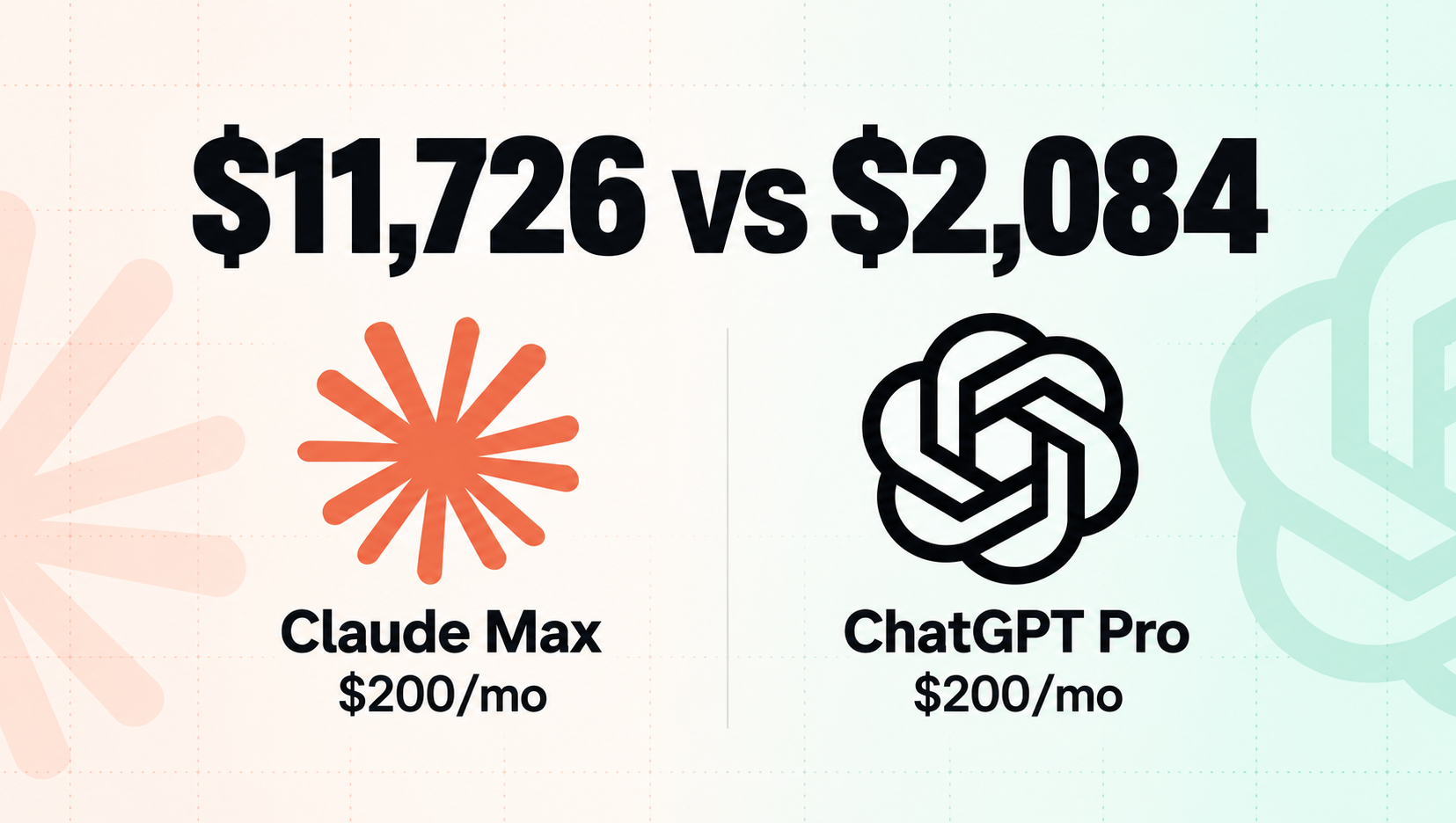
Two things stand out. First, a maxed-out $200 Claude plan currently delivers about 5.6 times the API value of the equivalent ChatGPT plan. (An earlier June test found even bigger multiples, up to 40x on Claude Max and 70x on ChatGPT Pro, on older model configurations.)
Second, these are maximum-quota figures, not what a normal subscriber gets. SemiAnalysis is explicit: most customers never come close to exhausting their limits. Power users running big codebases and agentic loops do, and that is exactly where the economics break for the labs.
Why the subsidy existed in the first place
Subscriptions are only about 10% of Anthropic's revenue, yet they eat more than 40% of its inference compute, according to SemiAnalysis's reporting. On their modeling, a user maxing out Opus 5.5 on the $200 plan runs at a negative 369% gross margin. In plain English: Anthropic loses money on every heavy subscriber. The Generative AI newsletter summed up the math well.
If you want background on the model at the center of this, we explained Claude Opus 5.5 here: what it is, what it costs, and who actually needs it.
The $42 billion Anthropic number, explained properly
The reel flashes a graphic of Anthropic's balance sheet showing a $42 billion net loss, drawn from IPO prospectus figures reported via Reuters. The headline is real, but it needs context.
- About $34 billion of the $42 billion is a non-cash accounting charge tied to convertible financing: as Anthropic's valuation soared, the estimated value of those instruments rose, and accounting rules book the increase as a loss. No cash left the building.
- The real operating number is an $8 billion operating loss on $4.6 billion of 2025 revenue, with $7.33 billion spent on compute alone.
- The scarier figure is $518 billion in multiyear infrastructure commitments, most of it non-cancelable, against a targeted IPO valuation near $2 trillion.
AInvest's breakdown puts it well: the $42 billion overstates today's cash burn and hides tomorrow's obligations. Either way, the direction is the same. Subsidized subscriptions cannot survive contact with these numbers.
OpenAI already started clawing it back
At DevDay 2026, OpenAI did exactly what the reel says. For new subscribers, the $200 Pro plan's included usage in ChatGPT Work and Codex dropped from 20 times to 10 times the Plus allowance, and the weekly GPT-6 Pro message limit fell from 200 to 100. Existing subscribers keep the old limits through October 29, 2026, plus a one-time grant of 62,500 usage credits. TechBytes has the full breakdown.
Above it sits a brand-new $500-a-month Pro 500 tier with 25 times Plus usage and an Ultrafast speed tier. The message is blunt: the old $200 allowance was a subsidy, and the full allowance now costs $500.
Anthropic, for now, is moving the other way. After cutting Opus 5.5's API prices, it raised Max-tier allowances about 20% and Pro-tier allowances about 50%. On current plans, Claude is the better deal. Expect that gap to close.
What this means if your business runs on AI
If you are a casual user, nothing changes. If AI is load-bearing in your business, three things matter.
- Price your usage at API rates, not subscription rates. That $200 plan feels fixed until it is not. Model what your workloads would cost per token, because that is where pricing is heading.
- Do not build client work on consumer subscriptions. Subscriptions can change limits without telling you. SemiAnalysis even caught one lab quietly giving identical plans 20% different limits. API pricing is boring and predictable, which is what you want under client work.
- Lock in grandfathered plans while they last, and audit which seats actually max out. Most do not, and those seats are safe on cheaper tiers.
This is also why every serious automation we build at BULDRR runs on API pricing inside n8n workflows, not on someone's personal ChatGPT login. Predictable cost per run beats a subscription that can be repriced overnight. Our ChatGPT-powered Telegram chatbot build is a good example of the pattern.
One more shift worth watching: as AI subscriptions get pricier, AI search keeps growing. Getting your business cited by ChatGPT and AI Overviews is becoming as important as ranking on Google.
The bottom line
Cheap AI was customer acquisition, not a business model. The labs bought the market with subsidized subscriptions, and now the meter is arriving, first at OpenAI, soon everywhere else. Businesses that plan for API-priced AI today will not be shocked when the subscription math changes tomorrow.
If you want your automations priced per run instead of per surprise, talk to us about a custom n8n build, or check how we price automation work.
- Is a $200 Claude subscription really worth 40 times its price?
- Under heavy use, close. SemiAnalysis's June 2026 limit test valued a maxed-out Claude Max 20x plan at about 40 times its $200 price in API-equivalent tokens. Their October retest on newer models puts the $200 Claude plan at $11,726 of API value versus $2,084 for ChatGPT Pro, about a 5.6x gap between the two plans. Both figures are maximum-quota values, not typical use.
- Is OpenAI really cutting the $200 ChatGPT Pro plan in half?
- Yes. From October 30, 2026, new Pro subscribers get 10 times the Plus allowance instead of 20 times, and 100 GPT-6 Pro messages a week instead of 200, at the same $200 price. Existing subscribers keep the old limits through October 29, 2026 and get a one-time 62,500-credit grant. A new $500 Pro 500 tier offers 25 times Plus usage.
- Did Anthropic really lose $42 billion?
- Its 2025 net loss was about $42 billion, but roughly $34 billion of that is a non-cash accounting charge on convertible financing. The cash-relevant figure is an $8 billion operating loss on $4.6 billion of revenue, plus $518 billion in long-term infrastructure commitments.
- Should my business use the API instead of a subscription?
- If your usage is heavy, spiky, or sits underneath client work, yes. API pricing is transparent and cannot be repriced overnight the way subscription allowances can. For light, everyday use, subscriptions are still the better deal.
Each button opens the assistant with the prompt already written, asking it to teach this article step by step, in simple words.
 ChatGPT
 Claude
 Grok
Grok Perplexity
 Add as a preferred source