 Schedule a Call

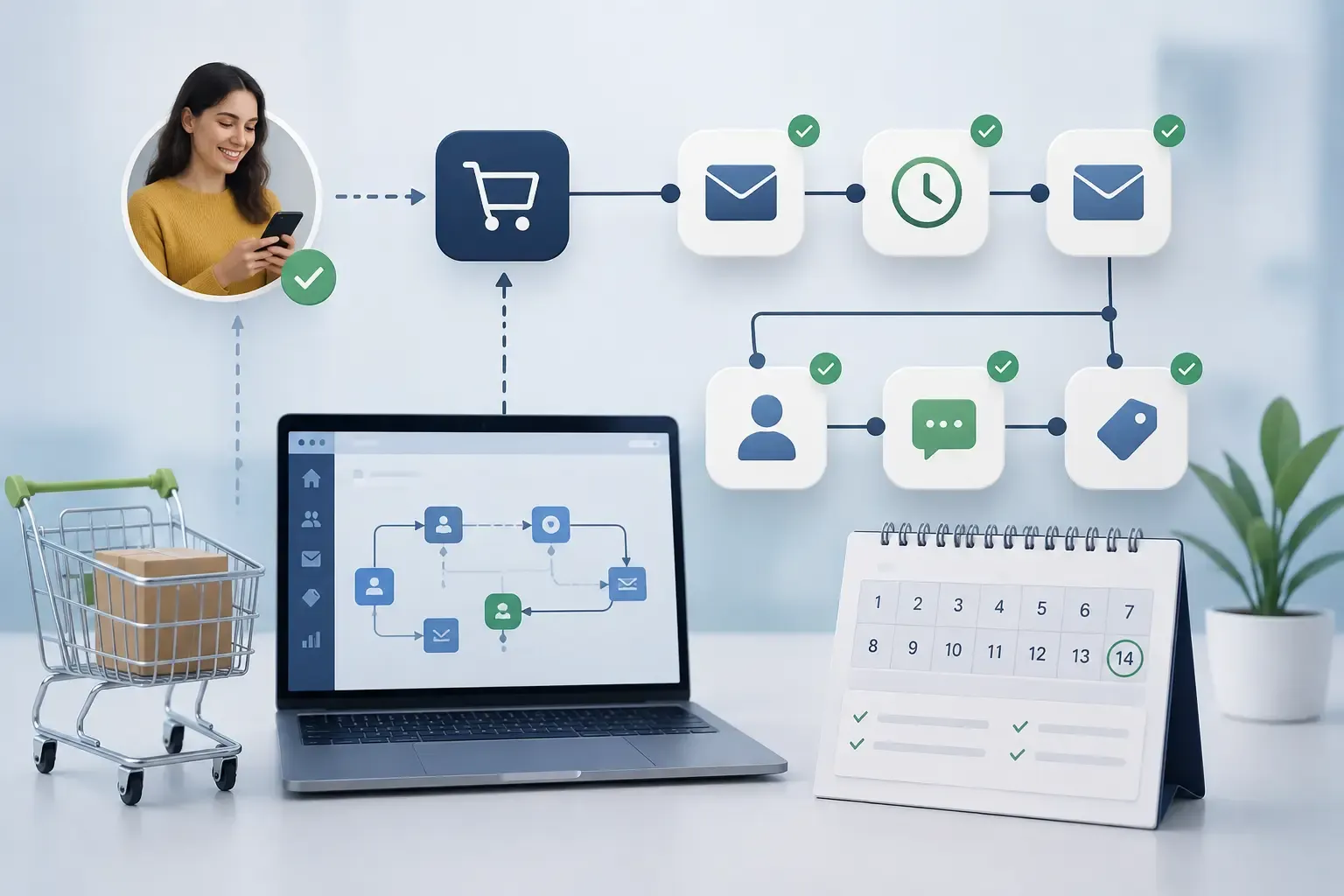
Most small businesses have no structured process for the first 14 days after a sale — no automatic welcome message, no scheduled check-in, just hope that the customer figures things out on their own. That window is where a new customer quietly decides whether to stick around, and most of it is repetitive enough to run itself without anyone lifting a finger after the deal closes.
The 14 days, manual vs. automated
What actually gets automated
This isn’t about replacing the relationship — it’s about making sure the predictable, repetitive parts happen every single time, so your team’s attention goes to the customers who actually need it. A typical build wires together: an instant welcome sequence the moment a deal is marked won in your CRM, auto-generated account or paperwork setup so nobody’s retyping the same information, a calendar link for the kickoff call that books itself instead of a back-and-forth email chain, and a day-7 nudge that only fires if the customer hasn’t engaged — so you’re not spamming people who are already off to a good start.
Where to draw the line between automated and human
The goal isn’t zero human involvement — it’s placing the human touch where it actually changes the outcome. Automate the account setup, the reminders, the paperwork. Keep a real person on the kickoff call and on anything that looks like a struggling customer at day 7 or day 14. The automation’s job is making sure those human moments actually happen on schedule, instead of depending on someone’s memory on a busy Tuesday.
Getting started without overbuilding
Frequently asked questions
- Isn’t onboarding automation only for big SaaS companies?
- No — any small business with a repeatable first-two-weeks process benefits, whether that’s a service business, a local shop, or a B2B vendor. The mechanics (trigger, sequence, check-in) work the same regardless of size.
- How much of this can I build without hiring a developer?
- A meaningful first version — welcome sequence, calendar booking, a day-7 nudge — is realistic to build with existing tools like n8n connected to your CRM and calendar, without a custom engineering hire.
- What happens when the automation gets something wrong?
- Build an escalation path from day one — if a customer replies with a question or a problem, it should route to a real person immediately rather than continuing down the automated sequence.
The first 14 days aren’t glamorous, which is exactly why they’re easy to neglect and exactly why automating them pays off. Get the predictable part running itself, and your team’s time goes to the customers who actually need a human.
Each button opens the assistant with the prompt already written, asking it to teach this article step by step, in simple words.
 ChatGPT
 Claude
 Grok
Grok Perplexity
 Add as a preferred source