

Automate Salesforce Account & Contact Creation with n8n

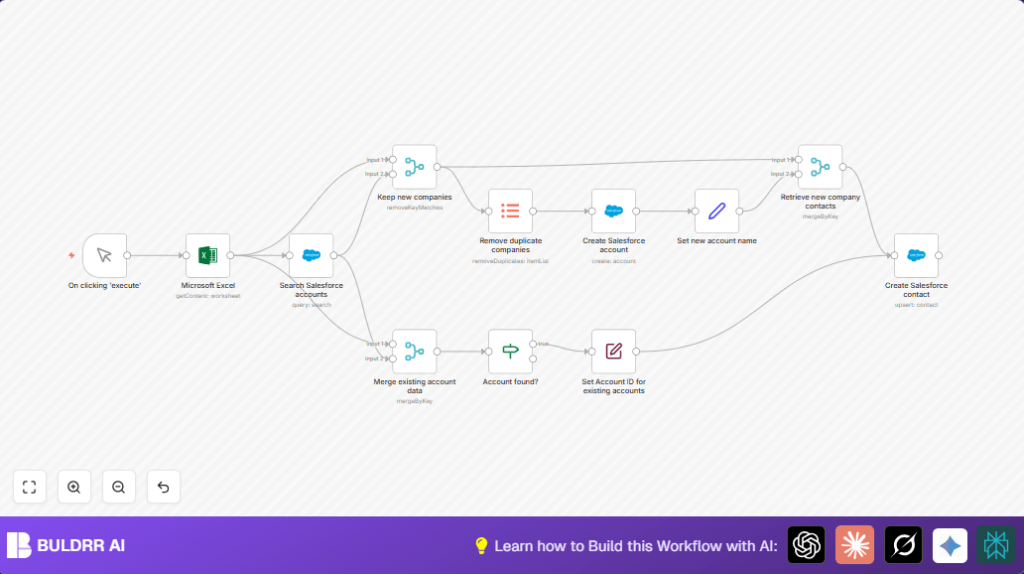
This n8n workflow automates managing Salesforce accounts and contacts from Excel. It prevents duplicates and streamlines data syncing by checking existing Salesforce accounts before creating new records, saving hours of manual work.
salesforce
microsoftExcel
manualTrigger
+5
Workflow Identifier: 1442
NODES in Use: Manual Trigger, Microsoft Excel, Salesforce, Merge, Item Lists, If, Rename Keys, Set

Press CTRL+F5 if the workflow didn't load.

Learn how to Build this Workflow with AI:

Visit through Desktop for Best experience

1. Opening Problem Statement

Meet Sarah, a busy sales operations manager at a growing tech startup. Every week, Sarah receives a Microsoft Excel sheet listing new companies interested in her company’s products. She spends hours manually checking if each company already exists in Salesforce, then creating accounts and contacts for those that don’t. The repetitive manual task not only wastes time but also often leads to duplicate records and data inconsistencies, disrupting her team’s sales workflow and causing potential revenue loss.

Imagine spending upwards of 5 hours a week just on this tedious task alone – that’s over 250 hours annually, all spent on what could be automated. This is exactly the problem this workflow solves.

2. What This Automation Does ⚙️

When triggered manually, this n8n workflow performs a seamless synchronization between Microsoft Excel and Salesforce accounts and contacts, ensuring data integrity and eliminating duplicates. Here’s what happens:

  • Reads company and contact data from a designated Microsoft Excel worksheet.
  • Checks Salesforce for existing accounts matching the company names to avoid duplicates.
  • Identifies and isolates new companies not yet in Salesforce.
  • Creates new accounts in Salesforce for companies not found.
  • Fetches and merges contact details for both new and existing companies.
  • Creates or upserts contacts in Salesforce, linking them correctly to their accounts.

By automating these steps, Sarah can save several hours weekly, reduce human error, and improve her sales team’s data accuracy.

3. Prerequisites ⚙️

  • 📧 Salesforce account with API access and valid OAuth2 credentials configured in n8n.
  • 📁 Microsoft Excel file stored on OneDrive or SharePoint accessible via Microsoft Excel OAuth2 in n8n.
  • ⏱️ n8n account with access to set up workflows (self-hosting is also an option for advanced users).
  • Basic familiarity with n8n’s interface, especially working with nodes and credentials.

4. Step-by-Step Guide

Step 1: Trigger the Workflow Manually

Navigate to your n8n editor and add a Manual Trigger node named “On clicking ‘execute'”. This node is your workflow’s starting point. Clicking the execute button will launch the automation.

Try it out by clicking the execute button yourself; you should see the node activate and pass empty data downstream.

Common mistake: Forgetting to connect this node properly downstream can stop your workflow from starting.

Step 2: Fetch Company Data from Microsoft Excel

Add a Microsoft Excel node configured to Get Content from the specific workbook and worksheet. In this workflow, the range A1:E11 is targeted.

Ensure you have OAuth2 credentials set up for your Microsoft Excel account linked in n8n. You should see data rows representing companies with fields like “Company Name”, “First Name”, “Last Name”, and “Email”.

Common mistake: Using incorrect worksheet IDs or workbook names will cause the node to fail fetching data.

Step 3: Search for Existing Salesforce Accounts

Add a Salesforce node, set to the search resource, and configure the SOQL query as:

=SELECT id, Name FROM Account WHERE Name = '{{$json["Company Name"].replace(/'/g, '\'')}}'

This dynamically searches for Salesforce accounts matching company names from Excel.

Make sure your Salesforce OAuth2 credentials are attached and tested.

Common mistake: Not escaping single quotes in company names can break the query.

Step 4: Filter Out New Companies

Use the Merge node in the Remove Key Matches mode, comparing Excel “Company Name” to Salesforce “Name” fields. This filters companies not present in Salesforce.

The output will be the list of companies that need new Salesforce accounts.

Common mistake: Mismatching field names or case sensitivity can cause incorrect filtering.

Step 5: Remove Duplicate Company Names

Add an Item Lists node to Remove Duplicates based on the “Company Name” field. This ensures your workflow doesn’t create multiple accounts of the same company.

Common mistake: Not setting the fields to compare properly will lead to duplicates slipping through.

Step 6: Create New Salesforce Accounts

Add a Salesforce node with the resource set to account. Use the expression {{$json["Company Name"]}} for the account name.

This creates new accounts for companies that did not exist previously.

Common mistake: Not mapping the name field exactly will cause the creation to fail.

Step 7: Prepare Contact Data for New Accounts

Add a Set node to format the new account data, setting the ID and Name fields, which will be used to merge contact information.

Common mistake: Omitting the correct keys or values will disrupt later merges.

Step 8: Retrieve Contact Details

Use another Merge node in Merge By Key mode to join new and existing account data based on company names.

This node outputs a unified list of accounts paired with their contact information from Excel.

Common mistake: Incorrect key mapping can cause contacts to link with wrong accounts.

Step 9: Check for Existing Accounts

Add an If node named Account found? that checks if an existing Salesforce account ID is present. Configure it to test if {{$json["Id"]}} is not empty.

This branches the flow for creating or updating contacts.

Common mistake: Misconfiguring the condition can route data incorrectly.

Step 10: Rename Account IDs for Contact Linking

Add a Rename Keys node to rename the Salesforce “Id” field to “Account ID”. This makes it easier to reference in the contact creation step.

Common mistake: Forgetting to rename will break account-to-contact associations.

Step 11: Create or Update Salesforce Contacts

Finally, add a Salesforce node set to contact – upsert. Configure the fields as:

  • Last Name: {{$json["Last Name"]}}
  • Email (external ID): {{$json["Email"]}}
  • First Name: {{$json["First Name"]}}
  • Account ID: {{$json["Account ID"]}} (note the correctly spelled key)

This step efficiently creates or updates contacts linked to their Salesforce accounts.

Common mistake: Be careful to spell the field names exactly, especially “Account ID” vs “acconuntId” typo in the original workflow which should be corrected.

5. Customizations ✏️

  • Change Data Source Range: In the Microsoft Excel node, modify the range parameter to accommodate larger datasets, like A1:G100, to handle more companies.
  • Add More Salesforce Fields to Accounts: In the Create Salesforce account node, add fields like Industry or Phone by expanding additionalFields to map those Excel columns.
  • Enable Email Notifications: Insert an Email node after the contact creation to notify sales reps of new contacts added.
  • Handle Account Name Conflicts: Add a node to append suffixes or prefixes to duplicate names to avoid creation errors.
  • Batch Processing: Set up the workflow to run on a schedule with a Cron Trigger node for fully automated periodic imports.

6. Troubleshooting 🔧

Problem: “Salesforce node returns empty or error on search.”
Cause: The SOQL query dynamically inserts company names; unescaped quotes or invalid characters break the query.
Solution: Ensure proper escaping in the query using replace(/'/g, '\'') or test with static queries first.

Problem: “Microsoft Excel node fails to read data.”
Cause: Incorrect workbook ID or worksheet name.
Solution: Double-check the workbook and worksheet parameters under node settings; test connectivity via credentials.

Problem: “Contacts not linked to accounts in Salesforce.”
Cause: Misspelled field key for Account ID (e.g., “acconuntId” instead of “Account ID”).
Solution: Correct the field name in the contact creation Salesforce node to “Account ID” exactly.

7. Pre-Production Checklist ✅

  • Verify Microsoft Excel credentials and that the workbook and worksheet are accessible and contain the expected columns.
  • Test the Salesforce OAuth2 connection and validate the SOQL query format with sample company names.
  • Run the workflow manually first on a small dataset to check the flow and node outputs.
  • Confirm no duplicate companies exist in the Excel sheet or handled properly.
  • Backup existing Salesforce data before bulk creating new records as a precaution.

8. Deployment Guide

Activate the workflow in n8n by setting it to active status. You can trigger it manually with the manual trigger or add a Cron Trigger node to run on a schedule (e.g., nightly). Monitor execution logs in n8n’s dashboard to track successes or errors.

This workflow can be integrated into wider sales automation processes by adding notifications or reporting nodes.

9. FAQs

  • Can I use Google Sheets instead of Microsoft Excel? Yes, but the node and credentials would need to be adapted accordingly. The workflow logic remains similar.
  • Does this use API credits on Salesforce? Yes, each search and create operation counts against your Salesforce API limits.
  • Is the data transfer secure? Salesforce OAuth2 and Microsoft OAuth2 use encryption. Ensure your n8n instance is secured and credentials stored safely.
  • Can this handle hundreds of companies at once? Depends on your Salesforce limits and n8n queue settings; consider batching for large volumes.

10. Conclusion

By building this tailored n8n workflow, you’ve automated the tedious process of syncing Excel company data with Salesforce accounts and contacts. You’ve eliminated duplicates, ensured data accuracy, and saved hours every week that you can redirect into strategic sales activities.

Next steps could include adding automated notifications, expanding to other CRM objects, or integrating email marketing tools like Mailchimp for follow-up campaigns.

Congratulations on setting up a powerful automation that directly impacts your sales productivity!

Promoted by BULDRR AI

Related Workflows

Automate Viral UGC Video Creation Using n8n + Degaus (Beginner-Friendly Guide)

Learn how to automate viral UGC video creation using n8n, AI prompts, and Degaus. This beginner-friendly guide shows how to import, configure, and run the workflow without technical complexity.
Form Trigger
Google Sheets
Gmail
+37
Free

AI SEO Blog Writer Automation in n8n

A complete beginner guide to building an AI-powered SEO blog writer automation using n8n.
AI Agent
Google Sheets
httpRequest
+5
Free

Automate CrowdStrike Alerts with VirusTotal, Jira & Slack

This workflow automates processing of CrowdStrike detections by enriching threat data via VirusTotal, creating Jira tickets for incident tracking, and notifying teams on Slack for quick response. Save hours daily by transforming complex threat data into actionable alerts effortlessly.
scheduleTrigger
httpRequest
jira
+5
Free

Automate Telegram Invoices to Notion with AI Summaries & Reports

Save hours on financial tracking by automating invoice extraction from Telegram photos to Notion using Google Gemini AI. This workflow extracts data, records transactions, and generates detailed spending reports with charts sent on schedule via Telegram.
lmChatGoogleGemini
telegramTrigger
notion
+9
Free

Automate Email Replies with n8n and AI-Powered Summarization

Save hours managing your inbox with this n8n workflow that uses IMAP email triggers, AI summarization, and vector search to draft concise replies requiring minimal review. Automate business email processing efficiently with AI guidance and Gmail integration.
emailReadImap
vectorStoreQdrant
emailSend
+12
Free

Automate Email Campaigns Using n8n with Gmail & Google Sheets

This n8n workflow automates personalized email outreach campaigns by integrating Gmail and Google Sheets, saving hours of manual follow-up work and reducing errors in email sequences. It ensures timely follow-ups based on previous email interactions, optimizing communication efficiency.
googleSheets
gmail
code
+5
Free